

10 Pfennigs – Germany
Germany
Context
Years: 1916–1922
Issuer: Germany 
Ruler: William II
Currency:
(1873—1923)
Demonetization: 11 October 1924
Total mintage: 245,477,639
Material
References
KM: #Click to copy to clipboard20
Numista: #1953
Obverse
Description:
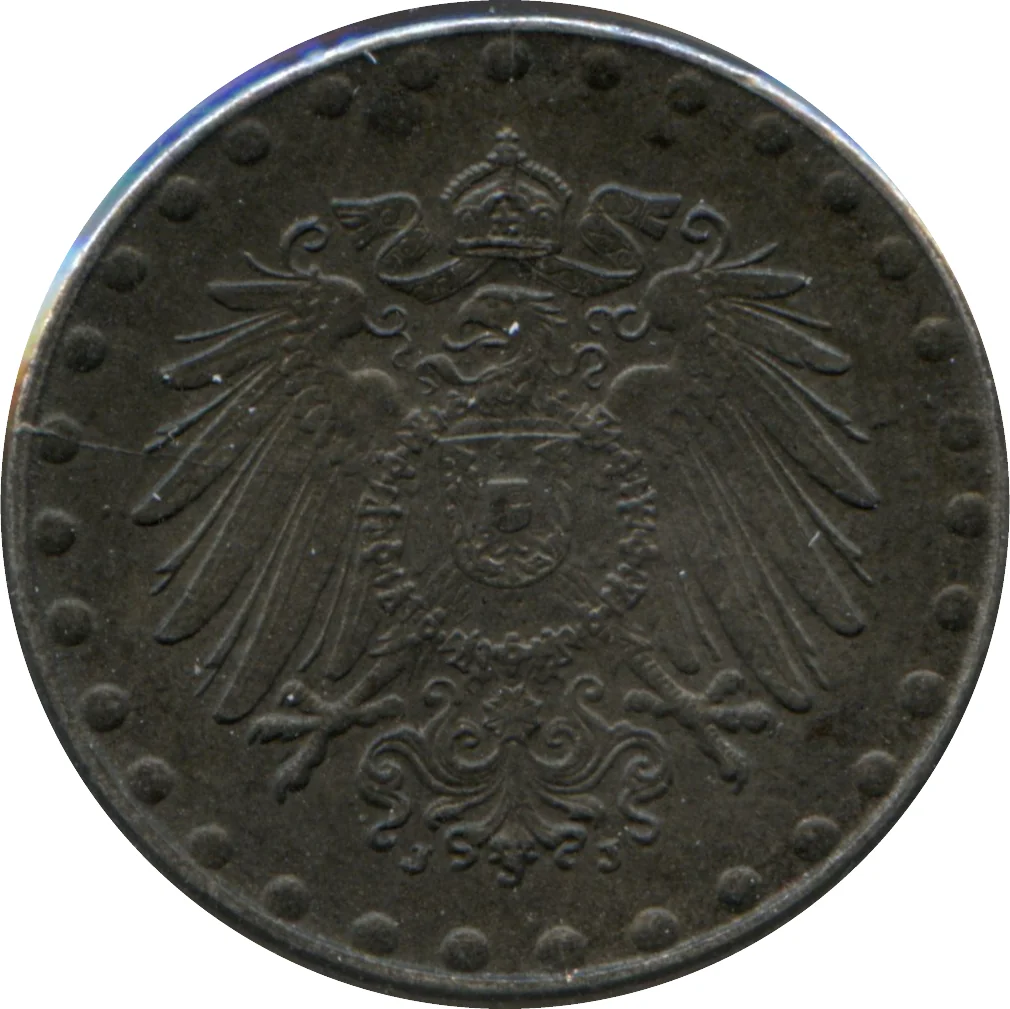
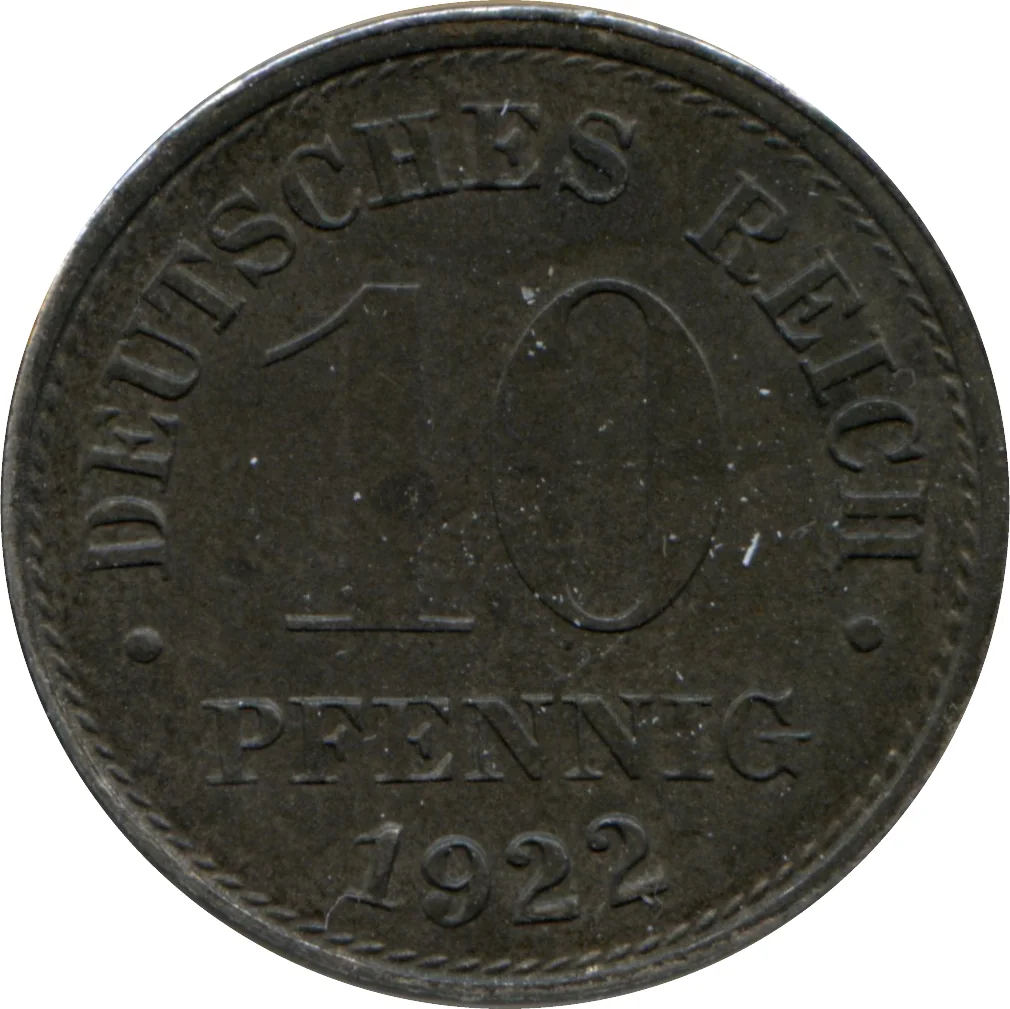
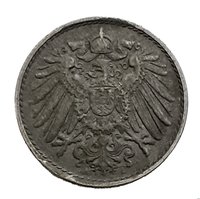
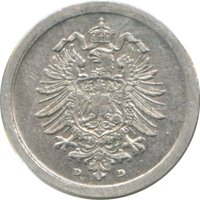
An Imperial eagle within a border of 31 large dots. Mintmark on both sides of the tail.
Script: Latin
Reverse
Edge
Plain
Mints
| Name | Mark |
|---|---|
| Berlin | A |
| Munich | D |
| Muldenhütten | E |
| Staatliche Münze Baden-Württemberg | F |
| Staatliche Münze Baden-Württemberg | G |
| Hamburgische Münze | J |
Mintings
| Year | Mint Mark | Mintage | Quality | Collection |
|---|---|---|---|---|
| 1916 | — | — | ||
| 1916 | D | 11,608,655 | ||
| 1916 | E | 8,280,200 | ||
| 1916 | F | 7,472,758 | ||
| 1916 | J | 11,682,651 | ||
| 1916 | A | 69,143,415 | ||
| 1916 | G | 5,877,590 | ||
| 1917 | F | 11,340,981 | ||
| 1917 | G | 7,087,920 | ||
| 1917 | J | 9,205,000 | ||
| 1917 | A | 53,198,389 | ||
| 1917 | D | 16,370,093 | ||
| 1917 | E | 9,182,457 | ||
| 1918 | D | 42,054 | ||
| 1921 | A | 16,264,657 | ||
| 1922 | D | 779,714 | ||
| 1922 | E | 2,235,000 | ||
| 1922 | E | 26 | Proof | |
| 1922 | F | 1,927,820 | ||
| 1922 | G | 1,358,000 | ||
| 1922 | J | 2,420,259 |
Historical background
By 1916, Germany’s wartime currency situation was defined by the escalating pressures of financing a protracted total war. The initial confidence and "war enthusiasm" of 1914, funded through war bonds and the suspension of gold convertibility, had given way to a deepening reliance on the printing press. The Reichsbank, subordinating monetary stability to the war effort, provided massive loans to the government by discounting treasury bills, effectively monetizing the state's debt. This flood of paper money, without corresponding economic output, began to steadily erode the Mark's purchasing power, though the full catastrophic hyperinflation was still several years away.
The domestic economy was severely strained by the British naval blockade, which crippled imports and led to critical shortages of food, raw materials, and consumer goods. With fewer goods available for purchase, the increasing volume of currency in circulation chased scarce resources, creating significant inflationary pressures. Price controls and rationing were implemented to manage the crisis, but these measures created black markets where prices soared far above official rates. The value of the Mark, therefore, began to diverge sharply: stable on the controlled surface, but weakening in reality.
Internationally, the Reichsmark had been isolated from global finance since 1914. Germany’s gold reserves were largely immobilized to support the currency symbolically and for crucial neutral trade. By 1916, the exchange rate against neutral currencies like the Dutch guilder or Swiss franc was falling, reflecting growing international skepticism about Germany's eventual ability to repay its debts or achieve victory. Thus, the currency situation in 1916 was one of controlled but undeniable deterioration, laying the institutional and monetary groundwork for the severe instability that would engulf the postwar Weimar Republic.
The domestic economy was severely strained by the British naval blockade, which crippled imports and led to critical shortages of food, raw materials, and consumer goods. With fewer goods available for purchase, the increasing volume of currency in circulation chased scarce resources, creating significant inflationary pressures. Price controls and rationing were implemented to manage the crisis, but these measures created black markets where prices soared far above official rates. The value of the Mark, therefore, began to diverge sharply: stable on the controlled surface, but weakening in reality.
Internationally, the Reichsmark had been isolated from global finance since 1914. Germany’s gold reserves were largely immobilized to support the currency symbolically and for crucial neutral trade. By 1916, the exchange rate against neutral currencies like the Dutch guilder or Swiss franc was falling, reflecting growing international skepticism about Germany's eventual ability to repay its debts or achieve victory. Thus, the currency situation in 1916 was one of controlled but undeniable deterioration, laying the institutional and monetary groundwork for the severe instability that would engulf the postwar Weimar Republic.
🌱 Very Common