

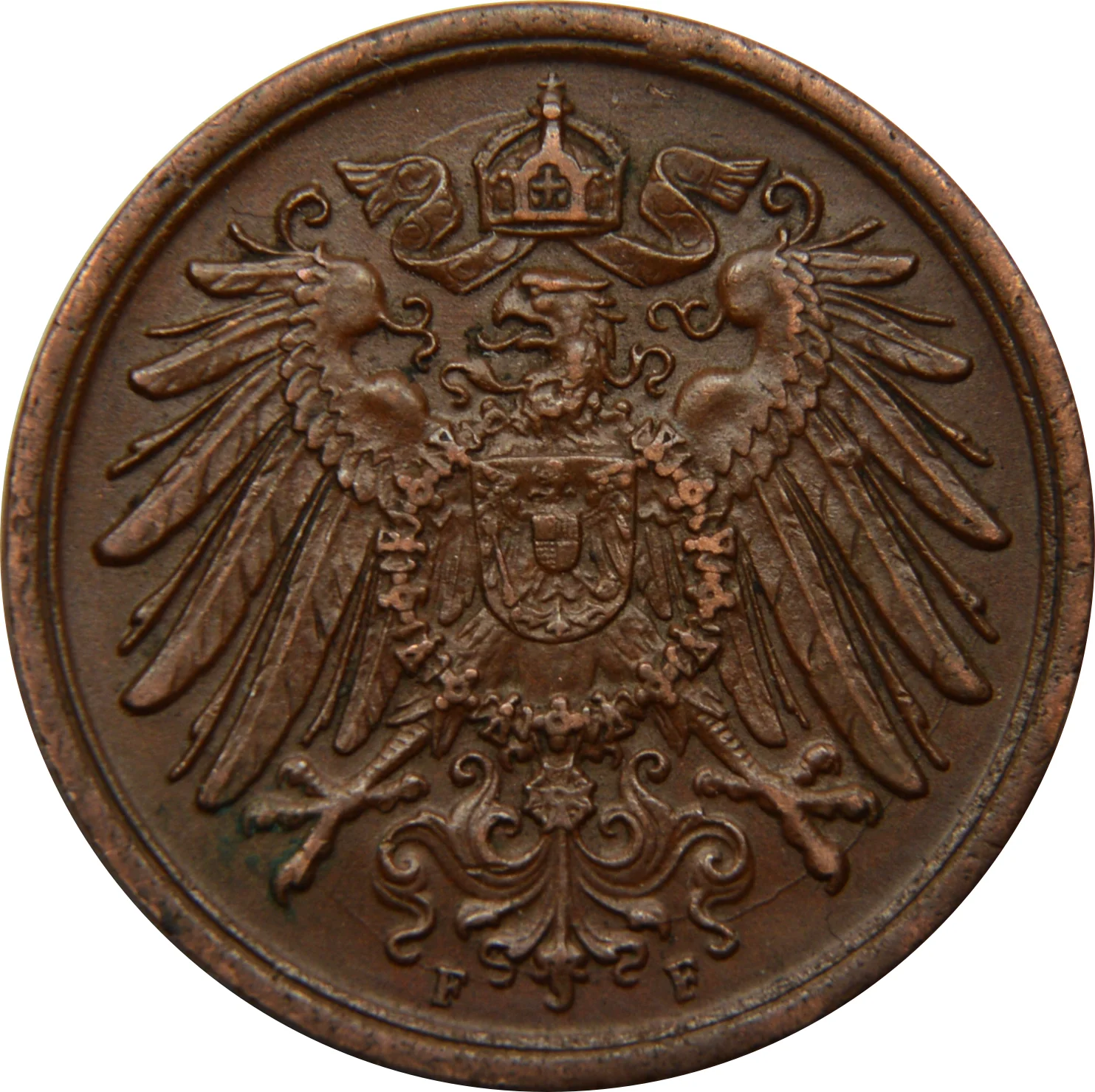
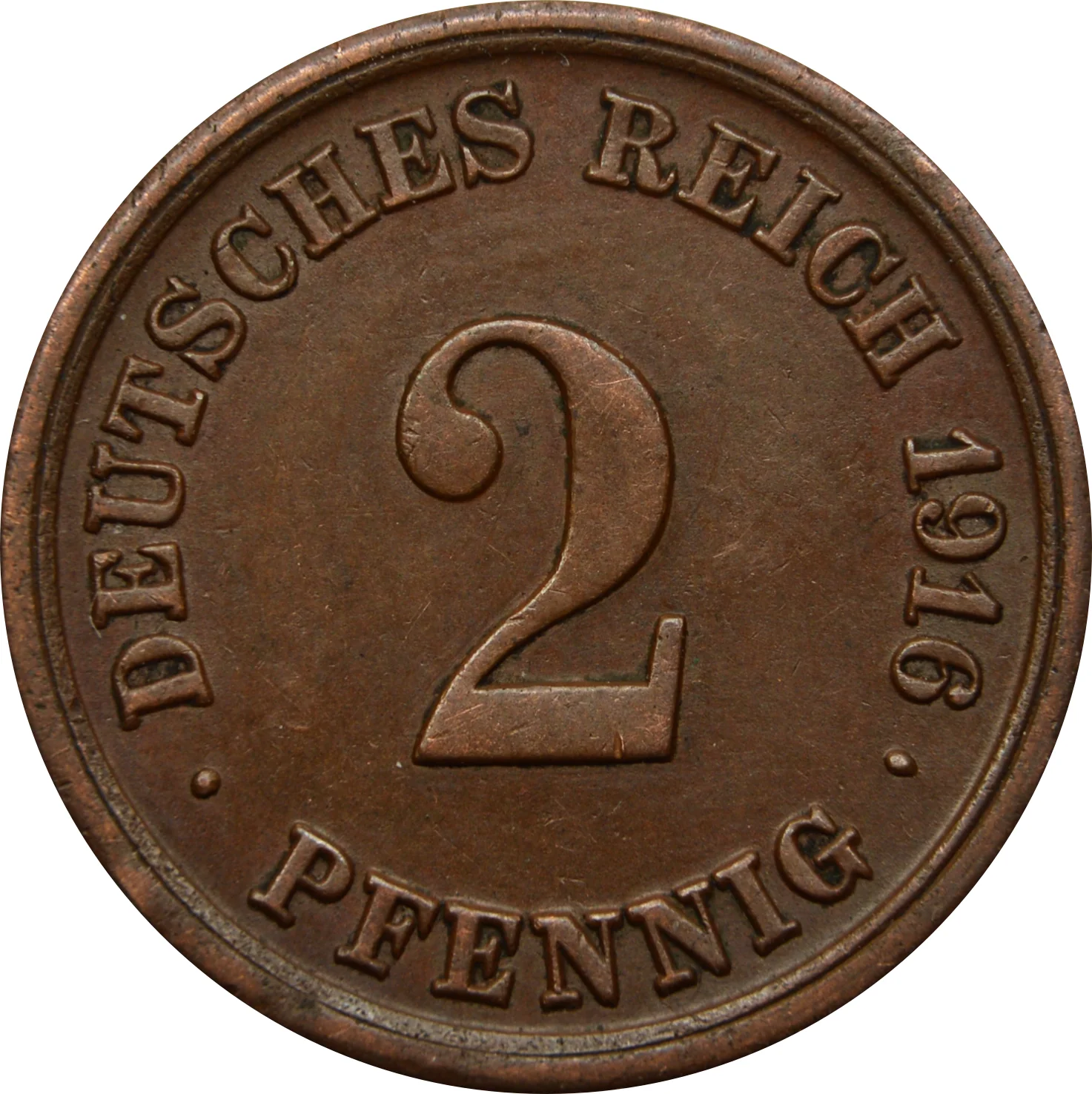
2 pfennigs – Germany
Add to wishlist
Germany
Context
Years: 1904–1916
Issuer: Germany
Ruler: William II
Currency:
(1873—1923)
Demonetized: Yes
Total mintage: 151,512,768
Material
References
KM: #
Numista: #2557
Obverse
Reverse
Description:
Centre: value
Above: lettering, date
Below: denomination
Above: lettering, date
Below: denomination
Inscription:
DEUTSCHES REICH 1916
2
• PFENNIG •
2
• PFENNIG •
Translation:
German Empire 1916
2
• PFENNIG •
2
• PFENNIG •
Script: Latin
Language: German
Engraver: Emil Weigand
Edge
Plain
Mints
| Name | Mark |
|---|---|
| Berlin | A |
| Munich | D |
| Muldenhütten | E |
| Staatliche Münze Baden-Württemberg | F |
| Staatliche Münze Baden-Württemberg | G |
| Hamburgische Münze | J |
Mintings
| Year | Mint Mark | Mintage | Quality | Collection |
|---|---|---|---|---|
| 1904 | A | 5,414,157 | ||
| 1904 | D | 1,404,041 | ||
| 1904 | E | 744,422 | ||
| 1904 | F | 1,002,124 | ||
| 1904 | G | 495,010 | ||
| 1904 | J | 433,830 | ||
| 1905 | A | 5,171,865 | ||
| 1905 | E | 924,469 | ||
| 1905 | F | 1,115,000 | ||
| 1905 | G | 1,030,380 | ||
| 1905 | J | 1,608,569 | ||
| 1905 | D | 1,570,000 | ||
| 1906 | A | 8,459,482 | ||
| 1906 | E | 2,055,093 | ||
| 1906 | F | 2,839,723 | ||
| 1906 | G | 1,526,761 | ||
| 1906 | J | 1,907,500 | ||
| 1906 | D | 3,539,028 | ||
| 1907 | A | 13,467,957 | ||
| 1907 | D | 1,921,128 | ||
| 1907 | E | 744,742 | ||
| 1907 | F | 1,058,809 | ||
| 1907 | G | 610,229 | ||
| 1907 | J | 951,837 | ||
| 1908 | D | 1,407,174 | ||
| 1908 | E | 744,860 | ||
| 1908 | A | 5,421,165 | ||
| 1908 | F | 1,003,329 | ||
| 1908 | G | 610,093 | ||
| 1908 | J | 816,869 | ||
| 1910 | D | 1,406,663 | ||
| 1910 | E | 745,269 | ||
| 1910 | F | 1,002,656 | ||
| 1910 | G | 517,302 | ||
| 1910 | J | 568,000 | ||
| 1910 | A | 5,421,183 | ||
| 1911 | A | 8,186,918 | ||
| 1911 | D | 2,100,450 | ||
| 1911 | E | 1,132,500 | ||
| 1911 | F | 1,490,000 | ||
| 1911 | G | 1,313,340 | ||
| 1911 | J | 1,882,876 | ||
| 1912 | E | 1,807,959 | ||
| 1912 | F | 2,366,256 | ||
| 1912 | J | 1,605,000 | ||
| 1912 | A | 13,580,338 | ||
| 1912 | D | 3,108,852 | ||
| 1912 | G | 1,395,000 | ||
| 1913 | A | 4,211,978 | ||
| 1913 | D | 2,525,311 | ||
| 1913 | E | 412,894 | ||
| 1913 | F | 1,601,664 | ||
| 1913 | G | 740,643 | ||
| 1913 | J | 1,253,989 | ||
| 1914 | J | 816,970 | ||
| 1914 | A | 5,350,313 | ||
| 1914 | E | 1,201,971 | ||
| 1914 | F | 157,763 | ||
| 1914 | G | 610,403 | ||
| 1915 | E | 287,610 | ||
| 1915 | F | 903,921 | ||
| 1915 | A | 3,897,165 | ||
| 1915 | D | 1,407,339 | ||
| 1916 | E | 484,470 | ||
| 1916 | G | 396,670 | ||
| 1916 | F | 651,464 | ||
| 1916 | A | 3,524,135 | ||
| 1916 | D | 914,815 | ||
| 1916 | J | 531,072 |
Historical background
In 1904, Germany’s currency situation was defined by stability and confidence, underpinned by the gold standard established by the Reichsbank Act of 1875. Following unification, the Reichsmark had replaced the myriad of regional currencies, creating a uniform monetary system for the entire empire. The mark was legally defined as 0.358423 grams of fine gold, and banknotes were convertible into gold coin upon demand. This "hard currency" policy facilitated robust international trade and investment, positioning Germany as a leading industrial and financial power.
The system was managed conservatively by the Reichsbank, which held substantial gold reserves to back the currency in circulation. This discipline fostered low inflation and attracted foreign capital, supporting the rapid expansion of German industry, infrastructure, and naval projects. However, the monetary stability was not without underlying tensions. The government and major banks occasionally clashed over policy, particularly regarding the discount rate and the management of credit to fuel economic growth versus maintaining reserve safety margins.
Looking ahead, the very strength of the system contained the seeds of future strain. The commitment to gold convertibility, while a pillar of credibility, constrained the Reichsbank's ability to respond flexibly to financial crises or the escalating fiscal demands of the European arms race. By 1904, the financial foundations appeared solid, but they were being steadily pressured by imperial ambitions and military spending, which would later contribute to the severe economic difficulties experienced during and after the First World War.
The system was managed conservatively by the Reichsbank, which held substantial gold reserves to back the currency in circulation. This discipline fostered low inflation and attracted foreign capital, supporting the rapid expansion of German industry, infrastructure, and naval projects. However, the monetary stability was not without underlying tensions. The government and major banks occasionally clashed over policy, particularly regarding the discount rate and the management of credit to fuel economic growth versus maintaining reserve safety margins.
Looking ahead, the very strength of the system contained the seeds of future strain. The commitment to gold convertibility, while a pillar of credibility, constrained the Reichsbank's ability to respond flexibly to financial crises or the escalating fiscal demands of the European arms race. By 1904, the financial foundations appeared solid, but they were being steadily pressured by imperial ambitions and military spending, which would later contribute to the severe economic difficulties experienced during and after the First World War.
🌱 Very Common