

25 centavos – Honduras
Add to wishlist
Honduras
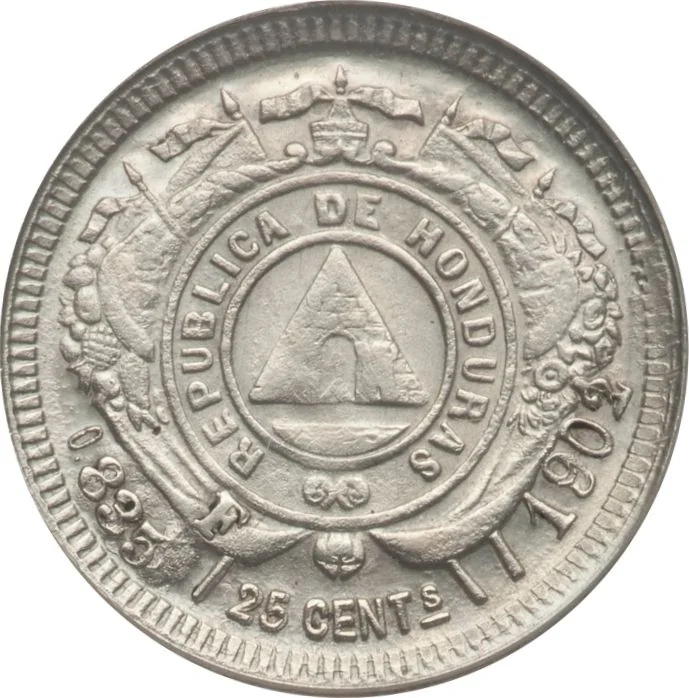
Obverse
Description:
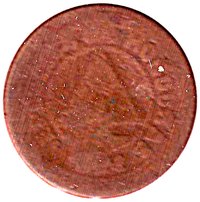
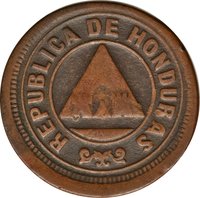
Coat of arms with legend; fineness, value, and date below.
Inscription:
REPUBLICA DE HONDURAS
0.835 25 CENTs 1902
0.835 25 CENTs 1902
Translation:
REPUBLIC OF HONDURAS
0.835 25 CENTS 1902
0.835 25 CENTS 1902
Script: Latin
Language: Spanish
Engraver: Jean-Baptiste Frener
Reverse
Description:
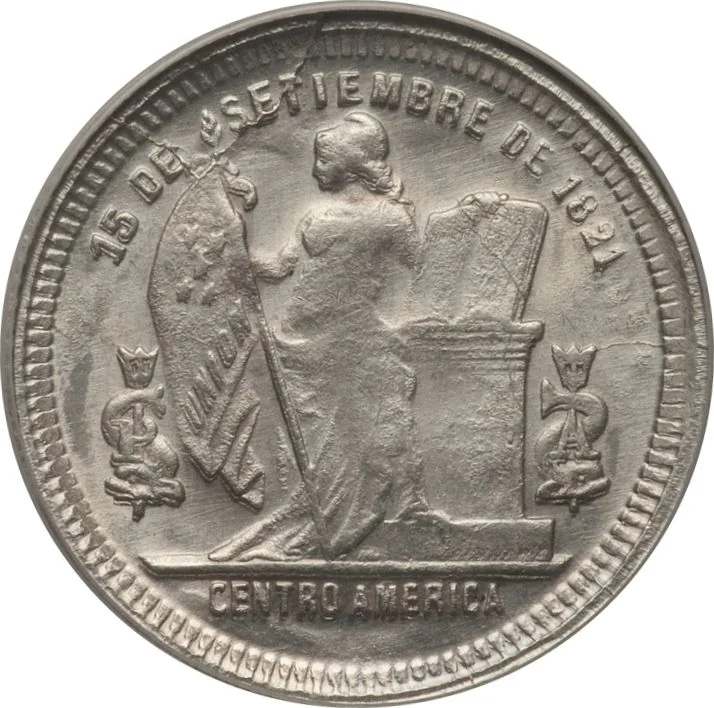
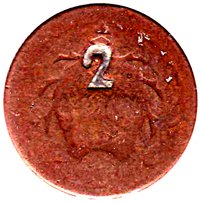
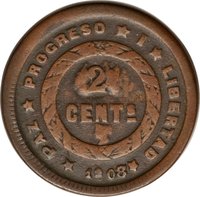
Liberty holding a flag marked "UNION" and five stars, her left arm resting on a column and the Constitution. Tridents with P and A flank her. Legends above and below.
Inscription:
15 DE SETIEMBRE DE 1821
CONSTITUCION
PAZ, PROGRESO Y LIBERTAD
UNION
27 DE AGOSTO DE 1876
P A
CENTRO AMERICA
CONSTITUCION
PAZ, PROGRESO Y LIBERTAD
UNION
27 DE AGOSTO DE 1876
P A
CENTRO AMERICA
Translation:
Fifteenth of September of 1821
Constitution
Peace, Progress and Liberty
Union
Twenty-seventh of August of 1876
P A
Central America
Constitution
Peace, Progress and Liberty
Union
Twenty-seventh of August of 1876
P A
Central America
Script: Latin
Language: Spanish
Engraver: Jean-Baptiste Frener
Edge
Reeded
Mints
| Name | Mark |
|---|---|
| Casa Nacional de la Moneda | — |
Mintings
| Year | Mint Mark | Mintage | Quality | Collection |
|---|---|---|---|---|
| 1899 | — | 30,024 | ||
| 1900 | — | 39,280 | ||
| 1901 | — | — | ||
| 1902 | — | — | ||
| 1902 | F | — | ||
| 1904 | — | — | ||
| 1907 | — | 13,682 | ||
| 1910 | — | 745 | ||
| 1912 | — | 7,168 | ||
| 1913 | — | 51,880 | ||
| 1918 | — | — |
Historical background
In 1899, Honduras operated under a complex and unstable monetary system, a legacy of its colonial past and 19th-century economic struggles. The official currency was the silver Honduran Peso, theoretically tied to the global silver standard. However, the nation's chronic political instability, foreign debt, and underdeveloped export economy (primarily bananas and precious metals) meant the government had limited capacity to mint sufficient coinage. This scarcity of official currency created a vacuum filled by a confusing array of foreign coins, primarily from neighboring nations and former colonial powers.
The most prominent foreign currency in circulation was the British Pound Sterling, due to the significant influence of British capital in the Honduran railway and banana industries. Alongside it, the US Dollar, the Mexican Peso, and even old Spanish colonial coins circulated freely and were used in everyday transactions. This de facto dollarization, especially in commercial ports and foreign enclaves, undermined the sovereignty of the national currency and complicated commerce, as exchange rates between these various coins fluctuated based on their metallic content and perceived reliability.
This monetary fragmentation reflected Honduras's position within the informal economic sphere of the United States and Great Britain. The lack of a strong, unified national currency was both a symptom and a cause of weak state fiscal authority, hindering domestic investment and economic planning. The situation in 1899 was therefore one of transition and dependency, setting the stage for future 20th-century monetary reforms that would eventually seek to consolidate a national currency system under the influence of the rising economic power of the United States.
The most prominent foreign currency in circulation was the British Pound Sterling, due to the significant influence of British capital in the Honduran railway and banana industries. Alongside it, the US Dollar, the Mexican Peso, and even old Spanish colonial coins circulated freely and were used in everyday transactions. This de facto dollarization, especially in commercial ports and foreign enclaves, undermined the sovereignty of the national currency and complicated commerce, as exchange rates between these various coins fluctuated based on their metallic content and perceived reliability.
This monetary fragmentation reflected Honduras's position within the informal economic sphere of the United States and Great Britain. The lack of a strong, unified national currency was both a symptom and a cause of weak state fiscal authority, hindering domestic investment and economic planning. The situation in 1899 was therefore one of transition and dependency, setting the stage for future 20th-century monetary reforms that would eventually seek to consolidate a national currency system under the influence of the rising economic power of the United States.
💎 Very Rare