

10 Cash – Kiangsu Province
China
Context
Year: 1902
Country: China 
Issuer: Kiangsu Province
Ruler: Guangxu
Currency:
(1901—1949)
Demonetized: Yes
Material
References
Y: #Click to copy to clipboard162.1-162.
Numista: #254462
Obverse
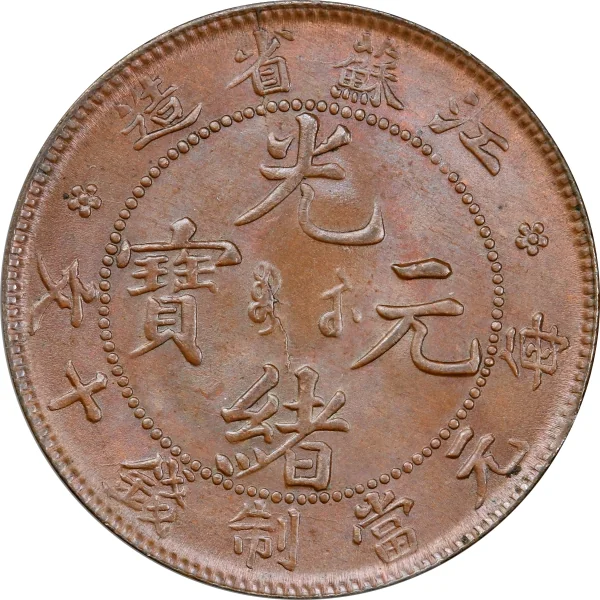
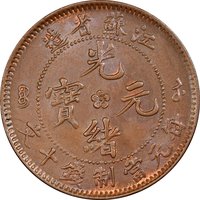
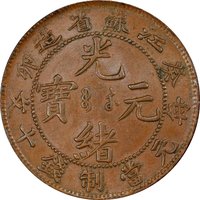
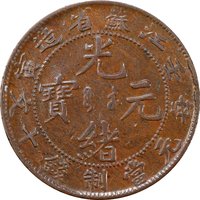
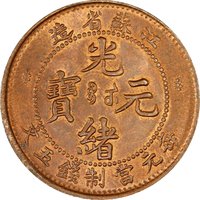
Description:
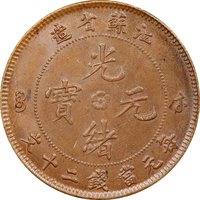
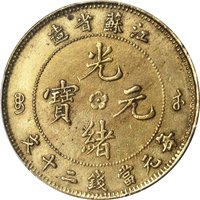
Chinese and Manchu characters arranged vertically, right to left.
Inscription:
造省蘇江
光
寶 ᠪᠣᠣ ᠰᡠ 元
緒
文十錢當元毎
光
寶 ᠪᠣᠣ ᠰᡠ 元
緒
文十錢當元毎
Translation:
Made in Jiangsu Province.
Guangxu
Treasure Boo Su Yuan
[Reign]
Wen Ten Cash Equivalent to One Yuan Each.
Guangxu
Treasure Boo Su Yuan
[Reign]
Wen Ten Cash Equivalent to One Yuan Each.
Scripts: Chinese, Mongolian / Manchu
Reverse
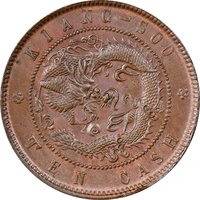
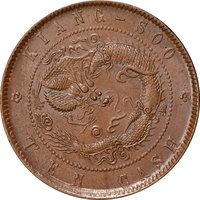
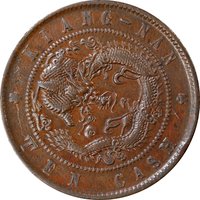
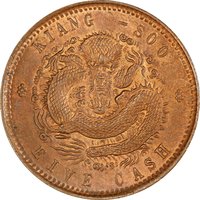
Description:
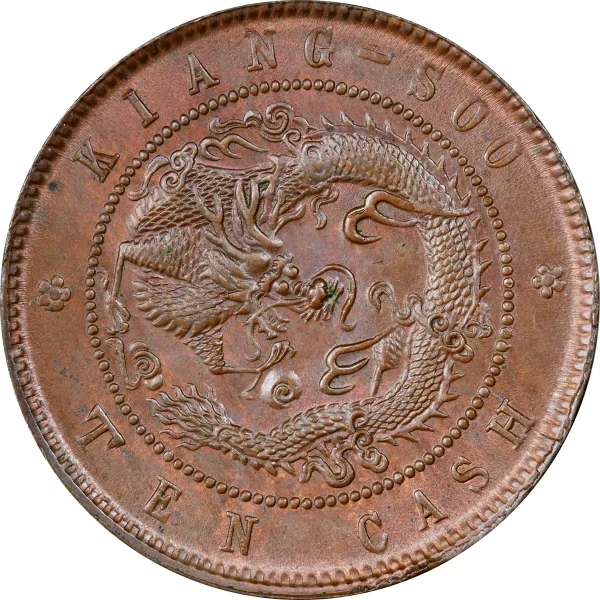
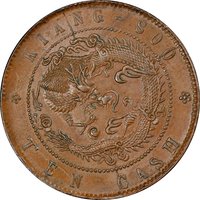
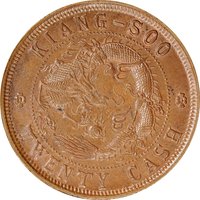
Dragon encircling a pearl, surrounded by English text.
Inscription:
KIANG-SOO
TEN CASH
TEN CASH
Script: Latin
Edge
Reeded or smooth.
Categories
| Mythology> Fantastic animal |
Mintings
| Year | Mint Mark | Mintage | Quality | Collection |
|---|---|---|---|---|
| 1902 | — | — |
Historical background
In 1902, Kiangsu (Jiangsu) Province, as a core economic region of the late Qing Empire, operated within a complex and chaotic multi-currency system. The primary medium for large-scale transactions and government finance remained the silver tael (liang), but there was no standard unit. Kiangsu, with its major commercial hub Shanghai, used its own local variant, the "Kuping tael" (Treasury tael), alongside other regional tael standards like the "Caoping tael" for salt trade revenue. This lack of uniformity created constant difficulties in exchange and accounting, as values fluctuated between cities and trades.
Alongside silver by weight, a variety of silver coins circulated. These included imported Mexican Silver Dollars (popularly called "Eagle Dollars"), British Trade Dollars, and Japanese Yen. Crucially, the province also saw increasing circulation of Chinese-minted silver dollars, particularly from the nearby Kiangnan Arsenal in Shanghai. These coins, valued by their metallic content, competed with each other and with the older sycee (silver ingots). For everyday smaller transactions, the copper cash coin (wen) was essential, with strings of cash (theoretically 1000 coins) serving as the people's currency. However, the debasement of copper coinage and irregular minting by provincial authorities led to fluctuating exchange rates between cash and silver, causing hardship for peasants and laborers who were paid in cash but often taxed in silver.
This monetary fragmentation was symptomatic of the Qing dynasty's weakening sovereignty and the economic pressures of foreign imperialism. Foreign banks in Shanghai and other treaty ports issued their own banknotes, further complicating the landscape. The situation in Kiangsu was thus one of profound disunity: a traditional silver-weight system coexisted uneasily with modern coinage, all while foreign currencies and financial institutions exerted growing influence. This instability hampered commerce, facilitated fraud, and underscored the imperial government's inability to impose a uniform monetary standard, a problem that would persist until the currency reforms of the following decade.
Alongside silver by weight, a variety of silver coins circulated. These included imported Mexican Silver Dollars (popularly called "Eagle Dollars"), British Trade Dollars, and Japanese Yen. Crucially, the province also saw increasing circulation of Chinese-minted silver dollars, particularly from the nearby Kiangnan Arsenal in Shanghai. These coins, valued by their metallic content, competed with each other and with the older sycee (silver ingots). For everyday smaller transactions, the copper cash coin (wen) was essential, with strings of cash (theoretically 1000 coins) serving as the people's currency. However, the debasement of copper coinage and irregular minting by provincial authorities led to fluctuating exchange rates between cash and silver, causing hardship for peasants and laborers who were paid in cash but often taxed in silver.
This monetary fragmentation was symptomatic of the Qing dynasty's weakening sovereignty and the economic pressures of foreign imperialism. Foreign banks in Shanghai and other treaty ports issued their own banknotes, further complicating the landscape. The situation in Kiangsu was thus one of profound disunity: a traditional silver-weight system coexisted uneasily with modern coinage, all while foreign currencies and financial institutions exerted growing influence. This instability hampered commerce, facilitated fraud, and underscored the imperial government's inability to impose a uniform monetary standard, a problem that would persist until the currency reforms of the following decade.

🌟 Limited