

5 Cash – Kiangsu Province
China
Context
Year: 1901
Country: China 
Issuer: Kiangsu Province
Ruler: Guangxu
Currency:
(1901—1949)
Demonetized: Yes
Material
References
Y: #Click to copy to clipboard158
Numista: #32985
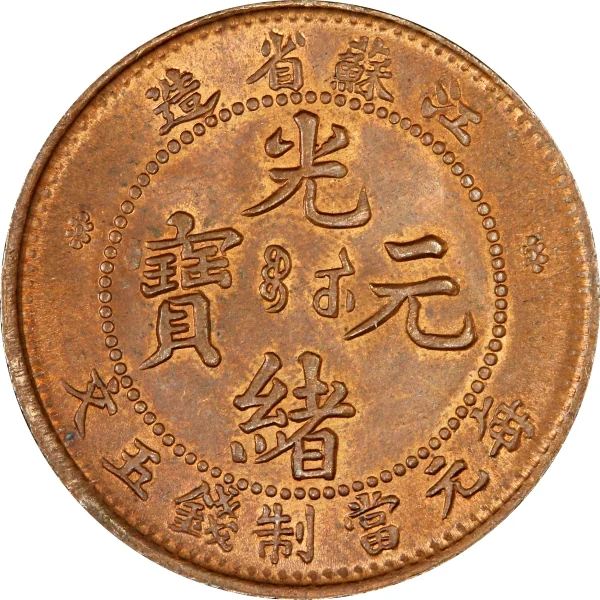
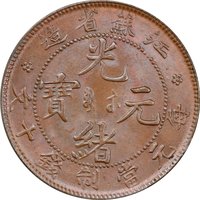
Obverse
Description:
Chinese and Manchu characters arranged vertically, right to left.
Inscription:
造省蘇江
光
寶 ᠪᠣᠣ ᠰᡠ 元
緒
文五錢制當元毎
光
寶 ᠪᠣᠣ ᠰᡠ 元
緒
文五錢制當元毎
Translation:
Made in Jiangsu Province.
Guangxu
Treasure Boo Su Yuan
[Period]
Value Five Mace Standard. Equivalent to One Dollar Each.
Guangxu
Treasure Boo Su Yuan
[Period]
Value Five Mace Standard. Equivalent to One Dollar Each.
Scripts: Chinese, Mongolian / Manchu
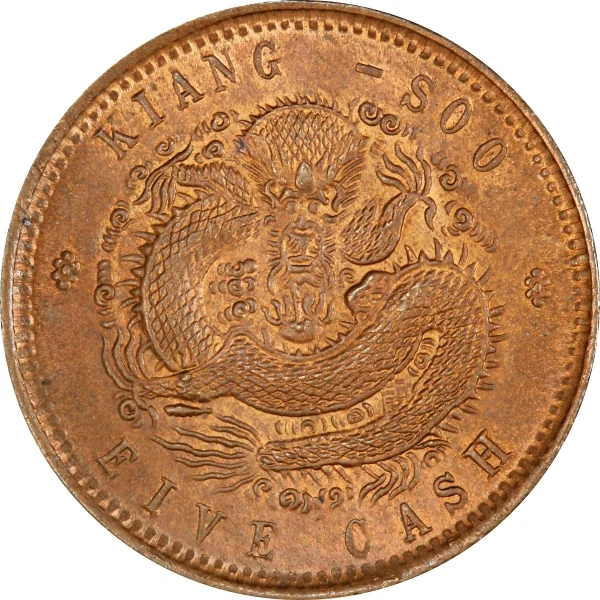
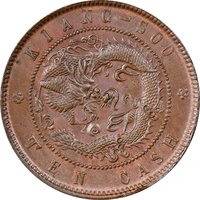
Reverse
Description:
Dragon encircling a pearl, surrounded by English text.
Inscription:
KIANG-SOO
EIVE CASH
EIVE CASH
Script: Latin
Edge
Plain
Categories
| Mythology> Fantastic animal |
Mintings
| Year | Mint Mark | Mintage | Quality | Collection |
|---|---|---|---|---|
| 1901 | — | — |
Historical background
In 1901, the currency situation in Kiangsu (Jiangsu) Province was one of profound complexity and instability, characteristic of the late Qing dynasty's final years. The monetary system was a chaotic mix of traditional, imperial, and foreign instruments. The primary foundation was the silver tael (liang), but it existed not as a coin but as a weight standard, with the province having several local tael units (like the Kuping and Caoping tael) that differed in value. Alongside these were silver Mexican dollars, other foreign trade coins, and a dwindling supply of imperial silver sycee. Crucially, the copper cash system—the everyday currency for the masses—was in severe crisis due to decades of debasement, counterfeiting, and regional mint closures, leading to a shortage of small change that crippled local trade and caused widespread popular grievance.
This disarray was exacerbated by the economic shock of the recent Boxer Rebellion and the ensuing Boxer Protocol, signed in September 1901. The province, though not the epicenter of the conflict, was deeply affected by the indemnity of 450 million taels imposed on China. Kiangsu, as a wealthy province, bore a significant portion of this burden, leading to increased taxation and a outward drain of silver to meet imperial obligations. This fiscal pressure further distorted the local currency market, causing volatile exchange rates between silver and copper cash and amplifying hardship for peasants and laborers who were paid in cash but often taxed in silver.
Consequently, the province stood on the cusp of a monetary transition. The chaos of 1901 underscored urgent calls for reform that would soon lead to concrete actions. In the following years, Kiangsu would become a leader in the late Qing currency reforms, establishing modern mints (like the one in Nanking) to produce uniform silver and copper coins in an attempt to centralize control, phase out the old tael system, and stabilize the relationship between silver and copper denominations. Thus, the situation in 1901 represents the peak of a decaying monetary order, directly precipitating the push for a standardized, modern currency system.
This disarray was exacerbated by the economic shock of the recent Boxer Rebellion and the ensuing Boxer Protocol, signed in September 1901. The province, though not the epicenter of the conflict, was deeply affected by the indemnity of 450 million taels imposed on China. Kiangsu, as a wealthy province, bore a significant portion of this burden, leading to increased taxation and a outward drain of silver to meet imperial obligations. This fiscal pressure further distorted the local currency market, causing volatile exchange rates between silver and copper cash and amplifying hardship for peasants and laborers who were paid in cash but often taxed in silver.
Consequently, the province stood on the cusp of a monetary transition. The chaos of 1901 underscored urgent calls for reform that would soon lead to concrete actions. In the following years, Kiangsu would become a leader in the late Qing currency reforms, establishing modern mints (like the one in Nanking) to produce uniform silver and copper coins in an attempt to centralize control, phase out the old tael system, and stabilize the relationship between silver and copper denominations. Thus, the situation in 1901 represents the peak of a decaying monetary order, directly precipitating the push for a standardized, modern currency system.
💎 Extremely Rare