

Peru
Context

Material
References
KM: #Click to copy to clipboard210
Numista: #25403
Value
Exchange value: 2 PEH
Bullion value: $244.69
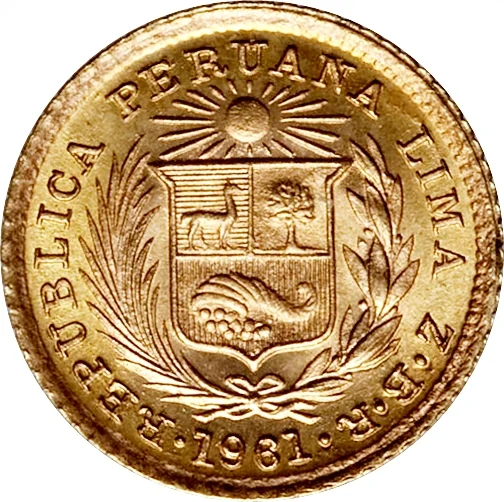
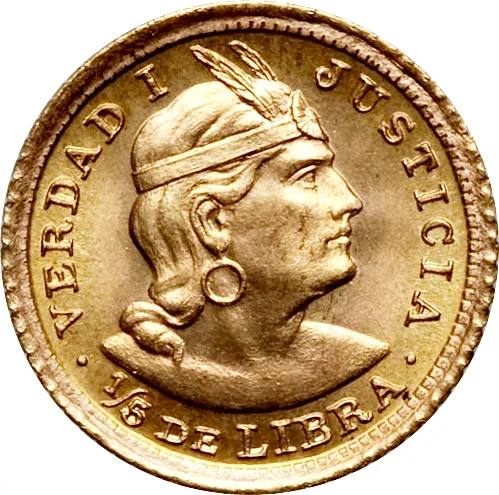
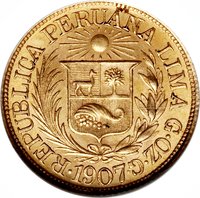
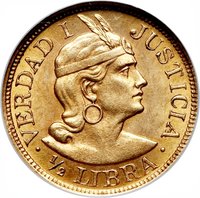
Obverse
Reverse
Edge
Categories
| Symbols> Coat of Arms |
Mints
| Name | Mark |
|---|---|
| Lima | — |
Mintings
| Year | Mint Mark | Mintage | Quality | Collection |
|---|---|---|---|---|
| 1906 | GOZF | 106,000 | ||
| 1907 | GOZF | 31,000 | ||
| 1907 | GOZG | — | ||
| 1909 | GOZG | — | ||
| 1910 | GOZG | — | ||
| 1911 | GOZF | 62,000 | ||
| 1911 | GOZG | — | ||
| 1912 | GOZG | — | ||
| 1912 | POZG | — | ||
| 1913 | POZG | 60,000 | ||
| 1914 | PBLG | — | ||
| 1914 | POZG | 25,000 | ||
| 1915 | — | 10,000 | ||
| 1916 | — | 13,000 | ||
| 1917 | — | 3,896 | ||
| 1918 | — | 16,000 | ||
| 1919 | — | 10,000 | ||
| 1920 | — | 72,000 | ||
| 1922 | — | 8,110 | ||
| 1923 | — | 27,000 | ||
| 1924 | — | — | ||
| 1925 | — | 20,000 | ||
| 1926 | — | 11,000 | ||
| 1927 | — | 14,000 | ||
| 1928 | — | 9,322 | ||
| 1929 | — | 8,971 | ||
| 1930 | — | 9,991 | ||
| 1953 | BBR | 9,821 | ||
| 1955 | ZBR | 10,000 | ||
| 1958 | ZBR | 5,098 | ||
| 1959 | ZBR | 6,308 | ||
| 1960 | ZBR | 6,083 | ||
| 1961 | ZBR | 12,000 | ||
| 1962 | ZBR | 5,431 | ||
| 1963 | ZBR | 11,000 | ||
| 1964 | ZBR | 25,000 | ||
| 1965 | ZBR | 19,000 | ||
| 1966 | ZBR | 60,000 | ||
| 1967 | BBR | 9,914 | ||
| 1968 | BBB | 4,781 | ||
| 1968 | BBR | — | ||
| 1969 | BBB | 15,000 |
Historical background
In 1906, Peru’s currency situation was characterized by a period of transition and instability, emerging from the economic devastation of the War of the Pacific (1879-1884). The national currency, the Peruvian sol, was a silver-based currency that had suffered severe devaluation and loss of public confidence. Following the war, the country faced massive external debt, a crippled mining and agricultural export sector, and a fragmented monetary system where various forms of money, including old coins, banknotes from defunct banks, and even foreign currencies, circulated with uncertain value. The government's attempts to issue paper money (billetes fiscales) to cover deficits had led to inflation, further complicating economic recovery.
The pivotal development of this era was the creation of the Banco de la Reserva del Perú (Central Reserve Bank of Peru) in 1922, but the groundwork for monetary reform began in the early 1900s. In 1901, the government had taken a significant step by adopting the gold standard officially, pegging the sol to the British pound sterling in an effort to stabilize its value and attract foreign investment. However, by 1906, this system was under severe strain. The country's limited gold reserves and persistent fiscal deficits made maintaining the gold peg difficult, leading to a situation where the official gold sol existed alongside a devalued silver sol in everyday transactions, creating a complex and inefficient dual system.
Consequently, the currency situation in 1906 was one of fragile and nominal adherence to the gold standard, masking deeper structural problems. The economy remained heavily dependent on a few primary exports, like copper and cotton, whose price fluctuations on the world market directly impacted Peru's ability to maintain its gold reserves. While the intent to establish a stable, modern monetary system was clear, the practical realities of post-war reconstruction, debt, and fiscal policy meant that true monetary stability and a unified currency would not be achieved until the establishment of a central banking authority nearly two decades later.
The pivotal development of this era was the creation of the Banco de la Reserva del Perú (Central Reserve Bank of Peru) in 1922, but the groundwork for monetary reform began in the early 1900s. In 1901, the government had taken a significant step by adopting the gold standard officially, pegging the sol to the British pound sterling in an effort to stabilize its value and attract foreign investment. However, by 1906, this system was under severe strain. The country's limited gold reserves and persistent fiscal deficits made maintaining the gold peg difficult, leading to a situation where the official gold sol existed alongside a devalued silver sol in everyday transactions, creating a complex and inefficient dual system.
Consequently, the currency situation in 1906 was one of fragile and nominal adherence to the gold standard, masking deeper structural problems. The economy remained heavily dependent on a few primary exports, like copper and cotton, whose price fluctuations on the world market directly impacted Peru's ability to maintain its gold reserves. While the intent to establish a stable, modern monetary system was clear, the practical realities of post-war reconstruction, debt, and fiscal policy meant that true monetary stability and a unified currency would not be achieved until the establishment of a central banking authority nearly two decades later.
🌟 Limited