

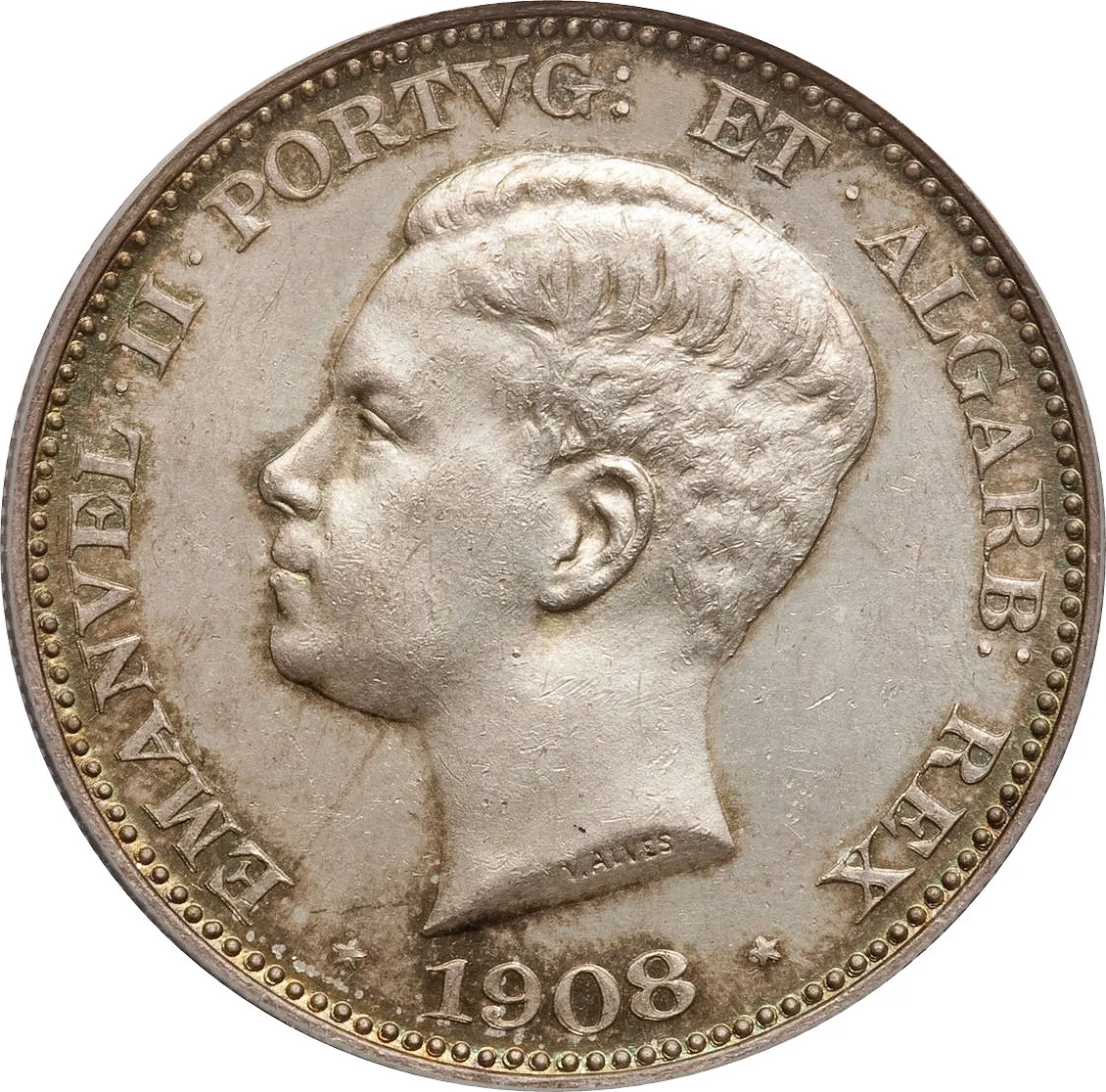
Obverse
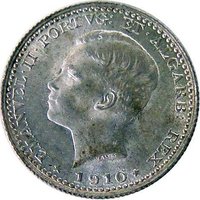
Description:
Turn left.
Inscription:
EMANVEL·II·PORTVG: ET·ALGARB:
V.ALVES
· 1908 ·
V.ALVES
· 1908 ·
Translation:
Emanuel II of Portugal and the Algarves
V. Alves
· 1908 ·
V. Alves
· 1908 ·
Script: Latin
Languages: Portuguese, Latin
Engraver: Valancio Alves
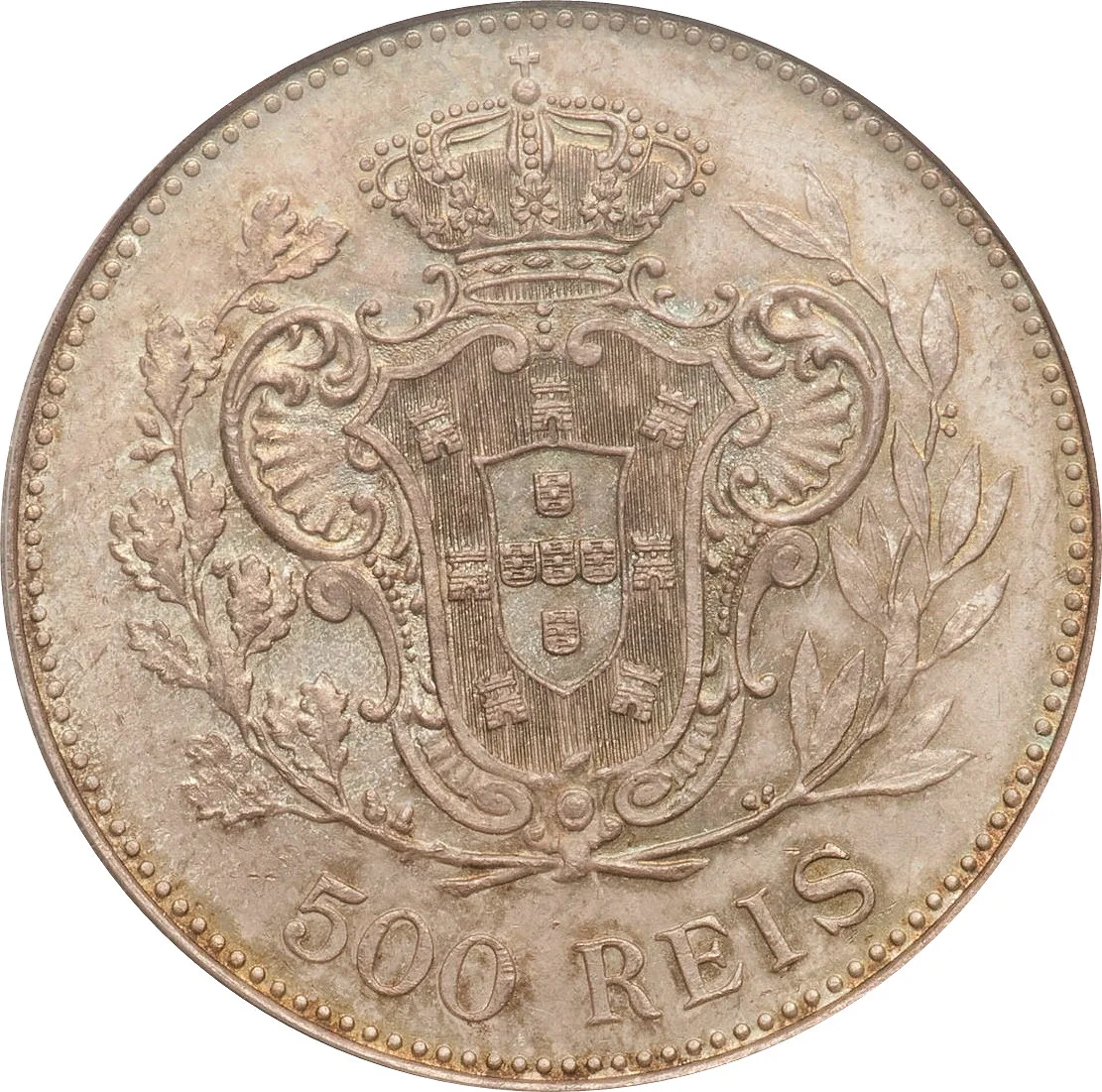
Reverse
Description:
Shield crowned, flanked by sprigs.
Inscription:
500 REIS
Script: Latin
Engraver: Valancio Alves
Edge
Reeded
Mints
| Name | Mark |
|---|---|
| Imprensa Nacional - Casa da Moeda | — |
Mintings
| Year | Mint Mark | Mintage | Quality | Collection |
|---|---|---|---|---|
| 1908 | — | 2,500,000 | ||
| 1908 | — | — | Proof | |
| 1909 | — | 1,513,000 |
Historical background
In 1908, Portugal's currency situation was defined by the escudo, which had replaced the real in 1911, following the establishment of the Republic. Therefore, in the specific year of 1908, the nation was still officially using the real (plural: réis) under the constitutional monarchy of King Carlos I. The monetary system was complex and cumbersome, with values often expressed in the thousands or millions of réis (mil réis, conto de réis), reflecting a currency that had been significantly devalued over centuries due to persistent budget deficits, high public debt, and economic stagnation relative to its European peers.
The underlying financial environment was one of profound instability. Portugal had accumulated massive external debt and had experienced a series of debt defaults and restructurings throughout the 19th century. This chronic fiscal crisis eroded confidence in the real and fueled inflation. Furthermore, the country operated on a bimetallic standard (gold and silver), but in practice struggled to maintain convertibility. The economy was heavily reliant on agriculture and remittances from emigrants, with limited industrial development, which constrained the state's ability to stabilize its finances and currency.
The currency woes of 1908 were symptomatic of the broader political and economic decay that culminated in the assassination of King Carlos and the Crown Prince in Lisbon on February 1st of that year. This act of regicide intensified the national crisis, paving the way for the republican revolution of 1910. The subsequent Republican government would directly address the monetary chaos by introducing the escudo in 1911 as part of a wider effort to modernize the state and symbolize a break from the monarchical past, pegging it to gold and simplifying the decimal system. Thus, 1908 stands as the final full year of the old monetary regime, operating under the shadow of imminent political and financial transformation.
The underlying financial environment was one of profound instability. Portugal had accumulated massive external debt and had experienced a series of debt defaults and restructurings throughout the 19th century. This chronic fiscal crisis eroded confidence in the real and fueled inflation. Furthermore, the country operated on a bimetallic standard (gold and silver), but in practice struggled to maintain convertibility. The economy was heavily reliant on agriculture and remittances from emigrants, with limited industrial development, which constrained the state's ability to stabilize its finances and currency.
The currency woes of 1908 were symptomatic of the broader political and economic decay that culminated in the assassination of King Carlos and the Crown Prince in Lisbon on February 1st of that year. This act of regicide intensified the national crisis, paving the way for the republican revolution of 1910. The subsequent Republican government would directly address the monetary chaos by introducing the escudo in 1911 as part of a wider effort to modernize the state and symbolize a break from the monarchical past, pegging it to gold and simplifying the decimal system. Thus, 1908 stands as the final full year of the old monetary regime, operating under the shadow of imminent political and financial transformation.
🌱 Fairly Common