

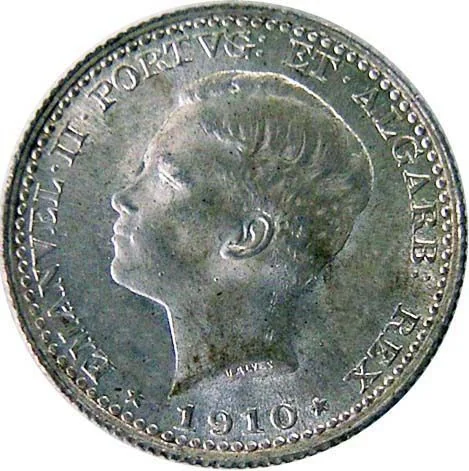
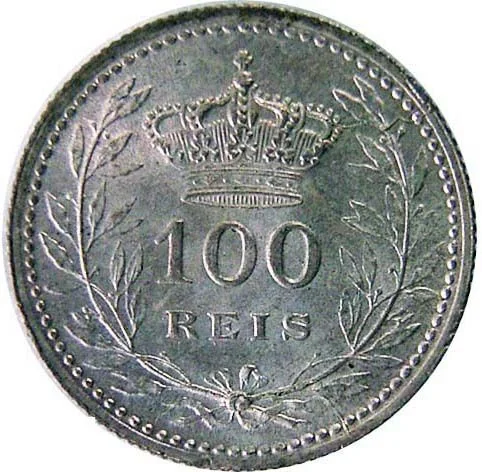
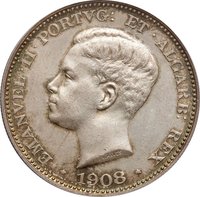
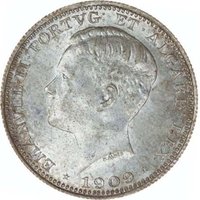
Obverse
Description:
Bust left, date beneath.
Inscription:
EMANVEL II PORTVG ET ALGARB REX
1910
1910
Translation:
Emmanuel II, King of Portugal and the Algarves
1910
1910
Script: Latin
Languages: Latin, Portuguese
Engraver: Valancio Alves
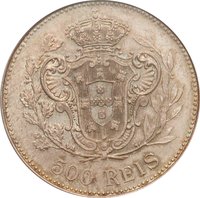
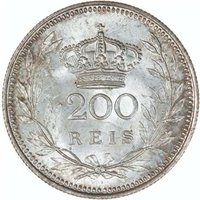
Reverse
Edge
Reeded
Mints
| Name | Mark |
|---|---|
| Imprensa Nacional - Casa da Moeda | — |
Mintings
| Year | Mint Mark | Mintage | Quality | Collection |
|---|---|---|---|---|
| 1909 | — | 6,363,000 | ||
| 1909 | — | — | Proof | |
| 1910 | — | — | ||
| 1910 | — | — | Proof |
Historical background
In 1909, Portugal's currency situation was one of profound instability and transition, rooted in the nation's deep financial and political crises. The country operated on a monometallic gold standard, with the real (plural: réis) as the unit of account, but this system was largely theoretical. Decades of chronic budget deficits, heavy foreign debt, and economic stagnation had led to severe currency depreciation and rampant speculation. The value of paper money (papel-moeda) had fallen drastically against gold, leading to a significant premium for gold coins, which were hoarded and circulated at a value far above their face value. This created a chaotic dual-system in everyday commerce, undermining public confidence and hindering economic activity.
This monetary disorder was a direct symptom of the broader collapse of the Portuguese constitutional monarchy. The government, under King Carlos I and then, after his assassination in 1908, under the young King Manuel II, was unable to implement fiscal discipline or secure stabilizing foreign loans. The Bank of Portugal, acting as the issuer of notes, was repeatedly forced to suspend the convertibility of its notes into gold to finance state expenditures, further eroding trust. Consequently, international creditors viewed Portugal with increasing skepticism, and the escudo, which would formally replace the real in 1911, was already being planned as part of a necessary monetary reform.
Thus, the currency landscape of 1909 was one of anticipation for radical change. The prevailing instability was a key grievance fueling republican and revolutionary sentiments. Within two years, the monarchy would be overthrown, and the new First Portuguese Republic would enact a sweeping monetary reform, introducing the escudo in 1911 at a rate of 1,000 réis to 1 escudo, in a ultimately only partially successful attempt to restore order, simplify the system, and signal a fresh start for the nation's finances.
This monetary disorder was a direct symptom of the broader collapse of the Portuguese constitutional monarchy. The government, under King Carlos I and then, after his assassination in 1908, under the young King Manuel II, was unable to implement fiscal discipline or secure stabilizing foreign loans. The Bank of Portugal, acting as the issuer of notes, was repeatedly forced to suspend the convertibility of its notes into gold to finance state expenditures, further eroding trust. Consequently, international creditors viewed Portugal with increasing skepticism, and the escudo, which would formally replace the real in 1911, was already being planned as part of a necessary monetary reform.
Thus, the currency landscape of 1909 was one of anticipation for radical change. The prevailing instability was a key grievance fueling republican and revolutionary sentiments. Within two years, the monarchy would be overthrown, and the new First Portuguese Republic would enact a sweeping monetary reform, introducing the escudo in 1911 at a rate of 1,000 réis to 1 escudo, in a ultimately only partially successful attempt to restore order, simplify the system, and signal a fresh start for the nation's finances.
🌱 Common