

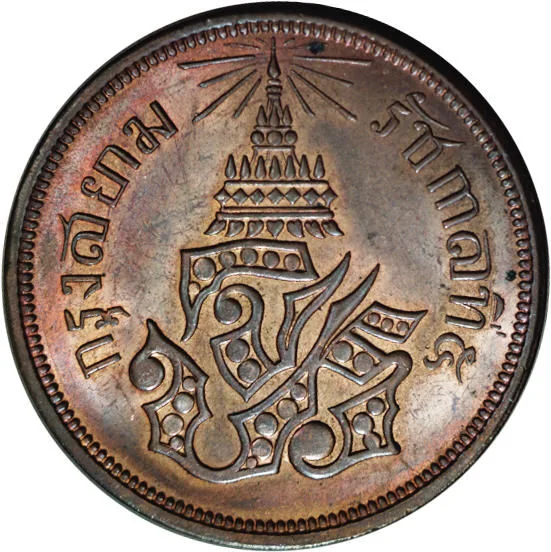
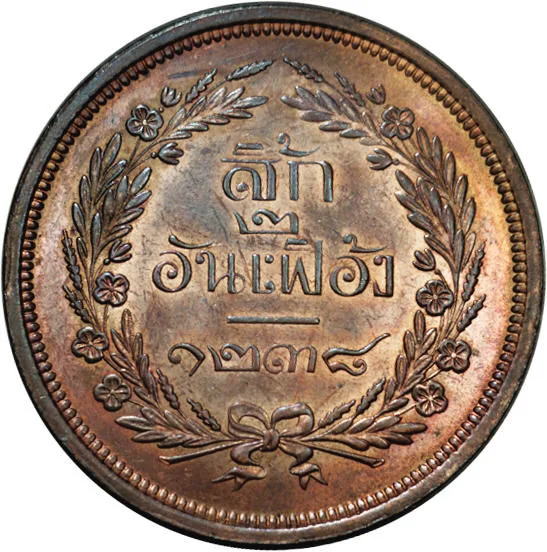
1 Sik – Thailand
Thailand
Context
Year: 1876
Buddhist (Chulasakarat) Year: 1238
Issuer: Thailand 
Ruler: Phra Chula Chom Klao
Currency:
(1869—1897)
Subdivision: 1 Sik = ½ Fuang = 1⁄16 Baht
Demonetization: 17 May 1909
Material
References
Y: #Click to copy to clipboard20
Numista: #24454
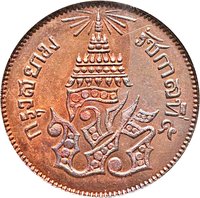
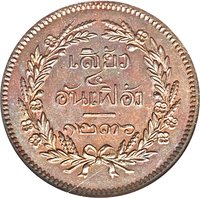
Obverse
Reverse
Edge
Plain
Mints
| Name | Mark |
|---|---|
| Heaton and Sons / The Mint Birmingham | — |
Mintings
| Year | Mint Mark | Mintage | Quality | Collection |
|---|---|---|---|---|
| 1876 | — | — |
Historical background
In 1876, the currency situation in the Kingdom of Siam (Thailand) was a complex and transitional system, caught between traditional Asian practices and the pressures of Western colonial trade. The economy operated on a bimetallic standard, but not a unified one. The official unit of account was the baht (or tical), a silver bullet coin, but its value in relation to gold and various foreign coins was unstable. Alongside these, a wide array of physical currencies circulated: indigenous pod duang (bullet money), Mexican and Spanish silver dollars, Indian rupees, and Chinese copper cash coins, all valued by weight and fineness in a cumbersome system that hindered commerce and state revenue collection.
This monetary fragmentation was a significant problem for King Chulalongkorn (Rama V) and his modernizing government. The irregular shapes of bullet money made it easy to clip and counterfeit, while the fluctuating exchange rates between the multitude of coins created uncertainty for both foreign merchants and local traders. Furthermore, the Siamese treasury found it difficult to budget and collect taxes efficiently when receipts came in a bewildering variety of metallic forms. The issue was exacerbated by the regional economic dominance of the British in neighboring Burma and the Straits Settlements, who operated on a sterling-based system.
Consequently, 1876 fell within a period of intense study and reform that would culminate in major changes. Just a few years prior, in 1874, the government had begun issuing flat, machine-struck silver baht coins to gradually replace the bullet money—a process still ongoing in 1876. The key transformative event, the Coinage Act of 1874, which established a modern decimal system (1 baht = 100 satang), had been passed but was not yet fully implemented across the kingdom. Therefore, 1876 represents a pivotal moment: the old eclectic system was still visibly in circulation, but the foundational laws and first batches of modern coinage were already in place, setting Siam on an irreversible path toward a standardized, decimalized, and centrally issued national currency.
This monetary fragmentation was a significant problem for King Chulalongkorn (Rama V) and his modernizing government. The irregular shapes of bullet money made it easy to clip and counterfeit, while the fluctuating exchange rates between the multitude of coins created uncertainty for both foreign merchants and local traders. Furthermore, the Siamese treasury found it difficult to budget and collect taxes efficiently when receipts came in a bewildering variety of metallic forms. The issue was exacerbated by the regional economic dominance of the British in neighboring Burma and the Straits Settlements, who operated on a sterling-based system.
Consequently, 1876 fell within a period of intense study and reform that would culminate in major changes. Just a few years prior, in 1874, the government had begun issuing flat, machine-struck silver baht coins to gradually replace the bullet money—a process still ongoing in 1876. The key transformative event, the Coinage Act of 1874, which established a modern decimal system (1 baht = 100 satang), had been passed but was not yet fully implemented across the kingdom. Therefore, 1876 represents a pivotal moment: the old eclectic system was still visibly in circulation, but the foundational laws and first batches of modern coinage were already in place, setting Siam on an irreversible path toward a standardized, decimalized, and centrally issued national currency.
Series: CPR - Java Cassia wreath series
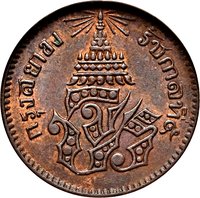
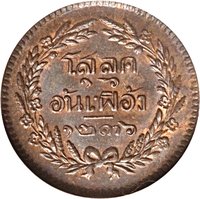
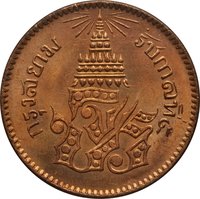
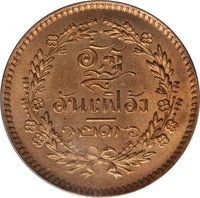
⭐ Somewhat Rare