

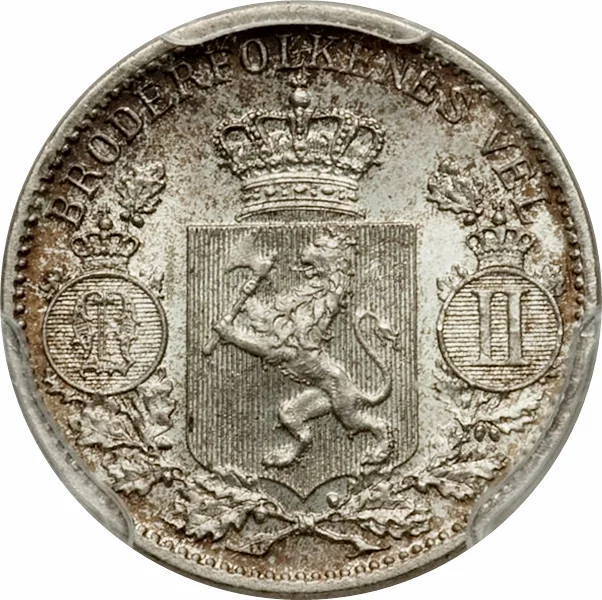

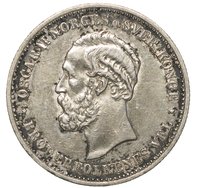
Obverse
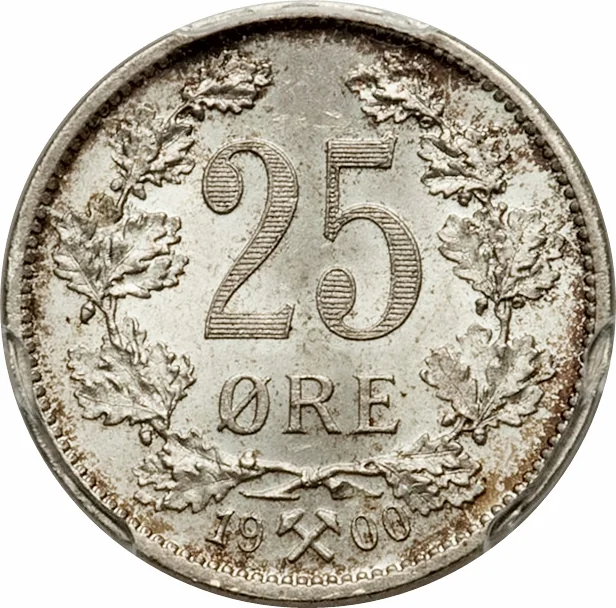
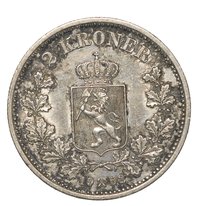
Reverse
Edge
Plain
Mints
| Name | Mark |
|---|---|
| Norwegian Mint | — |
Mintings
| Year | Mint Mark | Mintage | Quality | Collection |
|---|---|---|---|---|
| 1896 | — | 400,000 | ||
| 1898 | — | 400,000 | ||
| 1899 | — | 600,000 | ||
| 1900 | — | 400,000 | ||
| 1901 | — | 606,900 | ||
| 1902 | — | 611,700 | ||
| 1904 | — | 600,000 |
Historical background
In 1896, Norway's currency system was firmly embedded within the Scandinavian Monetary Union (SMU), established in 1873 with Denmark and joined by Sweden in 1875. This union created a unified currency area based on the gold standard, where the Norwegian krone (crown), pegged at 2.48 kroner per gram of fine gold, was legally interchangeable at par with the Danish and Swedish kronor. This facilitated seamless trade and financial transactions across the region, with coins from any member nation circulating freely within Norway's borders. The system was widely regarded as a success, providing monetary stability and fostering economic integration.
However, by the mid-1890s, underlying strains within the Union were becoming apparent. The fundamental issue was the lack of a central supranational authority to coordinate policy. While coins circulated freely, each nation retained its own central bank and issued its own banknotes, which were not legally required to be accepted at par outside their home country. In practice, Norwegian notes were often accepted in Sweden and Denmark, but the system relied on mutual trust and the gold reserves of each central bank. Furthermore, the global economic turbulence of the late 19th century, including fluctuating gold supplies and banking crises, tested the union's cohesion.
Economically, Norway in 1896 was in a period of robust growth, driven by a shipping boom, industrialization, and expanding exports of goods like fish, timber, and metals. This strong economic position bolstered confidence in the krone. Consequently, while academic and political discussions about the SMU's long-term future were beginning to emerge, the currency situation for the average Norwegian in 1896 remained one of notable stability. The krone was trusted, internationally convertible, and backed by gold, providing a solid foundation for the nation's accelerating economic development on the eve of the 20th century.
However, by the mid-1890s, underlying strains within the Union were becoming apparent. The fundamental issue was the lack of a central supranational authority to coordinate policy. While coins circulated freely, each nation retained its own central bank and issued its own banknotes, which were not legally required to be accepted at par outside their home country. In practice, Norwegian notes were often accepted in Sweden and Denmark, but the system relied on mutual trust and the gold reserves of each central bank. Furthermore, the global economic turbulence of the late 19th century, including fluctuating gold supplies and banking crises, tested the union's cohesion.
Economically, Norway in 1896 was in a period of robust growth, driven by a shipping boom, industrialization, and expanding exports of goods like fish, timber, and metals. This strong economic position bolstered confidence in the krone. Consequently, while academic and political discussions about the SMU's long-term future were beginning to emerge, the currency situation for the average Norwegian in 1896 remained one of notable stability. The krone was trusted, internationally convertible, and backed by gold, providing a solid foundation for the nation's accelerating economic development on the eve of the 20th century.
🌱 Fairly Common