

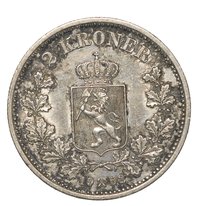
Obverse
Description:
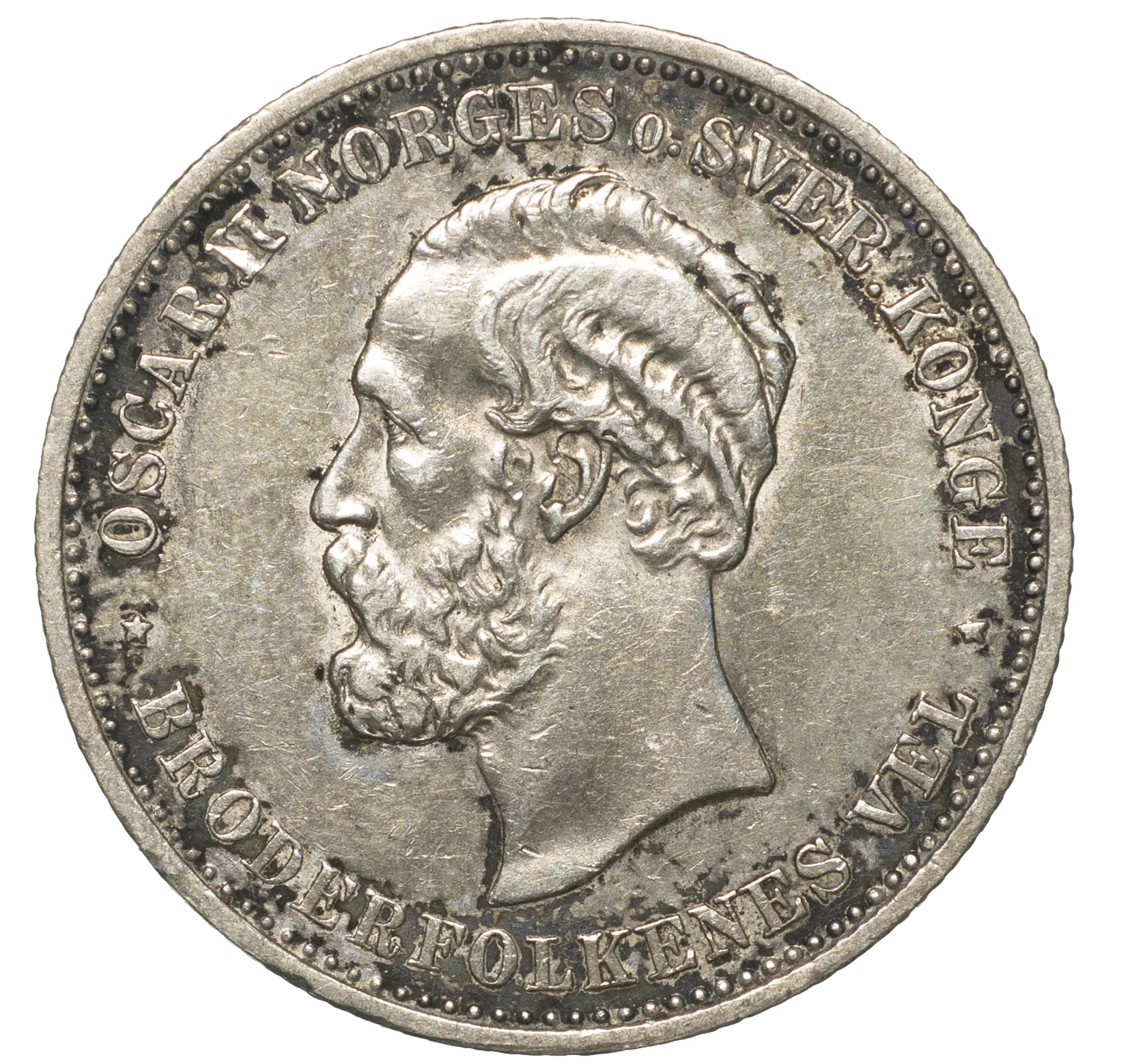
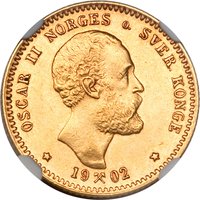
Bust of King Oscar II left, with inscription and beaded rim ring.
Inscription:
OSCAR II NORGES o. SVER. KONGE
⋆ BRODERFOLKENES VEL ⋆
⋆ BRODERFOLKENES VEL ⋆
Translation:
OSCAR II NORWAY'S AND SWEDEN'S KING
⋆ THE BROTHER PEOPLES' WELFARE ⋆
⋆ THE BROTHER PEOPLES' WELFARE ⋆
Script: Latin
Engraver: Lea Ahlborn
Reverse
Description:
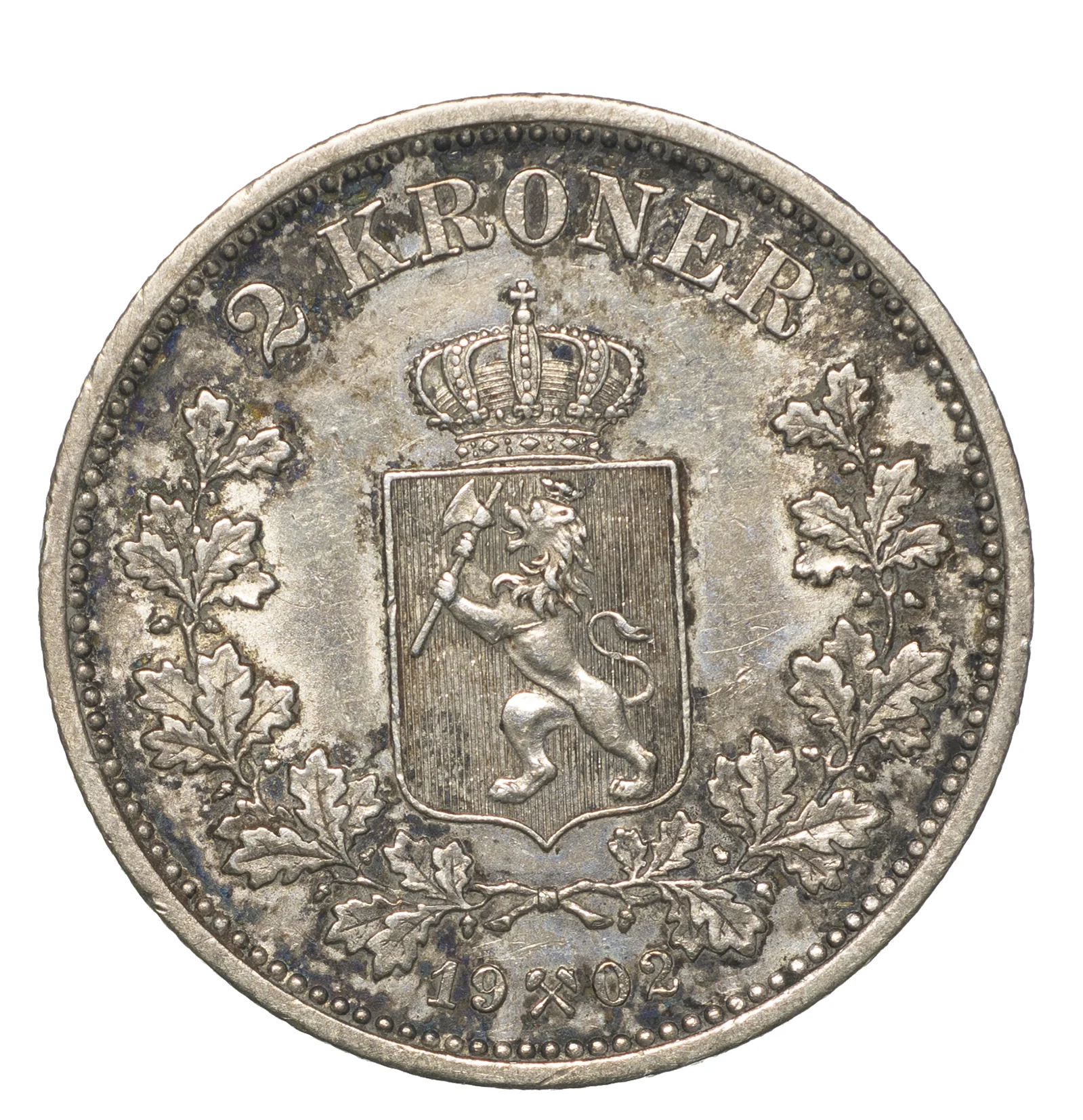
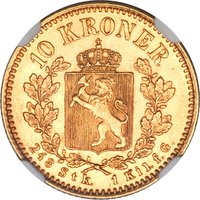
Shield with crowned Norwegian lion holding a halberd, within a wreath. Value above, date and mintmark below. Beaded rim.
Inscription:
2 KRONER
18 ⚒ 90
18 ⚒ 90
Script: Latin
Engraver: Lea Ahlborn
Edge
Reeded
Mints
| Name | Mark |
|---|---|
| Norwegian Mint | — |
Mintings
| Year | Mint Mark | Mintage | Quality | Collection |
|---|---|---|---|---|
| 1878 | — | 300,000 | ||
| 1885 | — | 25,000 | ||
| 1887 | — | 25,000 | ||
| 1888 | — | 25,000 | ||
| 1890 | — | 100,000 | ||
| 1892 | — | 50,000 | ||
| 1893 | — | 75,000 | ||
| 1894 | — | 75,000 | ||
| 1897 | — | 50,000 | ||
| 1898 | — | 50,000 | ||
| 1900 | — | 125,000 | ||
| 1902 | — | 153,100 | ||
| 1904 | — | 75,600 |
Historical background
In 1878, Norway found itself at a monetary crossroads, operating under the complex Scandinavian Monetary Union (SMU) established with Sweden and Denmark in 1873. This union was founded on the principle of a common gold standard, with the Norwegian krone (crown) as the unit of account, replacing the old speciedaler. The system allowed the member countries' coins to circulate freely across borders as legal tender, facilitating trade and economic integration. By 1878, this system was functioning, but Norway's participation was underpinned by its broader economic ties to Sweden within the political framework of the Swedish-Norwegian Union, a relationship that was increasingly strained by Norwegian desires for greater autonomy.
The year itself was not marked by a dramatic currency crisis but by a significant step in monetary consolidation. A key development was the Currency Act of 1878, which formally and fully implemented the gold standard in Norway, legally defining the krone's value in terms of gold. This act completed the transition begun in 1873 and aimed to provide long-term stability, curb inflation, and align Norway firmly with international financial markets. The commitment to gold was seen as essential for a small, trade-dependent nation, signaling credibility to foreign investors and trading partners.
However, the situation was not without its underlying tensions. Norway's economy was more susceptible to international price fluctuations than its partners, and debates persisted about the constraints the gold standard placed on responding to economic downturns. Furthermore, the monetary union's success was subtly challenged by the growing political movement for full Norwegian independence from Sweden. While the SMU itself would technically survive until 1914, the political divergence foreshadowed its eventual dissolution, making 1878 a point of solidification within a union that was, politically, beginning to fray.
The year itself was not marked by a dramatic currency crisis but by a significant step in monetary consolidation. A key development was the Currency Act of 1878, which formally and fully implemented the gold standard in Norway, legally defining the krone's value in terms of gold. This act completed the transition begun in 1873 and aimed to provide long-term stability, curb inflation, and align Norway firmly with international financial markets. The commitment to gold was seen as essential for a small, trade-dependent nation, signaling credibility to foreign investors and trading partners.
However, the situation was not without its underlying tensions. Norway's economy was more susceptible to international price fluctuations than its partners, and debates persisted about the constraints the gold standard placed on responding to economic downturns. Furthermore, the monetary union's success was subtly challenged by the growing political movement for full Norwegian independence from Sweden. While the SMU itself would technically survive until 1914, the political divergence foreshadowed its eventual dissolution, making 1878 a point of solidification within a union that was, politically, beginning to fray.
🌟 Uncommon