

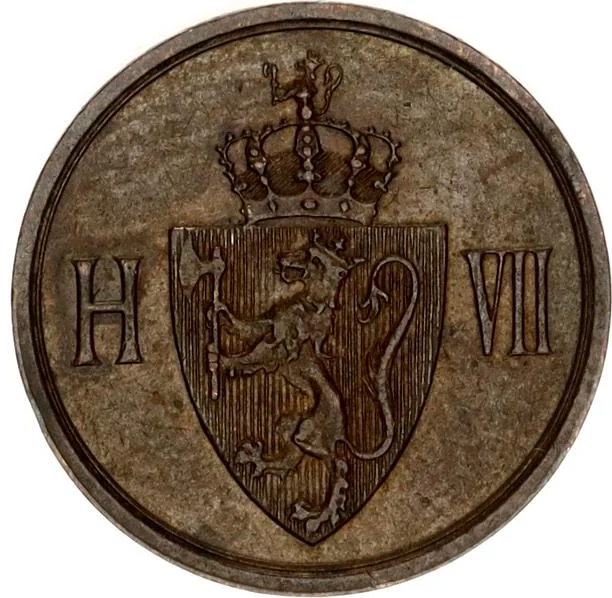
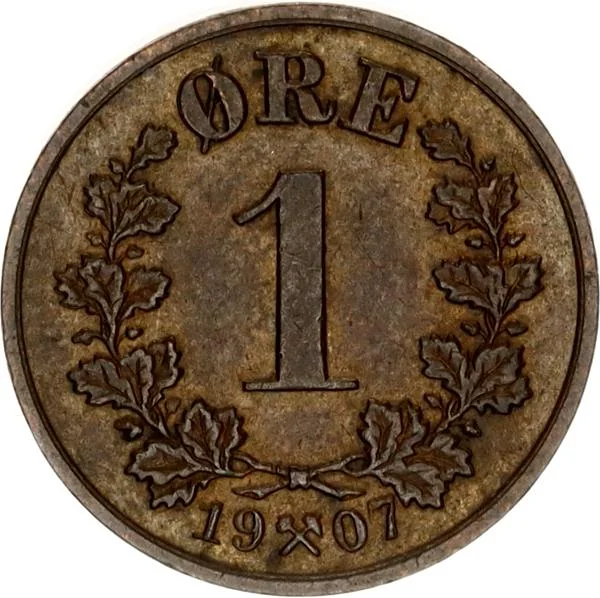
1 Øre – Norway
Norway
Context
Years: 1906–1907
Issuer: Norway 
Ruler: Haakon VII
Currency:
(since 1875)
Demonetized: Yes
Total mintage: 5,550,000
Material
References
KM: #Click to copy to clipboard361
Numista: #24380
Value
Exchange value: 0.01 NOK = $0.00
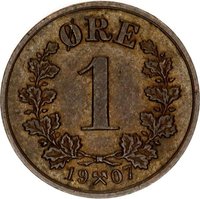
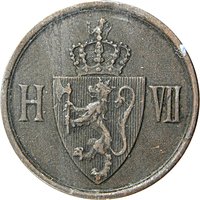
Obverse
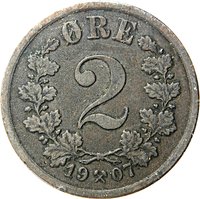
Reverse
Edge
Plain
Mints
| Name | Mark |
|---|---|
| Norwegian Mint | — |
Mintings
| Year | Mint Mark | Mintage | Quality | Collection |
|---|---|---|---|---|
| 1906 | — | 3,000,000 | ||
| 1907 | — | 2,550,000 |
Historical background
In 1906, Norway's currency situation was defined by its recent independence and its participation in the Scandinavian Monetary Union (SMU). Established in 1873 with Denmark and joined by Sweden in 1875, the Union created a fixed exchange rate system where the Norwegian krone (NOK), Danish krone, and Swedish krona were pegged to gold and considered legally equivalent across borders. This facilitated seamless trade and financial stability within the region, with coins circulating freely in all three nations. Norway's currency was thus fully integrated into an international system, backed by gold reserves held by Norges Bank.
However, the Union was under strain by 1906. The system functioned without a central governing body, and World War I would later expose its fragility, leading to its effective dissolution. While still operational, underlying tensions existed, particularly regarding the acceptance of each other's subsidiary coins. Furthermore, Norway's economic development, driven by shipping, hydropower, and early industrialization, required a stable and credible currency, which the gold-backed krone provided. Norges Bank managed this system, ensuring convertibility and maintaining public confidence in the krone's value.
Therefore, the Norwegian krone in 1906 was a stable, gold-backed currency operating within a successful but increasingly fragile regional union. The situation reflected Norway's dual identity: a newly sovereign state (independent from Sweden in 1905) asserting its national institutions, while still deeply embedded in a cooperative Scandinavian framework for economic and monetary stability. The system provided the foundation for economic growth, though its long-term viability was soon to be tested by global upheaval.
However, the Union was under strain by 1906. The system functioned without a central governing body, and World War I would later expose its fragility, leading to its effective dissolution. While still operational, underlying tensions existed, particularly regarding the acceptance of each other's subsidiary coins. Furthermore, Norway's economic development, driven by shipping, hydropower, and early industrialization, required a stable and credible currency, which the gold-backed krone provided. Norges Bank managed this system, ensuring convertibility and maintaining public confidence in the krone's value.
Therefore, the Norwegian krone in 1906 was a stable, gold-backed currency operating within a successful but increasingly fragile regional union. The situation reflected Norway's dual identity: a newly sovereign state (independent from Sweden in 1905) asserting its national institutions, while still deeply embedded in a cooperative Scandinavian framework for economic and monetary stability. The system provided the foundation for economic growth, though its long-term viability was soon to be tested by global upheaval.
🌱 Common