

500 pesos – Colombia
Add to wishlist
Colombia
Context
Years: 1993–2012
Issuer: Colombia
Period:
(since 1886)
Currency:
(since 1847)
Total mintage: 1,058,394,000
Material
References
KM: #
Numista: #2432
Value
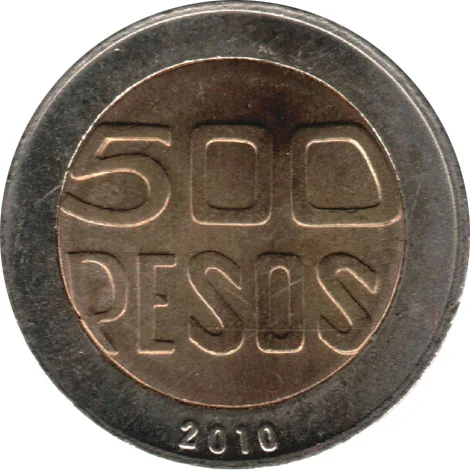
Exchange value: 500 COP
Inflation-adjusted value: 6502.00 COP
Obverse
Description:
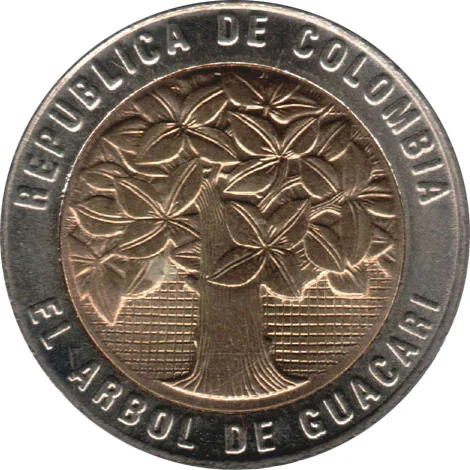
The Guacarí tree, named for the local community that protects this Samán tree.
Inscription:
REPUBLICA DE COLOMBIA
EL ARBOL DE GUACARI
EL ARBOL DE GUACARI
Translation:
REPUBLIC OF COLOMBIA
THE TREE OF GUACARI
THE TREE OF GUACARI
Script: Latin
Language: Spanish
Designer: David Manzur
Reverse
Edge
Segmented (8 milled, 8 smooth)
Mints
| Name | Mark |
|---|---|
| Fábrica de Moneda de Ibagué | — |
Mintings
| Year | Mint Mark | Mintage | Quality | Collection |
|---|---|---|---|---|
| 1993 | — | 15,642,000 | ||
| 1994 | — | 90,000,000 | ||
| 1995 | — | 90,000,000 | ||
| 1996 | — | 55,000,000 | ||
| 1997 | — | 50,000,000 | ||
| 2002 | — | 38,800,000 | ||
| 2003 | — | 26,410,000 | ||
| 2004 | — | 90,454,000 | ||
| 2005 | — | 97,664,000 | ||
| 2006 | — | 70,700,000 | ||
| 2007 | — | 109,624,000 | ||
| 2008 | — | 132,400,000 | ||
| 2009 | — | 39,700,000 | ||
| 2010 | — | 35,800,000 | ||
| 2011 | — | 76,200,000 | ||
| 2012 | — | 40,000,000 |
Historical background
In 1993, Colombia's currency situation was defined by a managed exchange rate regime operating within a "crawling peg" system. The Colombian peso was not freely floating; instead, the Banco de la República (the central bank) intervened regularly in the foreign exchange market to control its depreciation against the US dollar. This policy aimed to maintain export competitiveness by allowing a gradual, predictable devaluation, while also curbing imported inflation and preventing excessive volatility. The year saw relative stability in the nominal exchange rate, which hovered around 760-780 pesos per US dollar, a controlled depreciation from approximately 690 pesos at the start of the decade.
This period was one of transition and mounting pressure. The early 1990s had ushered in a wave of economic liberalization, including trade opening and financial deregulation, which increased the economy's exposure to foreign capital flows. While inflation remained high (around 22% in 1993), it was on a downward trajectory from the hyperinflationary crises of the past. However, the crawling peg system was becoming increasingly difficult to defend. Large capital inflows, partly attracted by high domestic interest rates, created upward pressure on the peso that conflicted with the central bank's devaluation targets, forcing costly and frequent interventions.
The backdrop to the 1993 currency management was the drafting and implementation of a new constitution in 1991, which granted autonomy to the Banco de la República with a primary mandate to control inflation. This institutional shift was crucial, setting the stage for future monetary policy. By 1993, the limitations of the crawling peg were evident, as maintaining it conflicted with the new anti-inflation mandate and the realities of an open economy. These tensions would culminate just a few years later in a severe crisis, leading to the abandonment of the peg and a move to a free-floating exchange rate system in September 1999.
This period was one of transition and mounting pressure. The early 1990s had ushered in a wave of economic liberalization, including trade opening and financial deregulation, which increased the economy's exposure to foreign capital flows. While inflation remained high (around 22% in 1993), it was on a downward trajectory from the hyperinflationary crises of the past. However, the crawling peg system was becoming increasingly difficult to defend. Large capital inflows, partly attracted by high domestic interest rates, created upward pressure on the peso that conflicted with the central bank's devaluation targets, forcing costly and frequent interventions.
The backdrop to the 1993 currency management was the drafting and implementation of a new constitution in 1991, which granted autonomy to the Banco de la República with a primary mandate to control inflation. This institutional shift was crucial, setting the stage for future monetary policy. By 1993, the limitations of the crawling peg were evident, as maintaining it conflicted with the new anti-inflation mandate and the realities of an open economy. These tensions would culminate just a few years later in a severe crisis, leading to the abandonment of the peg and a move to a free-floating exchange rate system in September 1999.
🌱 Very Common