

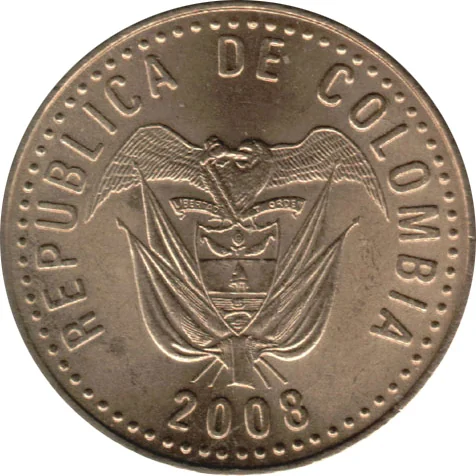
Obverse
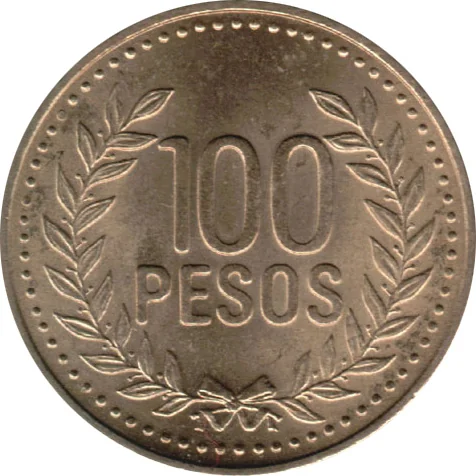
Reverse
Edge
Legend:
CIEN PESOS ||||||||||||||||| CIEN PESOS |||||||||||||||||
Translation:
ONE HUNDRED PESOS ||||||||||||||||| ONE HUNDRED PESOS |||||||||||||||||
Language: Spanish
Mintings
| Year | Mint Mark | Mintage | Quality | Collection |
|---|---|---|---|---|
| 1992 | — | 50,000,000 | ||
| 1993 | — | 180,500,000 | ||
| 1994 | — | 255,000,000 | ||
| 1995 | — | 180,000,000 | ||
| 2006 | — | 59,000,000 | ||
| 2007 | — | 55,000,000 | ||
| 2008 | — | 120,200,000 | ||
| 2009 | — | 41,800,000 | ||
| 2010 | — | 85,400,000 | ||
| 2011 | — | 108,500,000 | ||
| 2012 | — | 20,000,000 |
Historical background
In 1992, Colombia's currency situation was defined by a managed exchange rate regime within a broader context of economic liberalization and persistent inflationary pressures. Following a major reform in 1991, the country had transitioned to a crawling peg system, where the Colombian peso was allowed to depreciate gradually against the US dollar within a pre-announced band. This "crawling band" was managed by the Banco de la República, which intervened in the foreign exchange market to maintain the peso's value within the set parameters. The primary goal was to provide a measure of exchange rate stability for trade and investment while allowing for controlled adjustments to counteract inflation differentials with trading partners.
This monetary framework operated under the shadow of significant challenges. Inflation, though declining from the hyperinflationary crises of the 1970s, remained stubbornly high, ending 1992 at approximately 25%. This entrenched inflation complicated the central bank's dual objectives of price stability and exchange rate management. Furthermore, the economy was still adapting to the profound structural changes ushered in by the new Constitution of 1991 and President César Gaviria's "apertura económica" (economic opening), which involved trade liberalization, tariff reductions, and increased foreign investment flows. These inflows helped support the peso but also introduced new volatility.
Consequently, 1992 represented a period of cautious calibration within Colombia's evolving financial system. The managed depreciation of the peso aimed to maintain export competitiveness without triggering a destabilizing devaluation. However, the persistent high inflation underscored the underlying tensions in the economy and highlighted the limitations of using the exchange rate as a primary nominal anchor. This set the stage for more fundamental reforms later in the decade, culminating in the landmark move to a full-fledged inflation-targeting regime and a free-floating exchange rate in 1999.
This monetary framework operated under the shadow of significant challenges. Inflation, though declining from the hyperinflationary crises of the 1970s, remained stubbornly high, ending 1992 at approximately 25%. This entrenched inflation complicated the central bank's dual objectives of price stability and exchange rate management. Furthermore, the economy was still adapting to the profound structural changes ushered in by the new Constitution of 1991 and President César Gaviria's "apertura económica" (economic opening), which involved trade liberalization, tariff reductions, and increased foreign investment flows. These inflows helped support the peso but also introduced new volatility.
Consequently, 1992 represented a period of cautious calibration within Colombia's evolving financial system. The managed depreciation of the peso aimed to maintain export competitiveness without triggering a destabilizing devaluation. However, the persistent high inflation underscored the underlying tensions in the economy and highlighted the limitations of using the exchange rate as a primary nominal anchor. This set the stage for more fundamental reforms later in the decade, culminating in the landmark move to a full-fledged inflation-targeting regime and a free-floating exchange rate in 1999.
🌱 Very Common