

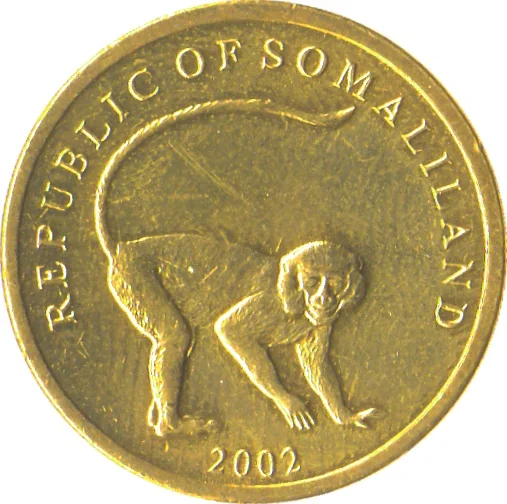
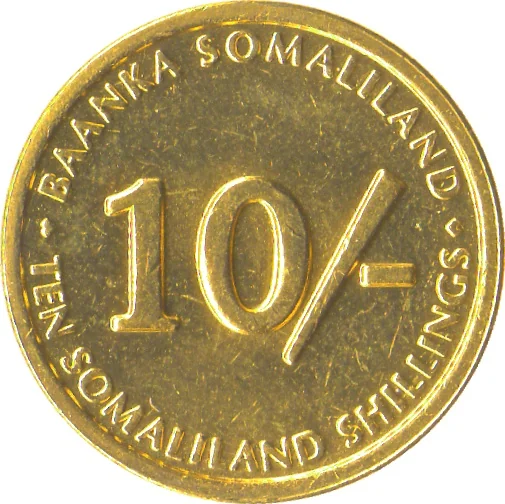
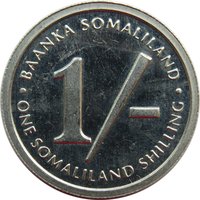
10 Shillings – Somaliland
Somalia
Context
Material
References
KM: #Click to copy to clipboard3
Numista: #2428
Value
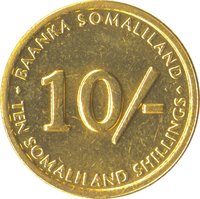
Exchange value: 10 SLS
Obverse
Reverse
Edge
Plain
Mintings
| Year | Mint Mark | Mintage | Quality | Collection |
|---|---|---|---|---|
| 2002 | — | — |
Historical background
In 2002, the currency situation in the self-declared Republic of Somaliland was defined by a critical struggle for monetary sovereignty and economic stability. The territory, which had declared independence from Somalia in 1991, lacked international recognition. This meant it could not access formal international banking systems or issue a legally recognized currency. Consequently, the economy operated on a complex dual-currency system. The most prevalent note was the Somali shilling, specifically the pre-1991 "SoSh" notes, which were printed in massive, unbacked quantities by various Mogadishu-based factions after the collapse of the central government, leading to severe devaluation and hyperinflation.
Facing this crisis, the Somaliland government took a bold step in 1994 by introducing the Somaliland shilling (SLSH) to establish a separate and stable monetary identity. However, by 2002, this initiative was still in a fragile and transitional phase. The new Somaliland shilling, while officially the national currency, competed directly with the old Somali shillings and the US dollar, which was widely used for large transactions and savings. Public confidence in the fledgling currency was limited, and its value was not firmly anchored, fluctuating based on political stability and trade balances, primarily with neighboring Ethiopia.
Therefore, the background of 2002 is one of a determined but challenged monetary authority. The Central Bank of Somaliland was actively promoting its own notes and withdrawing the devalued Somali shillings from circulation, a process of demonetization critical for economic control. The success of this policy was uneven, with the old notes still persisting in many areas. The fundamental currency situation remained a symbolic and practical battle: to build trust in a sovereign institution and to use monetary policy as a foundational pillar for Somaliland's claim to independent statehood, all while operating without the financial infrastructure that recognized nations take for granted.
Facing this crisis, the Somaliland government took a bold step in 1994 by introducing the Somaliland shilling (SLSH) to establish a separate and stable monetary identity. However, by 2002, this initiative was still in a fragile and transitional phase. The new Somaliland shilling, while officially the national currency, competed directly with the old Somali shillings and the US dollar, which was widely used for large transactions and savings. Public confidence in the fledgling currency was limited, and its value was not firmly anchored, fluctuating based on political stability and trade balances, primarily with neighboring Ethiopia.
Therefore, the background of 2002 is one of a determined but challenged monetary authority. The Central Bank of Somaliland was actively promoting its own notes and withdrawing the devalued Somali shillings from circulation, a process of demonetization critical for economic control. The success of this policy was uneven, with the old notes still persisting in many areas. The fundamental currency situation remained a symbolic and practical battle: to build trust in a sovereign institution and to use monetary policy as a foundational pillar for Somaliland's claim to independent statehood, all while operating without the financial infrastructure that recognized nations take for granted.
🌱 Common