

20 centesimi – Italy
Add to wishlist
Italy
Context
Material
Diameter: 21 mm
Weight: 4 g
Thickness: 1.4 mm
Shape: Round
Composition: Copper-nickel
Technique: Milled
Alignment: Coin alignment
flip
References
KM: #
Numista: #2394
Value
Exchange value: 0.20 ITL
Obverse
Description:
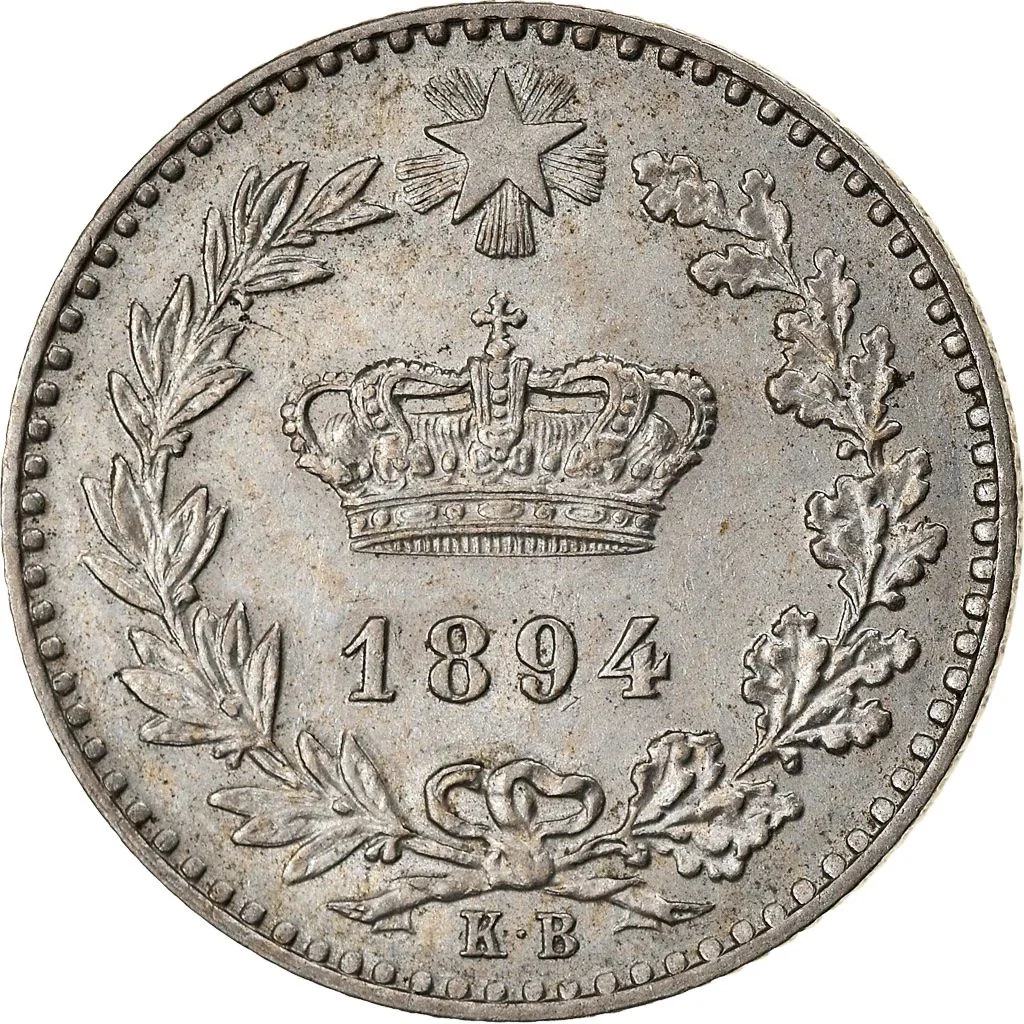
Central royal crown with date below, encircled by a laurel and oak wreath. The Star of Italy is above, and the mintmark is below the wreath. Mintmarks: KB (Berlin) or R (Rome).
Inscription:
1894
K·B
K·B
Script: Latin
Engraver: Filippo Speranza
Reverse
Description:
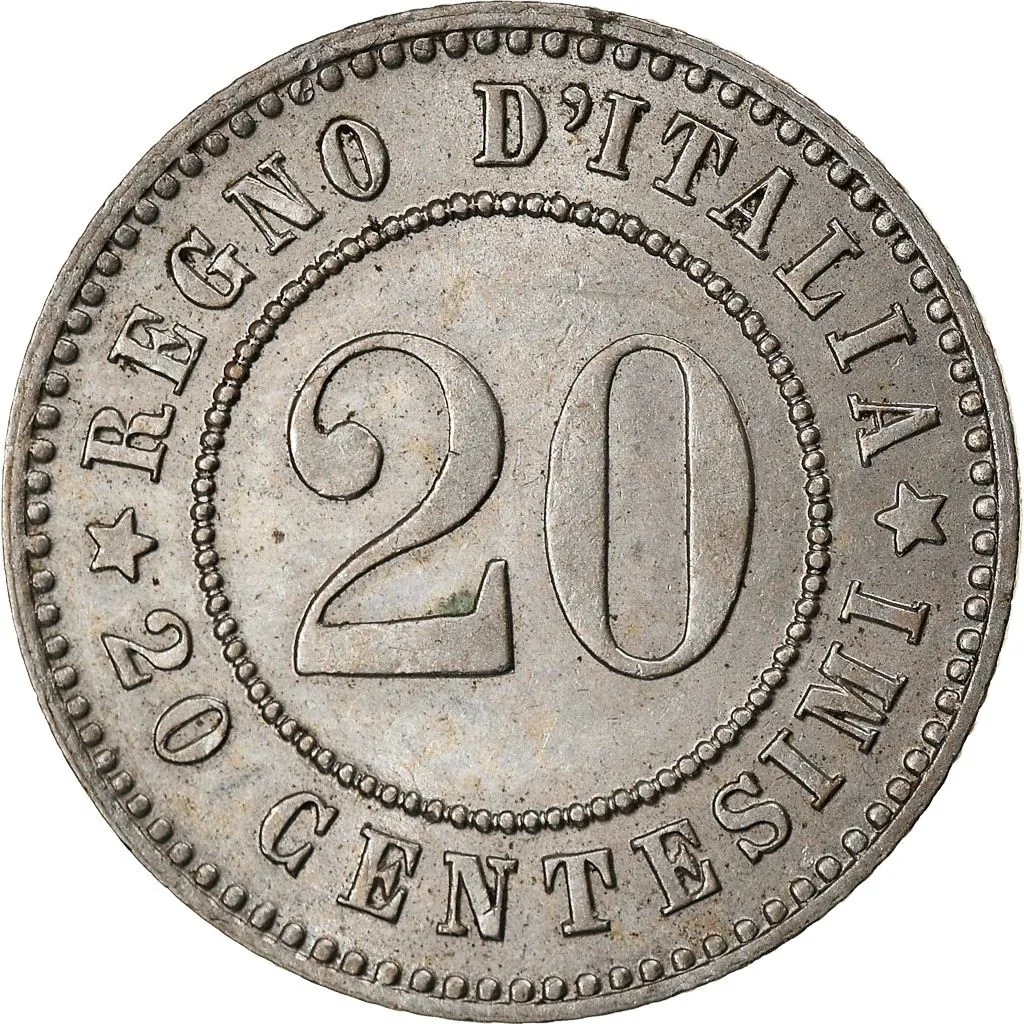
Denomination centered, lettering encircling.
Inscription:
REGNO D'ITALIA
20 CENTESIMI
20
20 CENTESIMI
20
Translation:
Kingdom of Italy
20 Centesimi
20
20 Centesimi
20
Script: Latin
Language: Italian
Engraver: Filippo Speranza
Edge
Milled
Historical background
In 1894, Italy found itself in the throes of a severe currency and banking crisis, a direct consequence of decades of fiscal mismanagement and the policy of corso forzoso (forced circulation). Since 1866, the government had suspended the convertibility of paper lire into gold or silver, printing money to finance heavy public spending, notably on unification infrastructure and a large military. This led to a significant depreciation of the lira against gold-backed currencies like the British pound, rampant inflation, and a loss of international confidence, creating a large public debt burden that was increasingly difficult to service.
The immediate trigger for the 1894 crisis was the near-collapse of the banking system, particularly the Banca Romana, one of the six banks authorized to issue currency. A scandal in 1893 revealed it had issued vast amounts of unbacked banknotes and made irresponsible loans, leaving it insolvent. To prevent total financial collapse, the government was forced to intervene. In 1894, it orchestrated the creation of the Banca d'Italia through the merger of three surviving banks of issue, a crucial step toward monetary stability and a unified national currency authority, though full convertibility was still years away.
Thus, the currency situation in 1894 was one of profound instability and transition. The state was grappling with the aftermath of bank failures, a weakened lira, and a massive debt. While the establishment of the Banca d'Italia marked the beginning of a long path toward monetary order, the immediate reality was one of austerity, deflationary pressures, and social unrest, setting the stage for the contentious economic policies of the late 1890s under Prime Minister Luigi Pelloux.
The immediate trigger for the 1894 crisis was the near-collapse of the banking system, particularly the Banca Romana, one of the six banks authorized to issue currency. A scandal in 1893 revealed it had issued vast amounts of unbacked banknotes and made irresponsible loans, leaving it insolvent. To prevent total financial collapse, the government was forced to intervene. In 1894, it orchestrated the creation of the Banca d'Italia through the merger of three surviving banks of issue, a crucial step toward monetary stability and a unified national currency authority, though full convertibility was still years away.
Thus, the currency situation in 1894 was one of profound instability and transition. The state was grappling with the aftermath of bank failures, a weakened lira, and a massive debt. While the establishment of the Banca d'Italia marked the beginning of a long path toward monetary order, the immediate reality was one of austerity, deflationary pressures, and social unrest, setting the stage for the contentious economic policies of the late 1890s under Prime Minister Luigi Pelloux.
🌱 Very Common