

500 Lire – Vatican City
Non-circulating coins
Commemoration: Sede Vacante
Vatican City
Context
Material
References
KM: #Click to copy to clipboard57
Numista: #12216
Value
Exchange value: 500 VAL
Bullion value: $26.48
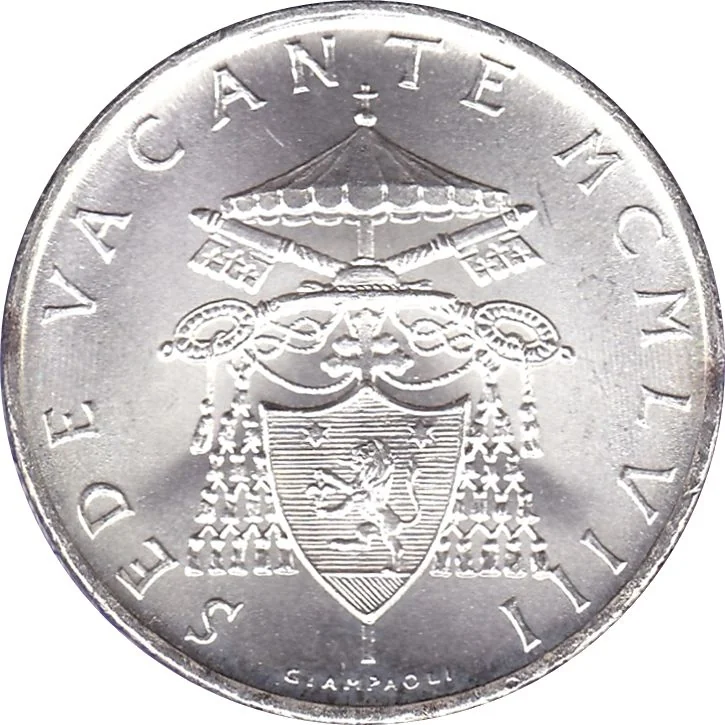
Obverse
Description:
Cardinal Benedetto Aloisi-Masella's coat of arms.
Inscription:
SEDE VACANTE MCMLVIII
GIAMPAOLI
GIAMPAOLI
Script: Latin
Engraver: Pietro Giampaoli
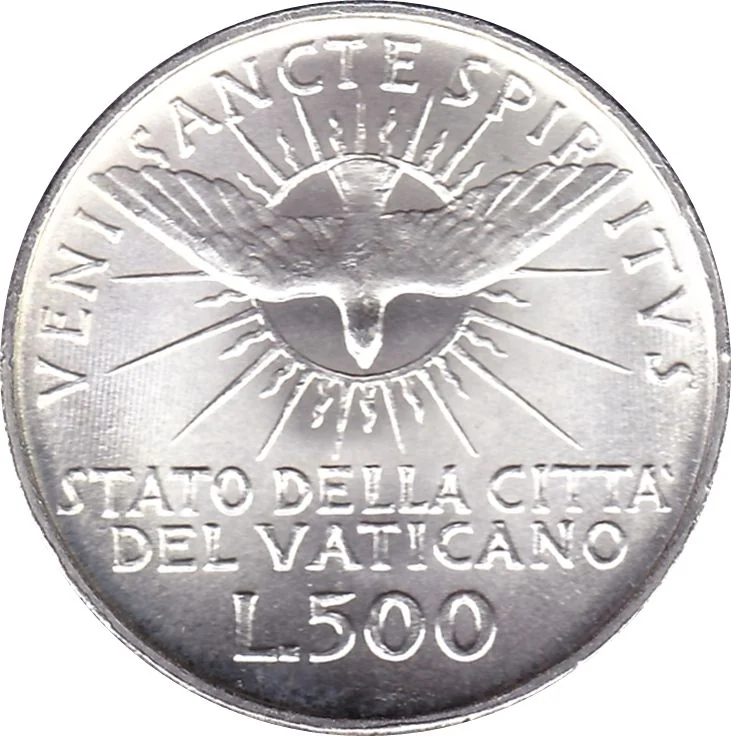
Reverse
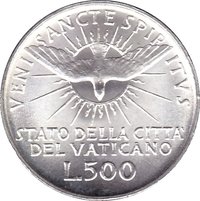
Description:
Dove splits sun over worth.
Inscription:
VENI SANCTE SPIRITVS
STATO DELLA CITTA'
DEL VATICANO
L.500
STATO DELLA CITTA'
DEL VATICANO
L.500
Translation:
Come, Holy Spirit
State of the City
of the Vatican
L.500
State of the City
of the Vatican
L.500
Script: Latin
Engraver: Pietro Giampaoli
Edge
Inscription in rilief
Legend:
STATO DELLA CITTA' DEL VATICANO
Translation:
State of the City of the Vatican
Language: Italian
Mints
| Name | Mark |
|---|---|
| Rome | — |
Mintings
| Year | Mint Mark | Mintage | Quality | Collection |
|---|---|---|---|---|
| 1958 | — | — |
Historical background
In 1958, Vatican City's currency situation was defined by its unique status as a sovereign city-state without a traditional, independent monetary system. It did not mint its own circulating lira coins or print its own banknotes for general use. Instead, its official currency was the Italian lira, a consequence of the 1929 Lateran Treaty that settled the "Roman Question" and established Vatican City's independence. This arrangement meant that the Italian lira was legal tender within the tiny state's walls, and daily economic life was conducted using the currency of its much larger neighbor.
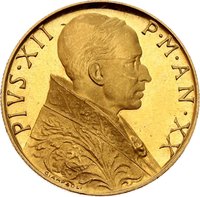
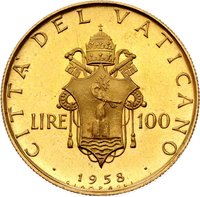
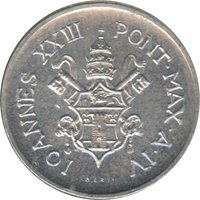
However, the Vatican did exercise a limited sovereign right to issue special coinage. Since 1929, it had minted its own distinct lira coins, but these were primarily numismatic and commemorative in nature, intended for collectors and ceremonial purposes rather than for everyday commerce. Struck in precious metals like silver and gold, their face value was far below their intrinsic metal value, making them unsuitable for circulation. These coins bore the image of the reigning pope, and with the death of Pope Pius XII in October 1958 and the subsequent conclave, a practical monetary consideration arose: the need to produce new coinage featuring the image of his successor, which would be Pope John XXIII.
Therefore, the backdrop of 1958 was one of monetary dependency intertwined with symbolic sovereignty. The Vatican's economy relied entirely on the Italian monetary system, while its own mint served as a tool of state identity, diplomatic gift-giving, and revenue from collectors. This hybrid system underscored the city-state's peculiar position: politically autonomous yet economically integrated into Italy, with its most tangible financial expression being commemorative coins that marked papal transitions rather than facilitating daily trade.
However, the Vatican did exercise a limited sovereign right to issue special coinage. Since 1929, it had minted its own distinct lira coins, but these were primarily numismatic and commemorative in nature, intended for collectors and ceremonial purposes rather than for everyday commerce. Struck in precious metals like silver and gold, their face value was far below their intrinsic metal value, making them unsuitable for circulation. These coins bore the image of the reigning pope, and with the death of Pope Pius XII in October 1958 and the subsequent conclave, a practical monetary consideration arose: the need to produce new coinage featuring the image of his successor, which would be Pope John XXIII.
Therefore, the backdrop of 1958 was one of monetary dependency intertwined with symbolic sovereignty. The Vatican's economy relied entirely on the Italian monetary system, while its own mint served as a tool of state identity, diplomatic gift-giving, and revenue from collectors. This hybrid system underscored the city-state's peculiar position: politically autonomous yet economically integrated into Italy, with its most tangible financial expression being commemorative coins that marked papal transitions rather than facilitating daily trade.
🌱 Fairly Common