

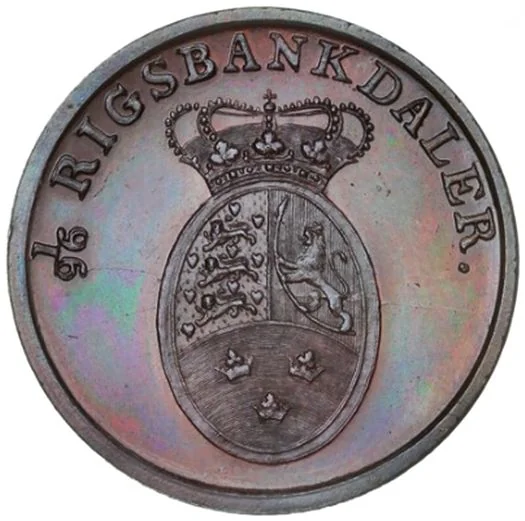
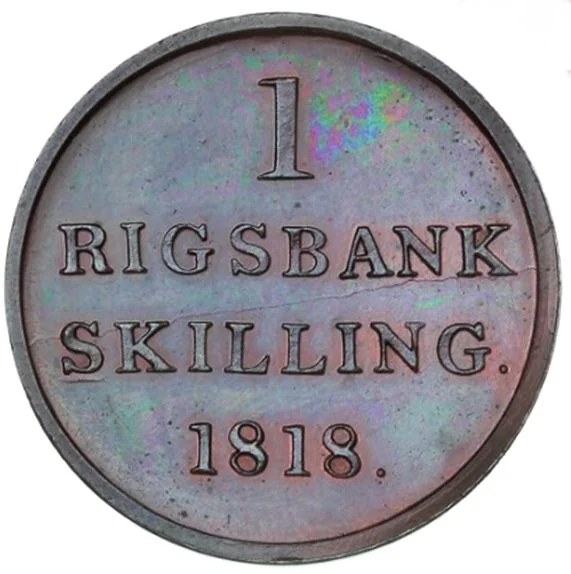
1 Rigsbankskilling – Denmark
Denmark

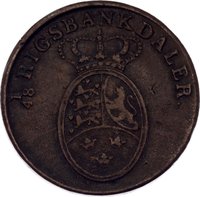
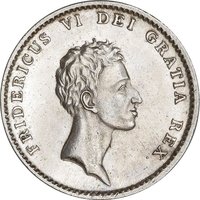
Obverse
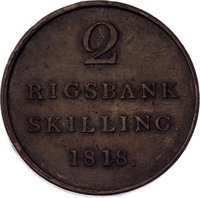
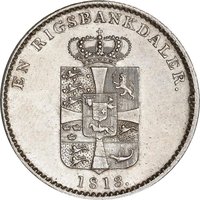
Reverse
Edge
Center Slanted Reeding Left
Categories
| Symbols> Coat of Arms |
Mints
| Name | Mark |
|---|---|
| Royal Danish Mint | — |
Mintings
| Year | Mint Mark | Mintage | Quality | Collection |
|---|---|---|---|---|
| 1818 | — | — |
Historical background
In 1818, Denmark was navigating a complex and precarious monetary landscape in the wake of the Napoleonic Wars and the state bankruptcy of 1813. The preceding years had seen rampant inflation due to excessive printing of paper money (kurantdaler) to finance the wars, leading to a severe loss of public confidence in the currency. To address this crisis, the government had introduced the Rigsbankdaler in 1813 as part of a comprehensive financial restructuring, but this new currency also quickly depreciated, failing to stabilize the economy.
The core problem was a severe shortage of specie (silver coins), as the paper money in circulation was not fully convertible. This created a dual-currency system where transactions were often conducted in both depreciated paper and valued silver, causing confusion and hindering trade. The state's finances were deeply strained by the burden of war debts and the loss of Norway in 1814, leaving the monetary authority with limited resources to restore stability and trust in the currency system.
Therefore, the currency situation in 1818 was one of fragile transition and ongoing crisis. The government was under significant pressure to establish a stable and unified monetary standard. This urgent need for reform would culminate in the Currency Act of 1818, which aimed to create a new silver-based currency, the rigsdaler, and formally tie the monetary system to a fixed silver standard, laying the crucial groundwork for future financial stability.
The core problem was a severe shortage of specie (silver coins), as the paper money in circulation was not fully convertible. This created a dual-currency system where transactions were often conducted in both depreciated paper and valued silver, causing confusion and hindering trade. The state's finances were deeply strained by the burden of war debts and the loss of Norway in 1814, leaving the monetary authority with limited resources to restore stability and trust in the currency system.
Therefore, the currency situation in 1818 was one of fragile transition and ongoing crisis. The government was under significant pressure to establish a stable and unified monetary standard. This urgent need for reform would culminate in the Currency Act of 1818, which aimed to create a new silver-based currency, the rigsdaler, and formally tie the monetary system to a fixed silver standard, laying the crucial groundwork for future financial stability.
Series: 1818 Denmark circulation coins
🌱 Fairly Common