

Denmark
Context
Years: 1813–1819
Issuer: Denmark 
Ruler: Frederick VI
Currency:
(1813—1854)
Subdivision: 6 Rigsdaler courant = 1 Rigsbankdaler
Demonetized: Yes
Material
References
KM: #Click to copy to clipboard683
Numista: #22803
Value
Bullion value: $36.17
Obverse
Description:
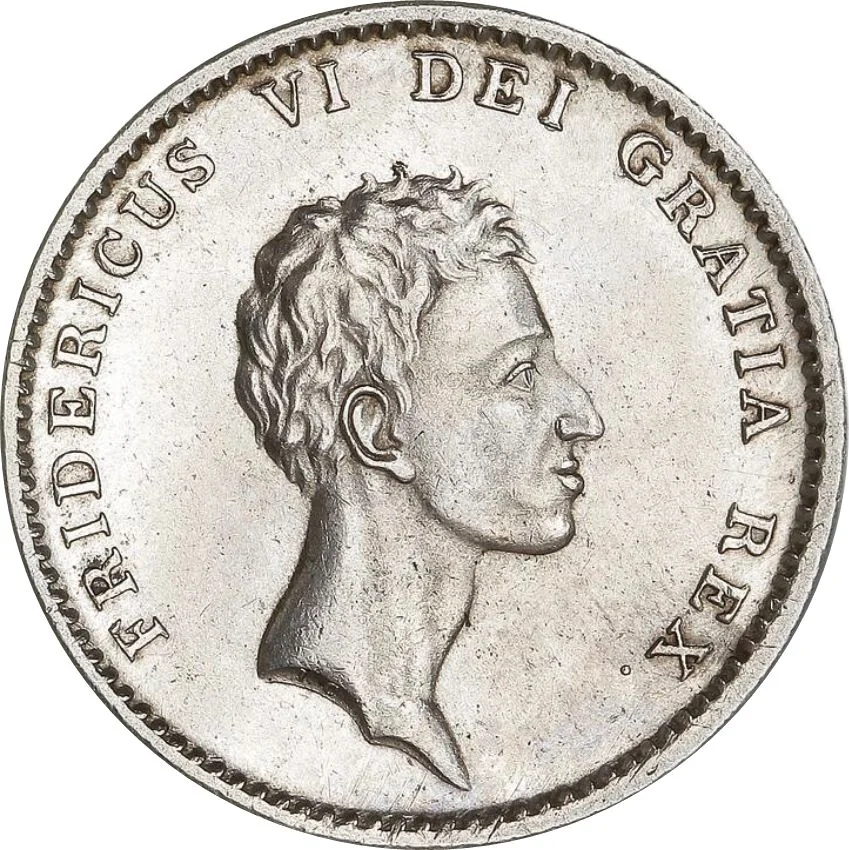
Bare head of Frederik VI facing right. Legend above. Engraver's initials on neck.
Inscription:
FRIDERICUS VI DEI GRATIA REX.
IC
IC
Translation:
FREDERICK VI BY THE GRACE OF GOD KING.
Script: Latin
Language: Latin
Engraver: Johannes Conradsen
Reverse
Description:
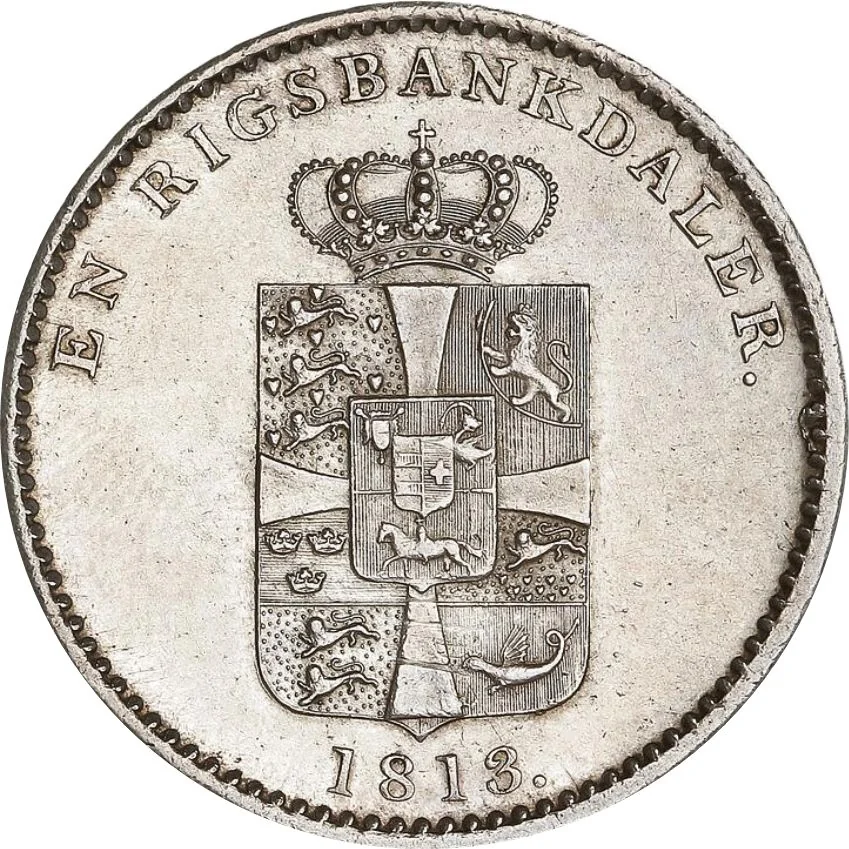
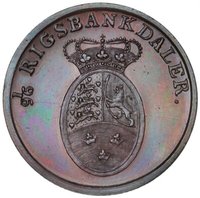
Shield with Danish arms. Value above; date and mintmaster initials below.
Inscription:
EN RIGSBANKDALER.
1813
1813
Script: Latin
Engraver: Johannes Conradsen
Edge
Mints
| Name | Mark |
|---|---|
| Altona, Schleswig-Holstein | — |
| Royal Danish Mint | — |
Mintings
| Year | Mint Mark | Mintage | Quality | Collection |
|---|---|---|---|---|
| 1813 | IC | — | ||
| 1813 | M | — | ||
| 1818 | IC; | — | ||
| 1819 | IC | — |
Historical background
In 1813, Denmark faced a profound currency crisis rooted in the devastating consequences of the Napoleonic Wars. The nation, allied with France, had suffered catastrophic losses, including the bombardment of Copenhagen in 1807 and the subsequent loss of its entire navy. This led to a crippling British naval blockade, which severed vital trade routes and plunged the Danish state into near bankruptcy. To finance the ongoing war, the government had resorted to excessive printing of paper money (the rigsdaler), leading to rampant inflation, a collapse in public confidence, and a severe devaluation of the currency.
In response, the state enacted the Currency Reforms of 1813 on January 5th, a drastic measure often called the "state bankruptcy." The old rigsdaler was declared invalid and replaced by a new currency, the rigsbankdaler. The conversion rate was severely unfavourable to holders of the old notes, effectively wiping out a large portion of domestic debt and savings. This was a deliberate policy to reset the financial system, but it came at a tremendous social cost, ruining many merchants and middle-class citizens who held paper assets.
The reform established the Rigsbank (a precursor to the National Bank) and aimed to restore stability by pegging the new currency to silver. However, confidence was slow to return, and the rigsbankdaler continued to struggle. The situation only began to truly stabilise after the end of the Napoleonic Wars in 1815 and with further monetary adjustments in the following decades. Thus, the 1813 crisis stands as a pivotal and traumatic event in Danish economic history, marking a forced transition from a war-inflated currency to a new, fragile monetary system.
In response, the state enacted the Currency Reforms of 1813 on January 5th, a drastic measure often called the "state bankruptcy." The old rigsdaler was declared invalid and replaced by a new currency, the rigsbankdaler. The conversion rate was severely unfavourable to holders of the old notes, effectively wiping out a large portion of domestic debt and savings. This was a deliberate policy to reset the financial system, but it came at a tremendous social cost, ruining many merchants and middle-class citizens who held paper assets.
The reform established the Rigsbank (a precursor to the National Bank) and aimed to restore stability by pegging the new currency to silver. However, confidence was slow to return, and the rigsbankdaler continued to struggle. The situation only began to truly stabilise after the end of the Napoleonic Wars in 1815 and with further monetary adjustments in the following decades. Thus, the 1813 crisis stands as a pivotal and traumatic event in Danish economic history, marking a forced transition from a war-inflated currency to a new, fragile monetary system.
💎 Very Rare