

1000 Pesos – Uruguay
Circulating commemorative coins
Commemoration: FAO
Uruguay
Obverse
Description:
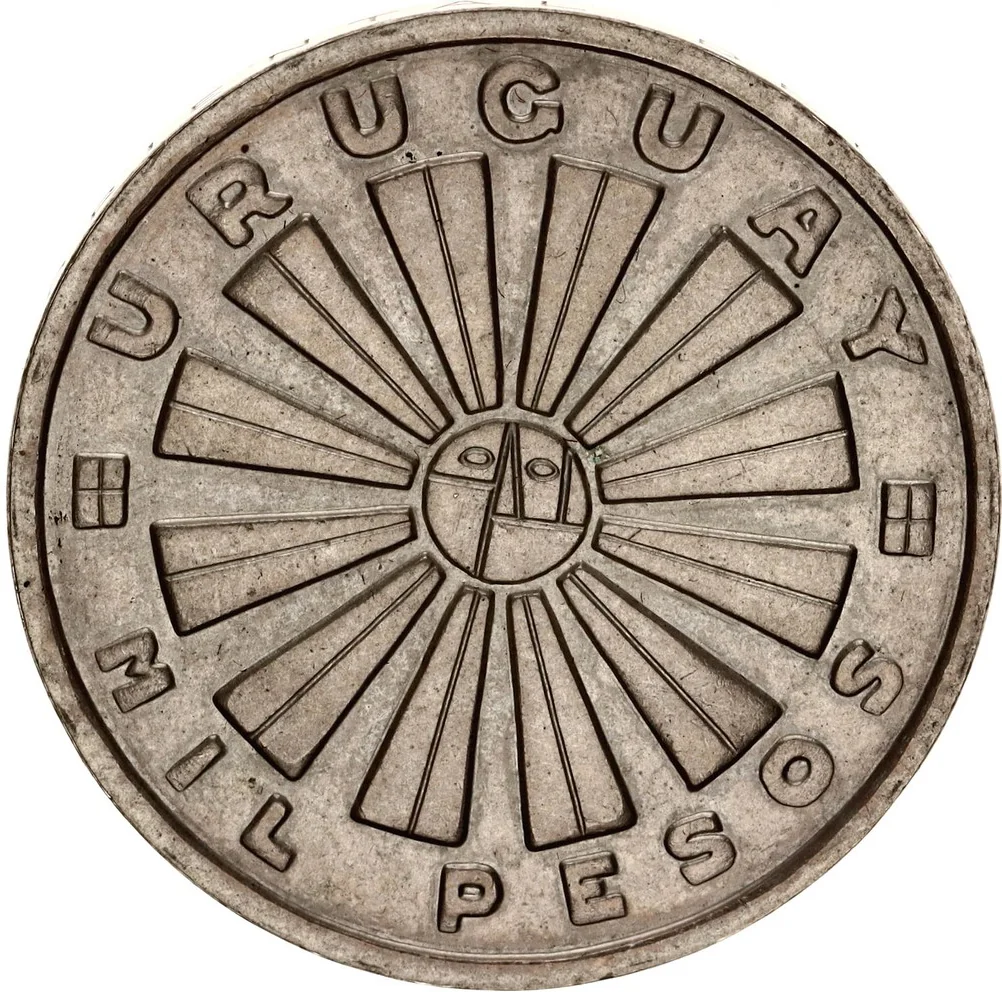
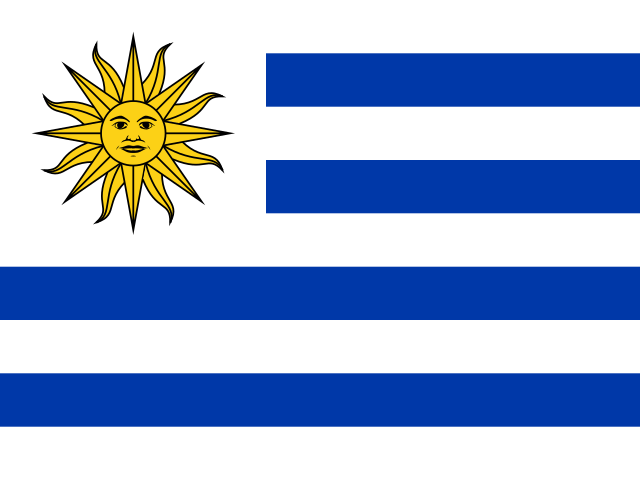
Stylized smiling sun
Inscription:
- URUGUAY -
MIL PESOS
MIL PESOS
Translation:
One Thousand Pesos
Script: Latin
Language: Spanish
Engraver: Francisco Matto Vilaró
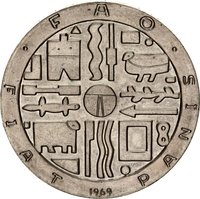
Reverse
Description:
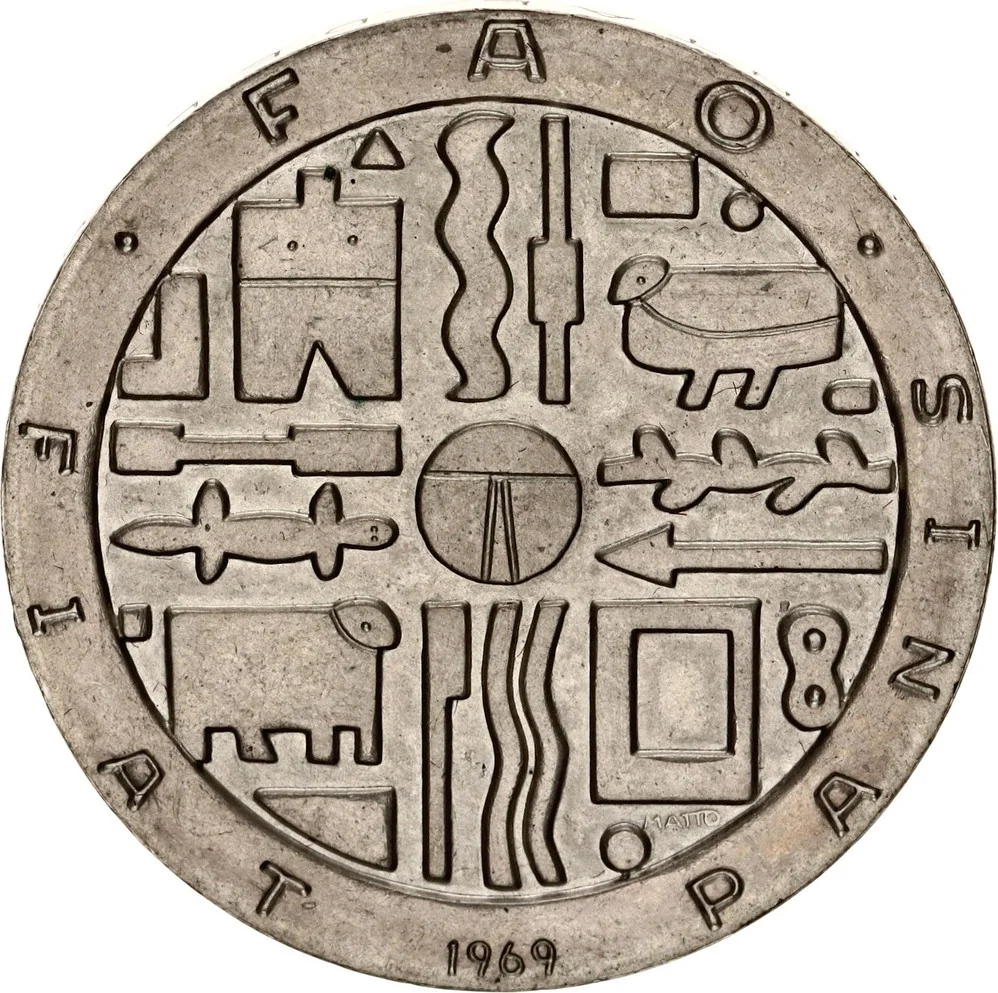
Stylized circle designs (see comments)
Inscription:
• F A O •
FIAT 1969 PANIS
FIAT 1969 PANIS
Translation:
Let there be bread 1969
Script: Latin
Language: Latin
Engraver: Francisco Matto Vilaró
Edge
Inscripted
Legend:
REPUBLICA ORIENTAL DEL URUGUAY So
Translation:
Eastern Republic of Uruguay
Language: Spanish
Categories
| Symbol> Sun |
| Organization> FAO |
Mints
| Name | Mark |
|---|---|
| Casa de Moneda de Chile | So |
Historical background
In 1969, Uruguay was in the midst of a prolonged period of economic stagnation and inflationary pressure known as the "crisis of the developmentalist model." The country's traditional export-led growth, reliant on wool and beef, had stagnated, while the ambitious import-substitution industrialization (ISI) policies of the 1950s and 1960s had failed to create a sustainable, efficient industrial base. This structural weakness was compounded by chronic fiscal deficits, largely financed by money creation from the Central Bank of Uruguay (BCU). Consequently, the Uruguayan peso was under persistent devaluation pressure, and inflation, though moderate by later Latin American standards, was a persistent concern, often exceeding 20% annually.
The currency situation was characterized by a complex and restrictive system of exchange controls, a legacy of efforts to manage balance of payments crises. Multiple exchange rates existed, with a preferential rate for essential imports and traditional exports, and a less favorable financial or "free" market rate for other transactions. This system created distortions, encouraged capital flight, and fueled a black market for dollars (mercado negro). The government of President Jorge Pacheco Areco, who took office in 1967, pursued a harsh stabilization program that included wage and price controls (congelación de precios y salarios), but these measures provided only temporary relief and did not address the underlying fiscal and structural issues.
By the end of the decade, the economic and currency instability was becoming intertwined with severe social and political unrest. The model of the "Switzerland of America" had definitively collapsed. The inability to achieve monetary stability, combined with falling real wages and rising social conflict, eroded confidence in institutions. This turbulent economic backdrop, marked by a weakening peso, inflationary financing, and cumbersome exchange controls, provided a key context for the rise of the Tupamaro guerrilla movement and set the stage for the severe economic shocks of the 1970s and the eventual military coup in 1973.
The currency situation was characterized by a complex and restrictive system of exchange controls, a legacy of efforts to manage balance of payments crises. Multiple exchange rates existed, with a preferential rate for essential imports and traditional exports, and a less favorable financial or "free" market rate for other transactions. This system created distortions, encouraged capital flight, and fueled a black market for dollars (mercado negro). The government of President Jorge Pacheco Areco, who took office in 1967, pursued a harsh stabilization program that included wage and price controls (congelación de precios y salarios), but these measures provided only temporary relief and did not address the underlying fiscal and structural issues.
By the end of the decade, the economic and currency instability was becoming intertwined with severe social and political unrest. The model of the "Switzerland of America" had definitively collapsed. The inability to achieve monetary stability, combined with falling real wages and rising social conflict, eroded confidence in institutions. This turbulent economic backdrop, marked by a weakening peso, inflationary financing, and cumbersome exchange controls, provided a key context for the rise of the Tupamaro guerrilla movement and set the stage for the severe economic shocks of the 1970s and the eventual military coup in 1973.
🌱 Common