

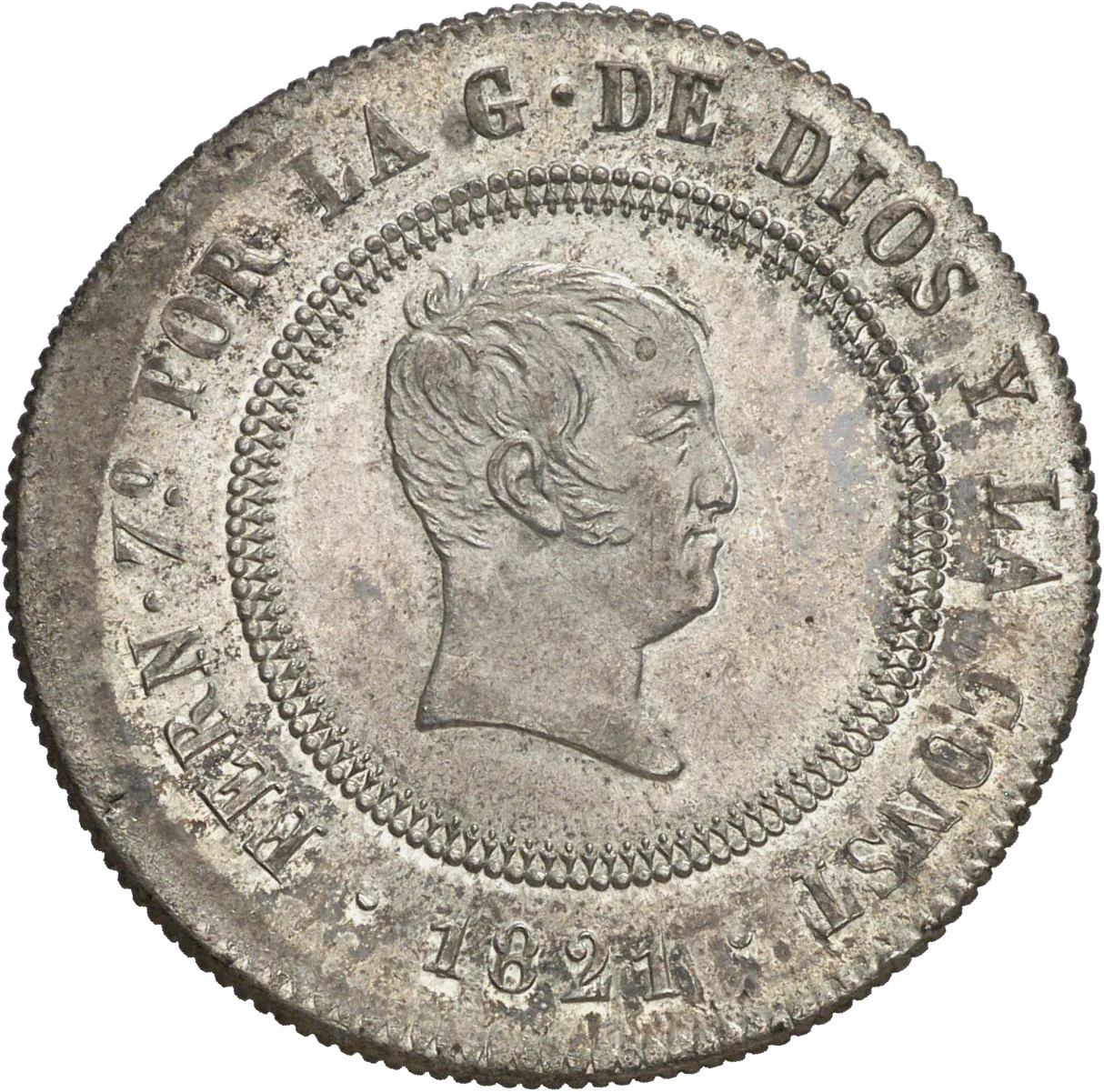
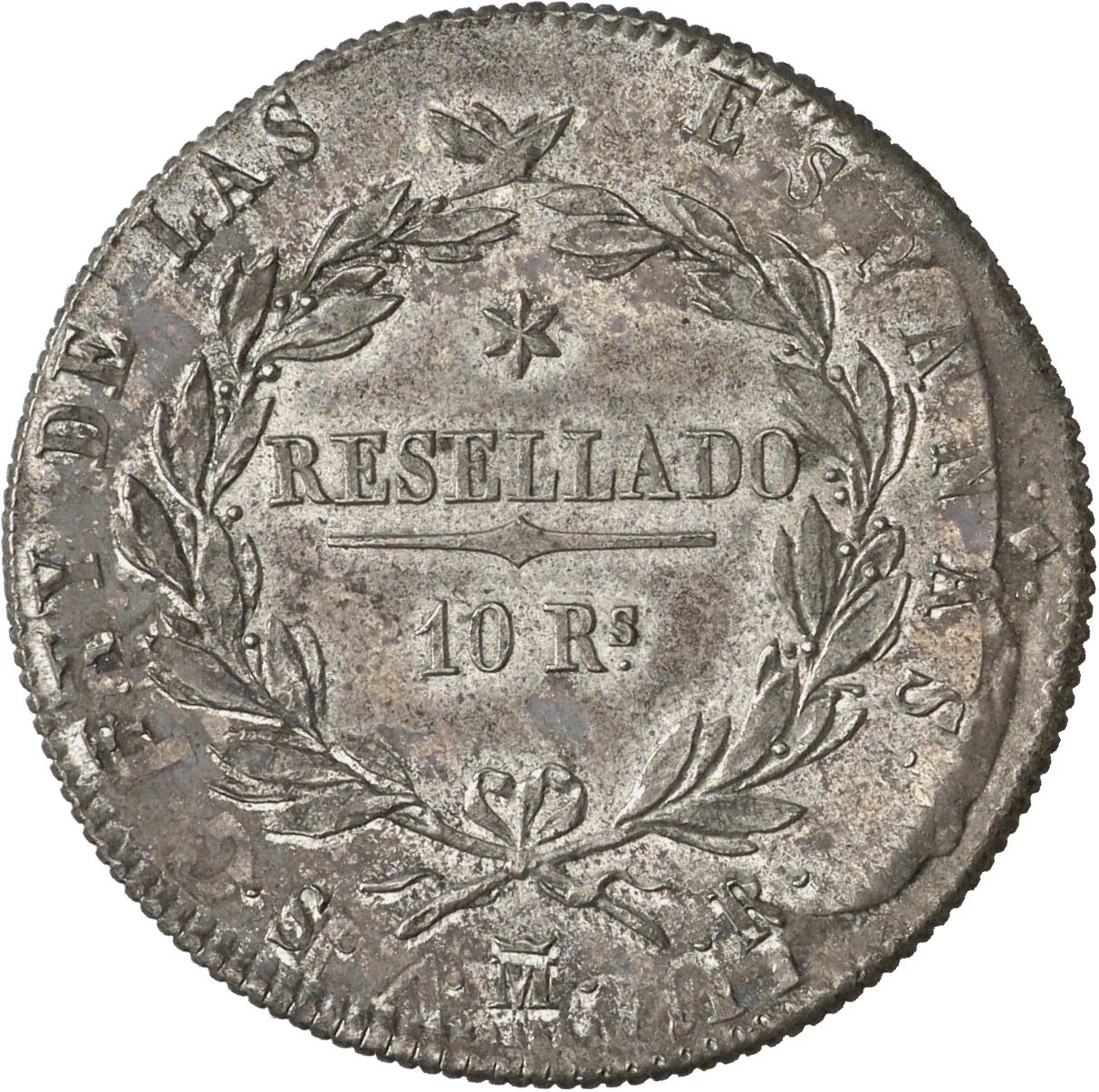
10 reales vellon – Spain
Add to wishlist
Spain
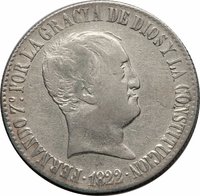
Obverse
Description:
King Fernando VII facing right in inner circle.
Inscription:
FERN · 7º. POR LA G · DE DIOS Y LA CONST
· 1821 ·
· 1821 ·
Translation:
FERDINAND 7TH. BY THE GRACE OF GOD AND THE CONSTITUTION
· 1821 ·
· 1821 ·
Script: Latin
Language: Spanish
Engraver: Félix Sagau y Dalmau de Galcerán
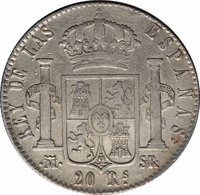
Reverse
Description:
Lettering with a border wreath.
Inscription:
REY DE LAS ESPAÑAS
RESELLADO
10 RS.
·S· ·M· ·R·
RESELLADO
10 RS.
·S· ·M· ·R·
Translation:
King of the Spains
Countermarked
10 Reales
·S· ·M· ·R·
Countermarked
10 Reales
·S· ·M· ·R·
Script: Latin
Language: Spanish
Engraver: Félix Sagau y Dalmau de Galcerán
Edge
Reeded
Mints
| Name | Mark |
|---|---|
| Bilbao | (BO) |
| Royal Mint of Madrid | (M) |
| Royal Mint of Seville | S |
| Santander | (SR) |
Mintings
| Year | Mint Mark | Mintage | Quality | Collection |
|---|---|---|---|---|
| 1821 | BO | — | ||
| 1821 | MSR | — | ||
| 1821 | SR | — | ||
| 1821 | SRD | — |
Historical background
In 1821, Spain's currency situation was a direct reflection of the profound political and economic turmoil engulfing the nation. The country was in the midst of the Trienio Liberal (1820-1823), a period of constitutional rule that followed a military uprising against the absolutist monarchy of Ferdinand VII. This political instability, coupled with the immense financial strain of losing most of its American colonies, created a fiscal crisis. The state treasury was effectively bankrupt, struggling to service a massive public debt accumulated from the Peninsular War against Napoleon and the ongoing colonial conflicts.
The monetary system itself was chaotic and fragmented. Circulation was dominated by a bewildering variety of coins, including not only official Spanish issues like the silver real and gold escudo, but also older, debased coins and even foreign currency from trade. Most critically, the government resorted to issuing vast quantities of paper money, known as vales reales (royal bonds). Originally introduced in 1780, these had depreciated drastically and were now virtually worthless, creating a severe loss of public confidence in any form of fiduciary currency. This led to widespread hoarding of precious metal coins, further contracting the money supply for everyday commerce.
Consequently, the Spanish economy suffered from rampant inflation, a crippling lack of credit, and severe monetary disarray. Different regions and cities often operated with different effective exchange rates, hampering internal trade. The situation was a vicious cycle: political weakness prevented decisive fiscal or monetary reform, while the currency chaos further undermined the economic stability needed to consolidate the liberal government. This precarious financial backdrop would contribute to the collapse of the Trienio Liberal just two years later, when foreign intervention restored Ferdinand VII to absolute power.
The monetary system itself was chaotic and fragmented. Circulation was dominated by a bewildering variety of coins, including not only official Spanish issues like the silver real and gold escudo, but also older, debased coins and even foreign currency from trade. Most critically, the government resorted to issuing vast quantities of paper money, known as vales reales (royal bonds). Originally introduced in 1780, these had depreciated drastically and were now virtually worthless, creating a severe loss of public confidence in any form of fiduciary currency. This led to widespread hoarding of precious metal coins, further contracting the money supply for everyday commerce.
Consequently, the Spanish economy suffered from rampant inflation, a crippling lack of credit, and severe monetary disarray. Different regions and cities often operated with different effective exchange rates, hampering internal trade. The situation was a vicious cycle: political weakness prevented decisive fiscal or monetary reform, while the currency chaos further undermined the economic stability needed to consolidate the liberal government. This precarious financial backdrop would contribute to the collapse of the Trienio Liberal just two years later, when foreign intervention restored Ferdinand VII to absolute power.
⭐ Somewhat Rare