

20 kroner (First Norwegian Railroad) – Norway
Add to wishlist
Circulating commemorative coins
Commemoration: 150th Anniversary of First Norwegian Railroad
Norway
Context
Material
References
KM: #
Numista: #23233
Value
Exchange value: 20 NOK
Inflation-adjusted value: 33.71 NOK
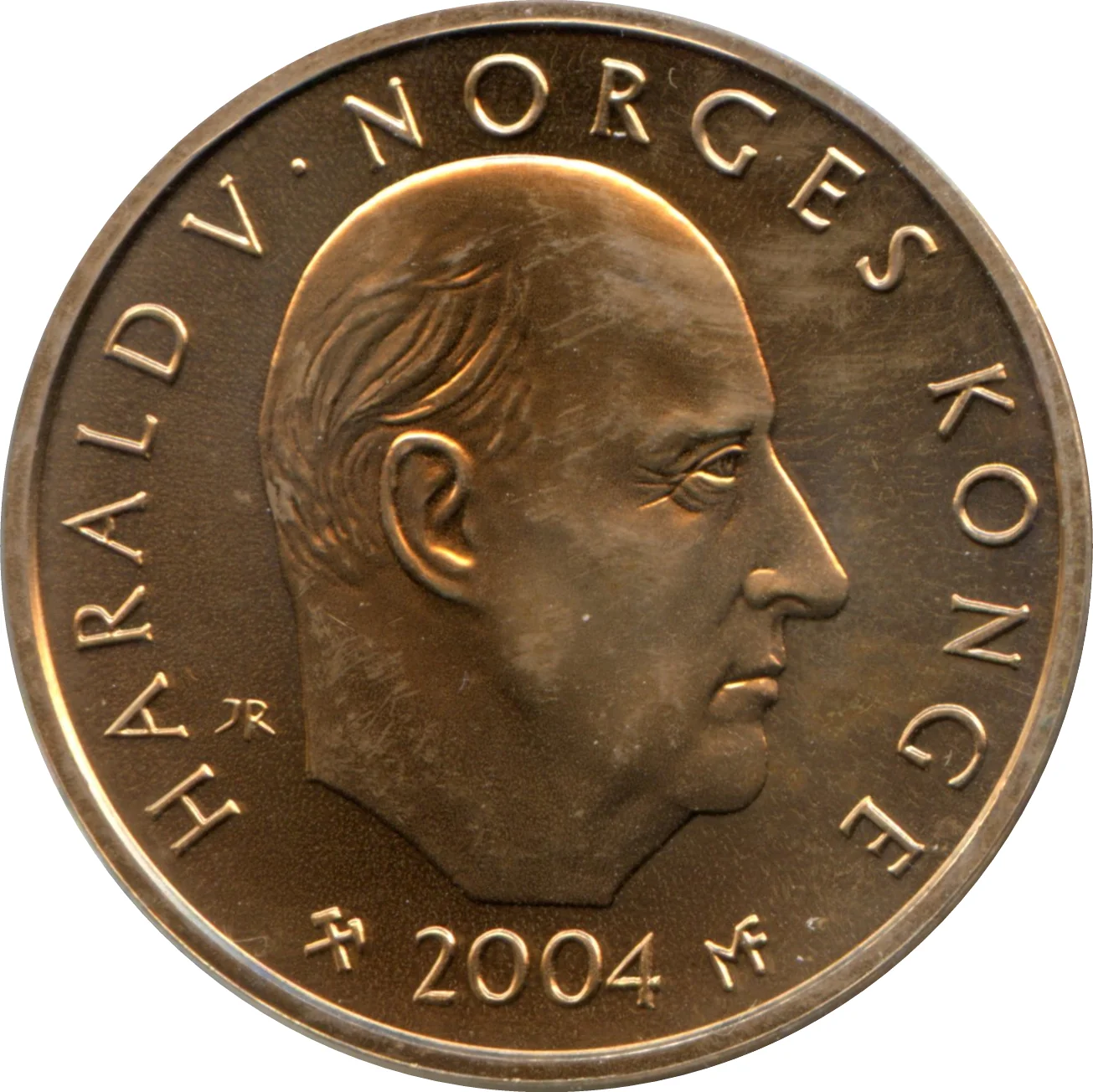
Obverse
Description:
King Harald V bust facing right. Engraver's initials behind bust. Surrounding inscription. Mintmark, date, and mintmaster's initials below. Solid rim ring.
Inscription:
HARALD V · NORGES KONGE
IAR
⚒ 2004 MF
IAR
⚒ 2004 MF
Translation:
Harald V, Norway's King
IAR
Dedicated 2004 MF
IAR
Dedicated 2004 MF
Script: Latin
Engraver: Ingrid Austlid Rise
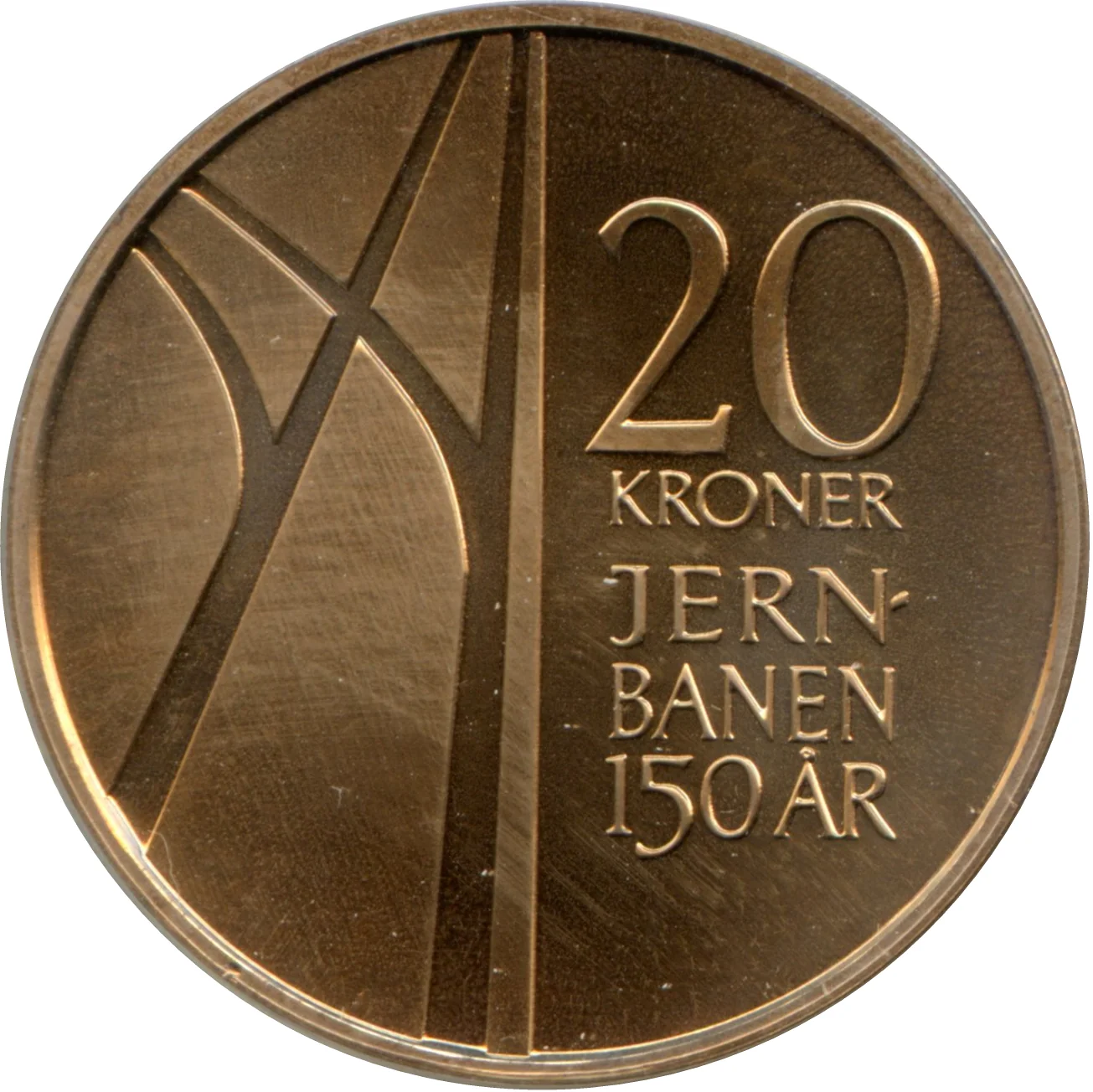
Reverse
Description:
Left: railway junction. Right: value and five-line inscription. Solid ring on rim.
Inscription:
20
KRONER
JERN-
BANEN
150 ÅR
KRONER
JERN-
BANEN
150 ÅR
Translation:
TWENTY KRONER RAILWAY 150 YEARS
Script: Latin
Engraver: Ingrid Austlid Rise
Edge
Plain
Mints
| Name | Mark |
|---|---|
| Norwegian Mint | — |
Mintings
| Year | Mint Mark | Mintage | Quality | Collection |
|---|---|---|---|---|
| 2004 | — | 459,450 | ||
| 2004 | — | 10,000 | BU | |
| 2004 | — | 8,900 | Proof |
Historical background
In 2004, Norway's currency situation was fundamentally shaped by the nation's vast oil and gas wealth, managed through the Government Pension Fund Global. The Norwegian krone (NOK) was, and remains, a freely floating currency, with its value influenced by global energy prices, interest rate differentials, and capital flows related to the sovereign wealth fund's operations. Norges Bank, the central bank, operated an inflation-targeting regime, having formally adopted it in 2001, with a primary goal of maintaining low and stable inflation, which was around 1% at the start of 2004.
The period was characterized by a strong krone, partly driven by high oil prices, which averaged well over $30 per barrel throughout the year. This strength presented a classic challenge for the Norwegian economy: while it boosted national income and purchasing power, it simultaneously exerted pressure on the non-oil tradable sector, particularly traditional exports like manufacturing and fisheries. This phenomenon, often referred to as "Dutch disease," was a constant concern for policymakers, who balanced monetary policy to control inflation without exacerbating the krone's appreciation.
Overall, 2004 represented a period of stability and economic confidence for Norway. Norges Bank cautiously raised its key policy rate during the year, moving from 1.75% to 2.0% by December, in response to solid domestic growth and underlying inflationary pressures, despite the krone's strength. The currency regime was well-established, providing a buffer against external shocks while ensuring that the immense petroleum revenues were largely saved and invested abroad, insulating the domestic economy from excessive volatility and overheating.
The period was characterized by a strong krone, partly driven by high oil prices, which averaged well over $30 per barrel throughout the year. This strength presented a classic challenge for the Norwegian economy: while it boosted national income and purchasing power, it simultaneously exerted pressure on the non-oil tradable sector, particularly traditional exports like manufacturing and fisheries. This phenomenon, often referred to as "Dutch disease," was a constant concern for policymakers, who balanced monetary policy to control inflation without exacerbating the krone's appreciation.
Overall, 2004 represented a period of stability and economic confidence for Norway. Norges Bank cautiously raised its key policy rate during the year, moving from 1.75% to 2.0% by December, in response to solid domestic growth and underlying inflationary pressures, despite the krone's strength. The currency regime was well-established, providing a buffer against external shocks while ensuring that the immense petroleum revenues were largely saved and invested abroad, insulating the domestic economy from excessive volatility and overheating.
🌱 Fairly Common