

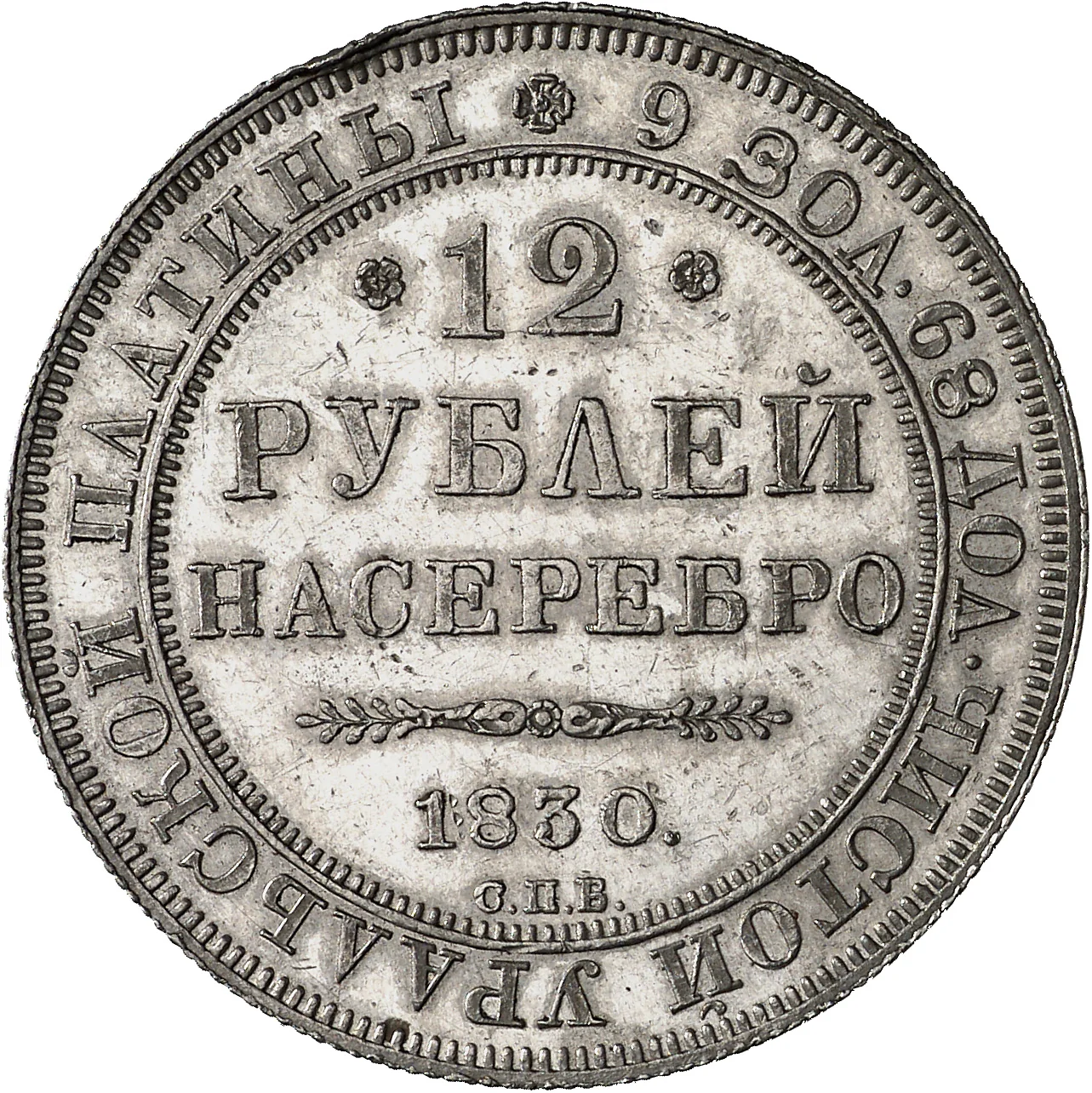
12 Rubles – Russian Empire
Russia
Context
Years: 1830–1845
Country: Russia 
Issuer: Russian Empire
Ruler: Nicholas I
Currency:
(1700—1917)
Demonetized: Yes
Total mintage: 3,500
Material
References
Numista: #23169
Value
Bullion value: $0.00
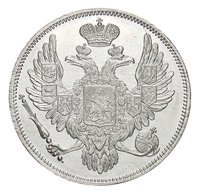
Obverse
Description:
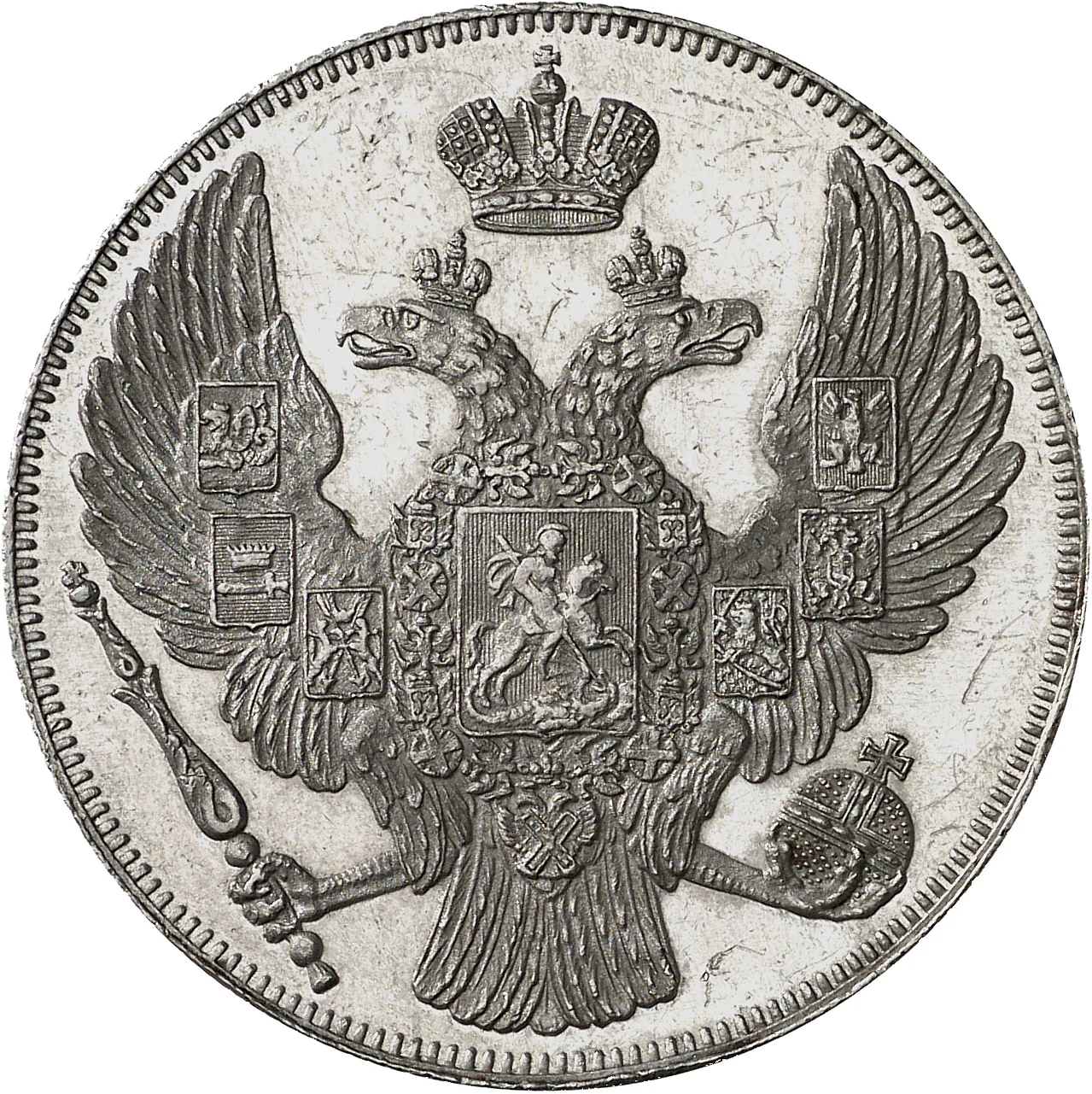
Crowned double-headed eagle.
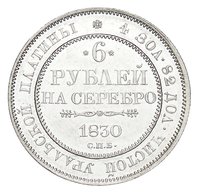
Reverse
Edge
Reeded
Mints
| Name | Mark |
|---|---|
| Saint Petersburg | — |
Mintings
| Year | Mint Mark | Mintage | Quality | Collection |
|---|---|---|---|---|
| 1830 | СПБ | 119 | BU | |
| 1831 | СПБ | 1,463 | BU | |
| 1832 | СПБ | 1,102 | BU | |
| 1833 | СПБ | 255 | BU | |
| 1834 | СПБ | 11 | BU | |
| 1834 | СПБ | 11 | Proof | |
| 1835 | СПБ | 127 | BU | |
| 1836 | СПБ | 11 | BU | |
| 1836 | СПБ | 11 | Proof | |
| 1837 | СПБ | 53 | BU | |
| 1838 | СПБ | 12 | BU | |
| 1839 | СПБ | 2 | BU | |
| 1840 | СПБ | 1 | BU | |
| 1841 | СПБ | 75 | BU | |
| 1842 | СПБ | 115 | BU | |
| 1843 | СПБ | 122 | BU | |
| 1844 | СПБ | 4 | BU | |
| 1844 | СПБ | 4 | Proof | |
| 1845 | СПБ | 2 | BU |
Historical background
By 1830, the currency system of the Russian Empire was defined by the persistent legacy of the Assignat Ruble, a paper currency first introduced in 1768 to finance wars. For decades, the state had printed assignats without sufficient metallic backing, leading to severe depreciation and a dual-currency system. The silver ruble and the paper assignat ruble circulated simultaneously but at different values, with the assignat trading at a significant discount to its silver counterpart. This created chronic economic instability, complicated trade, and undermined public confidence in the financial system.
Recognizing the crisis, Tsar Nicholas I's government, under Minister of Finance Yegor Kankrin, was actively working toward reform. The pivotal Manifesto of July 1, 1839 was in its preparatory stages, which would soon establish the silver ruble as the official monetary unit and introduce a new paper currency—the Credit Ruble—fully convertible into silver. Thus, 1830 represents a critical juncture: the empire was still burdened by the discredited assignat system, but was on the cusp of a major monetary transformation aimed at restoring stability and state credit.
The underlying economic reality was one of a primarily agrarian society with limited hard currency (silver and gold) reserves. The state's finances were heavily strained by military expenditures, including the recent 1828-1829 war with the Ottoman Empire and the ongoing suppression of the 1830-1831 Polish Uprising. Consequently, while the theoretical plan for a silver-based standard was clear, the practical challenge in 1830 remained amassing enough precious metal to guarantee the future convertibility and ensuring the reform would hold during a period of geopolitical tension.
Recognizing the crisis, Tsar Nicholas I's government, under Minister of Finance Yegor Kankrin, was actively working toward reform. The pivotal Manifesto of July 1, 1839 was in its preparatory stages, which would soon establish the silver ruble as the official monetary unit and introduce a new paper currency—the Credit Ruble—fully convertible into silver. Thus, 1830 represents a critical juncture: the empire was still burdened by the discredited assignat system, but was on the cusp of a major monetary transformation aimed at restoring stability and state credit.
The underlying economic reality was one of a primarily agrarian society with limited hard currency (silver and gold) reserves. The state's finances were heavily strained by military expenditures, including the recent 1828-1829 war with the Ottoman Empire and the ongoing suppression of the 1830-1831 Polish Uprising. Consequently, while the theoretical plan for a silver-based standard was clear, the practical challenge in 1830 remained amassing enough precious metal to guarantee the future convertibility and ensuring the reform would hold during a period of geopolitical tension.
💎 Extremely Rare