

6 Rubles – Russian Empire
Russia
Context
Years: 1829–1845
Country: Russia 
Issuer: Russian Empire
Ruler: Nicholas I
Currency:
(1700—1917)
Demonetized: Yes
Total mintage: 14,858
Material
References
Numista: #23168
Value
Bullion value: $0.00
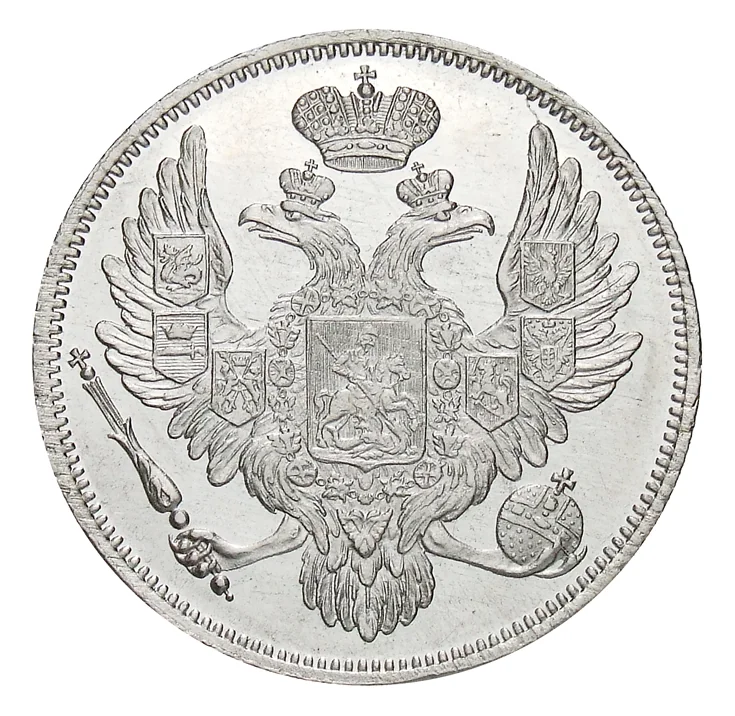
Obverse
Description:
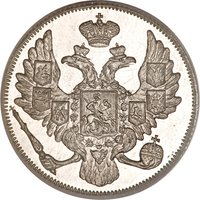
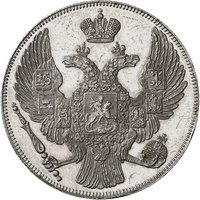
Crowned double-headed eagle.
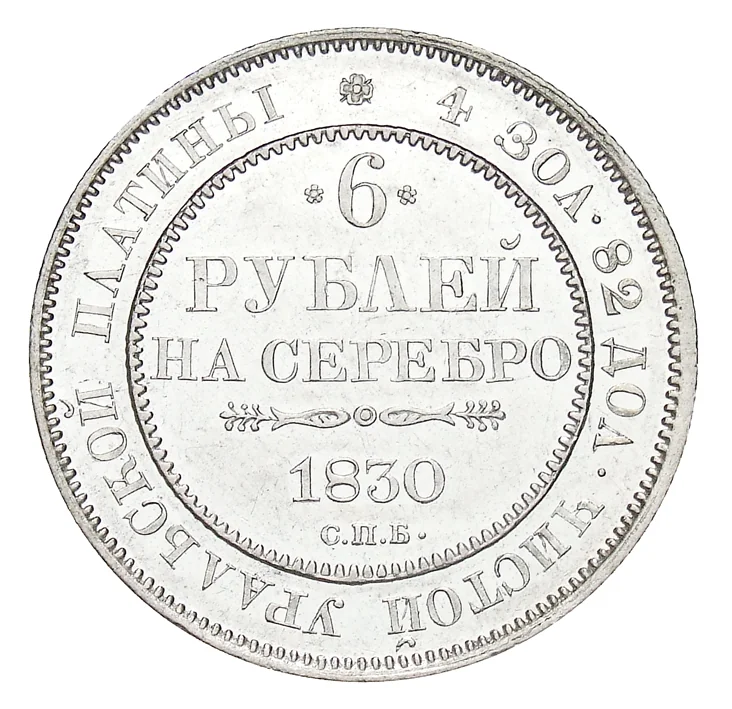
Reverse
Edge
Reeded
Mintings
| Year | Mint Mark | Mintage | Quality | Collection |
|---|---|---|---|---|
| 1829 | СПБ | 828 | BU | |
| 1830 | СПБ | 8,610 | BU | |
| 1830 | СПБ | — | Proof | |
| 1831 | СПБ | 2,784 | BU | |
| 1832 | СПБ | 1,502 | BU | |
| 1833 | СПБ | 302 | BU | |
| 1834 | СПБ | 11 | BU | |
| 1835 | СПБ | 107 | BU | |
| 1836 | СПБ | 11 | BU | |
| 1836 | СПБ | 11 | Proof | |
| 1837 | СПБ | 253 | BU | |
| 1838 | СПБ | 12 | BU | |
| 1839 | СПБ | 2 | BU | |
| 1840 | СПБ | 1 | BU | |
| 1841 | СПБ | 170 | BU | |
| 1842 | СПБ | 121 | BU | |
| 1843 | СПБ | 127 | BU | |
| 1844 | СПБ | 4 | BU | |
| 1845 | СПБ | 2 | BU |
Historical background
In 1829, the currency system of the Russian Empire was defined by the silver standard, formally established by the monetary reform of Count Egor Kankrin in 1839-1843, but whose foundational principles were already being implemented in the preceding decade. The state was grappling with the severe legacy of paper money (assignats), which had been issued heavily to finance the Napoleonic Wars and had depreciated significantly against silver. By the late 1820s, a dual system existed: transactions, especially in international trade and state finance, were conducted in silver rubles, while the depreciated assignats remained in widespread daily circulation among the populace, creating a complex and unstable economic environment.
The primary challenge was the fluctuating and unfavorable exchange rate between the silver ruble and the assignat ruble. In 1829, one silver ruble was worth approximately 3.75 rubles in assignats. This discrepancy caused confusion, hampered commerce, and strained the state budget, as revenues and expenditures had to be constantly calculated across two de facto separate currencies. The government, under Kankrin's fiscally conservative Ministry of Finance, was actively working to stabilize the currency by accumulating a silver reserve and cautiously reducing the volume of assignats in circulation, laying the groundwork for the future full reform.
Thus, the currency situation in 1829 was one of transition and constraint. The empire was moving deliberately, if slowly, toward the stability of a hard metallic currency, but remained burdened by the inflationary paper money of its past. This interim period was characterized by monetary duality, which presented significant administrative and commercial challenges, while the state's persistent efforts to amass precious metals reflected its commitment to eventually establishing a unified and stable monetary system anchored to silver.
The primary challenge was the fluctuating and unfavorable exchange rate between the silver ruble and the assignat ruble. In 1829, one silver ruble was worth approximately 3.75 rubles in assignats. This discrepancy caused confusion, hampered commerce, and strained the state budget, as revenues and expenditures had to be constantly calculated across two de facto separate currencies. The government, under Kankrin's fiscally conservative Ministry of Finance, was actively working to stabilize the currency by accumulating a silver reserve and cautiously reducing the volume of assignats in circulation, laying the groundwork for the future full reform.
Thus, the currency situation in 1829 was one of transition and constraint. The empire was moving deliberately, if slowly, toward the stability of a hard metallic currency, but remained burdened by the inflationary paper money of its past. This interim period was characterized by monetary duality, which presented significant administrative and commercial challenges, while the state's persistent efforts to amass precious metals reflected its commitment to eventually establishing a unified and stable monetary system anchored to silver.
💎 Extremely Rare