

50 Cents – East Africa
Context
Years: 1911–1919
Issuer: East Africa
Ruler: George V
Currency:
(1906—1920)
Demonetized: Yes
Total mintage: 790,000
Material
References
KM: #Click to copy to clipboard9
Numista: #22618
Value
Bullion value: $13.31
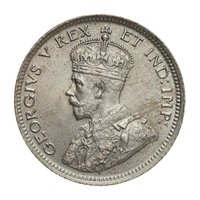
Obverse
Description:
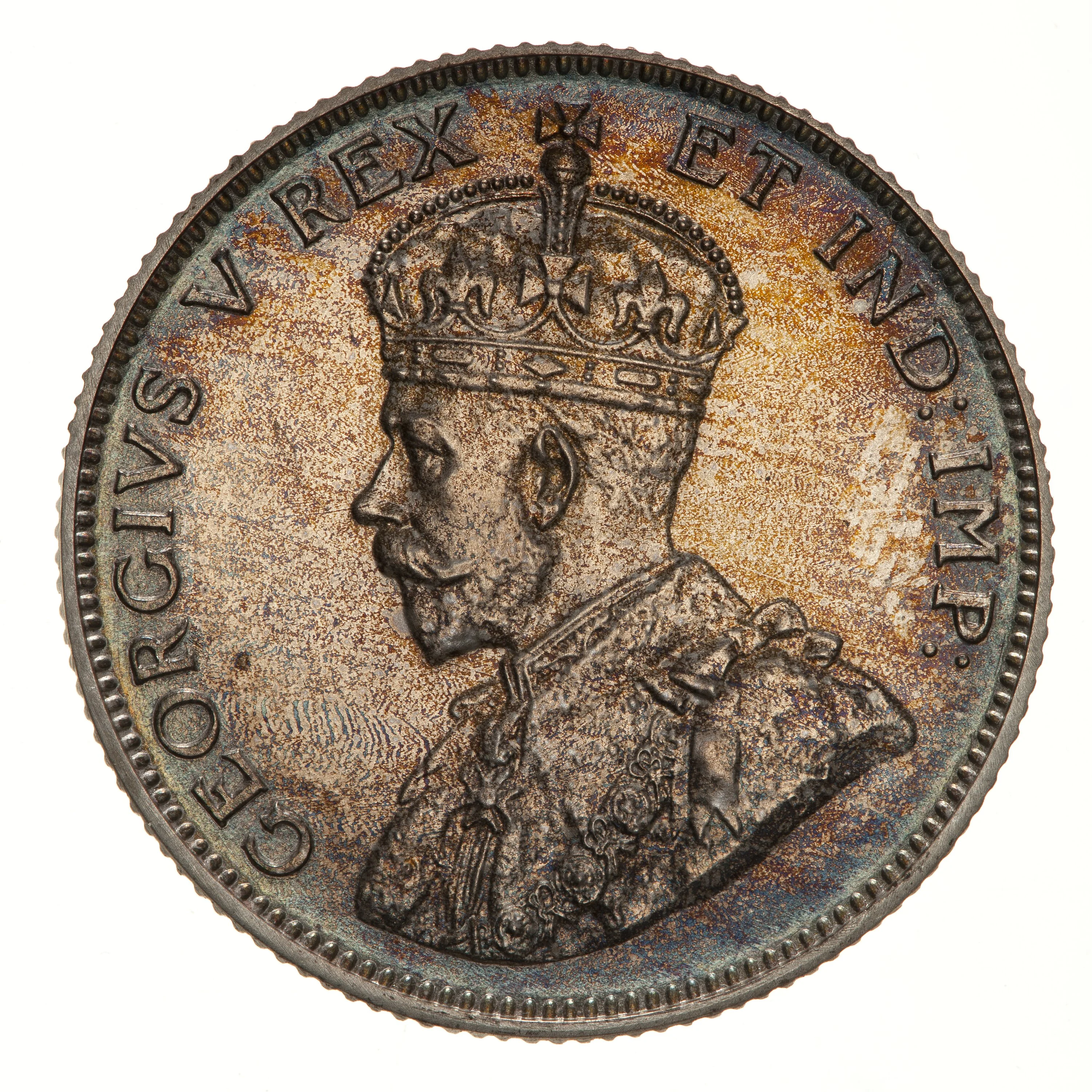
George V left-facing crowned bust with legend.
Inscription:
GEORGIVS V REX ET IND: IMP.
Script: Latin
Engraver: Edgar Bertram MacKennal
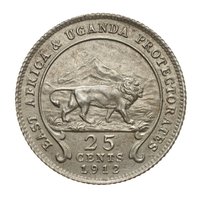
Reverse
Description:
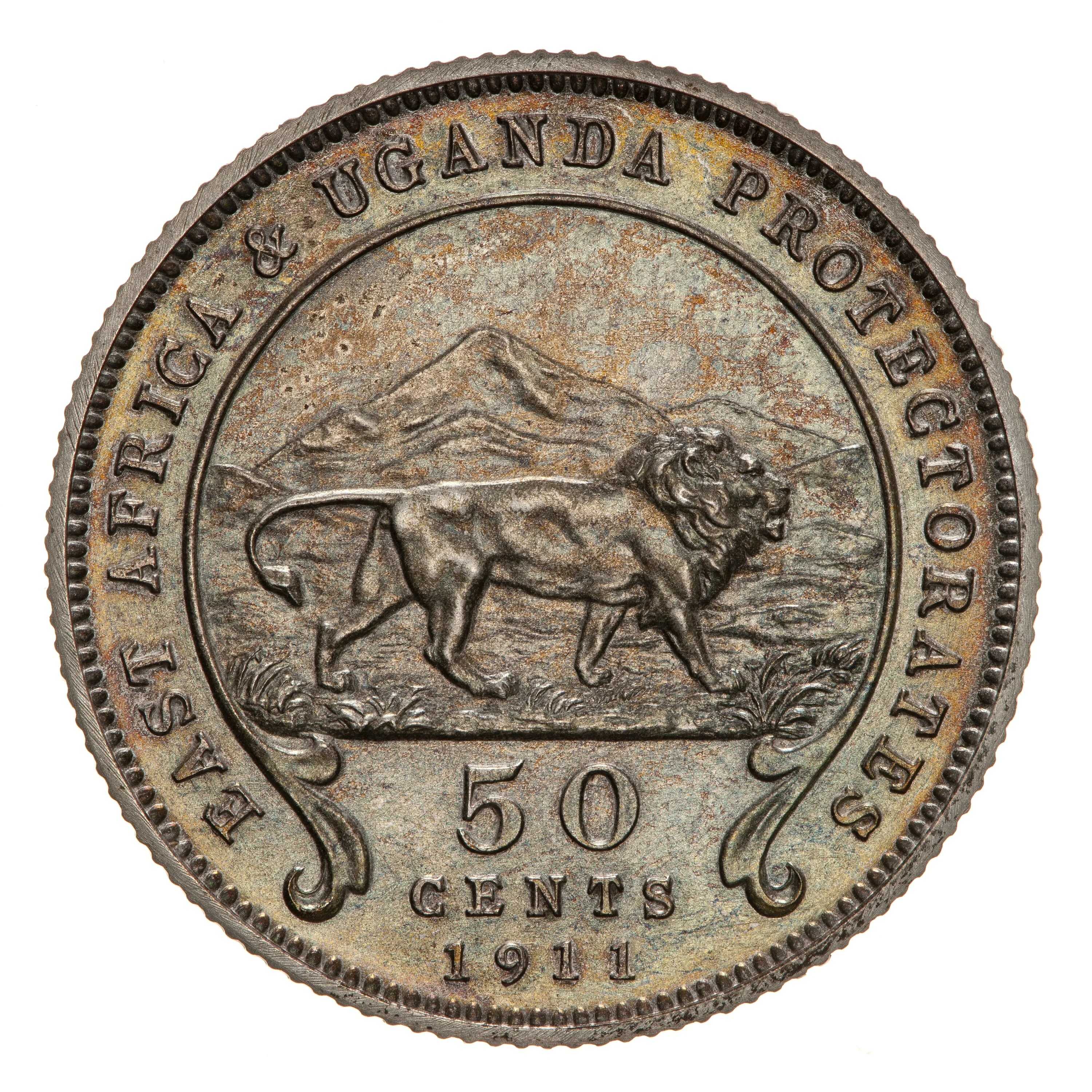
Lion walking right with mountains behind. Denomination and date below.
Inscription:
EAST AFRICA & UGANDA PROTECTORATES
50
CENTS
1912
50
CENTS
1912
Script: Latin
Edge
Reeded
Mints
| Name | Mark |
|---|---|
| Royal Mint (Tower Hill) | — |
| Heaton and Sons / The Mint Birmingham | H |
Mintings
Historical background
In 1911, East Africa's currency situation was a complex mosaic directly reflecting the region's colonial partition. The British East Africa Protectorate (modern Kenya) and the Uganda Protectorate were under the monetary authority of the rupee, administered by the East African Currency Board established in 1905. This Indian rupee was the dominant legal tender, a legacy of British imperial trade routes and administration, though barter and traditional currencies like cowrie shells persisted in remote areas. Meanwhile, German East Africa (modern Tanzania, Rwanda, Burundi) operated on the German East African rupie, a distinct silver-based currency tied to the German mark.
This fragmented system created significant commercial friction. Trade across colonial borders required constant exchange between rupees and rupies, with fluctuating values causing uncertainty. Furthermore, within British territories, the Indian rupee was unpopular with European settlers and traders who found its value too high for everyday local transactions and who agitated for a decimalized currency tied to sterling. The German rupie, conversely, faced issues of depreciation and was soon to be replaced (in 1912) by the hela, a precursor to the East African shilling.
Underlying these European-imposed systems was a vibrant and resilient indigenous economy that often operated outside colonial monetary control. A diversity of traditional currencies—including cattle, cloth (merikani), iron hoes, and copper wire—remained essential for local and regional trade, particularly inland. Thus, the monetary landscape of 1911 East Africa was one of overlapping and competing systems: official colonial currencies facilitating imperial extraction and settler trade, coexisting with deep-rooted pre-colonial networks of value that sustained the majority of the African population.
This fragmented system created significant commercial friction. Trade across colonial borders required constant exchange between rupees and rupies, with fluctuating values causing uncertainty. Furthermore, within British territories, the Indian rupee was unpopular with European settlers and traders who found its value too high for everyday local transactions and who agitated for a decimalized currency tied to sterling. The German rupie, conversely, faced issues of depreciation and was soon to be replaced (in 1912) by the hela, a precursor to the East African shilling.
Underlying these European-imposed systems was a vibrant and resilient indigenous economy that often operated outside colonial monetary control. A diversity of traditional currencies—including cattle, cloth (merikani), iron hoes, and copper wire—remained essential for local and regional trade, particularly inland. Thus, the monetary landscape of 1911 East Africa was one of overlapping and competing systems: official colonial currencies facilitating imperial extraction and settler trade, coexisting with deep-rooted pre-colonial networks of value that sustained the majority of the African population.
🌟 Limited