

25 Cents – East Africa
Context
Years: 1912–1918
Issuer: East Africa
Ruler: George V
Currency:
(1906—1920)
Demonetized: Yes
Total mintage: 600,000
Material
References
KM: #Click to copy to clipboard10
Numista: #12031
Value
Bullion value: $6.66
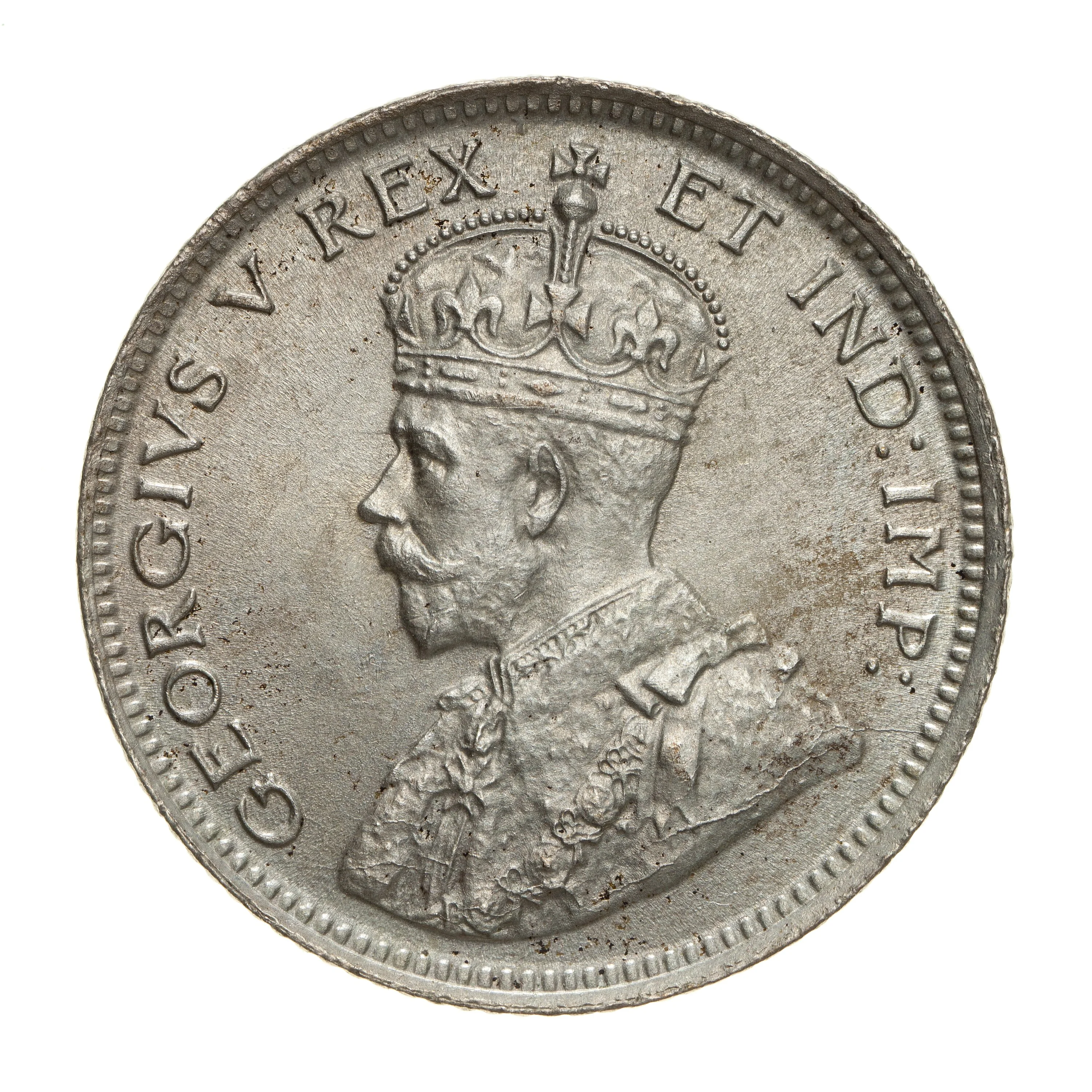
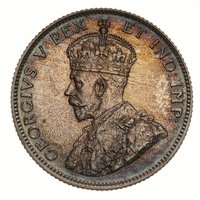
Obverse
Description:
King George V, crowned, facing left.
Inscription:
GEORGIVS V REX ET IND:IMP:
B.M.
B.M.
Translation:
George V King and Emperor of India:
B.M.
B.M.
Script: Latin
Language: Latin
Engraver: Edgar Bertram MacKennal
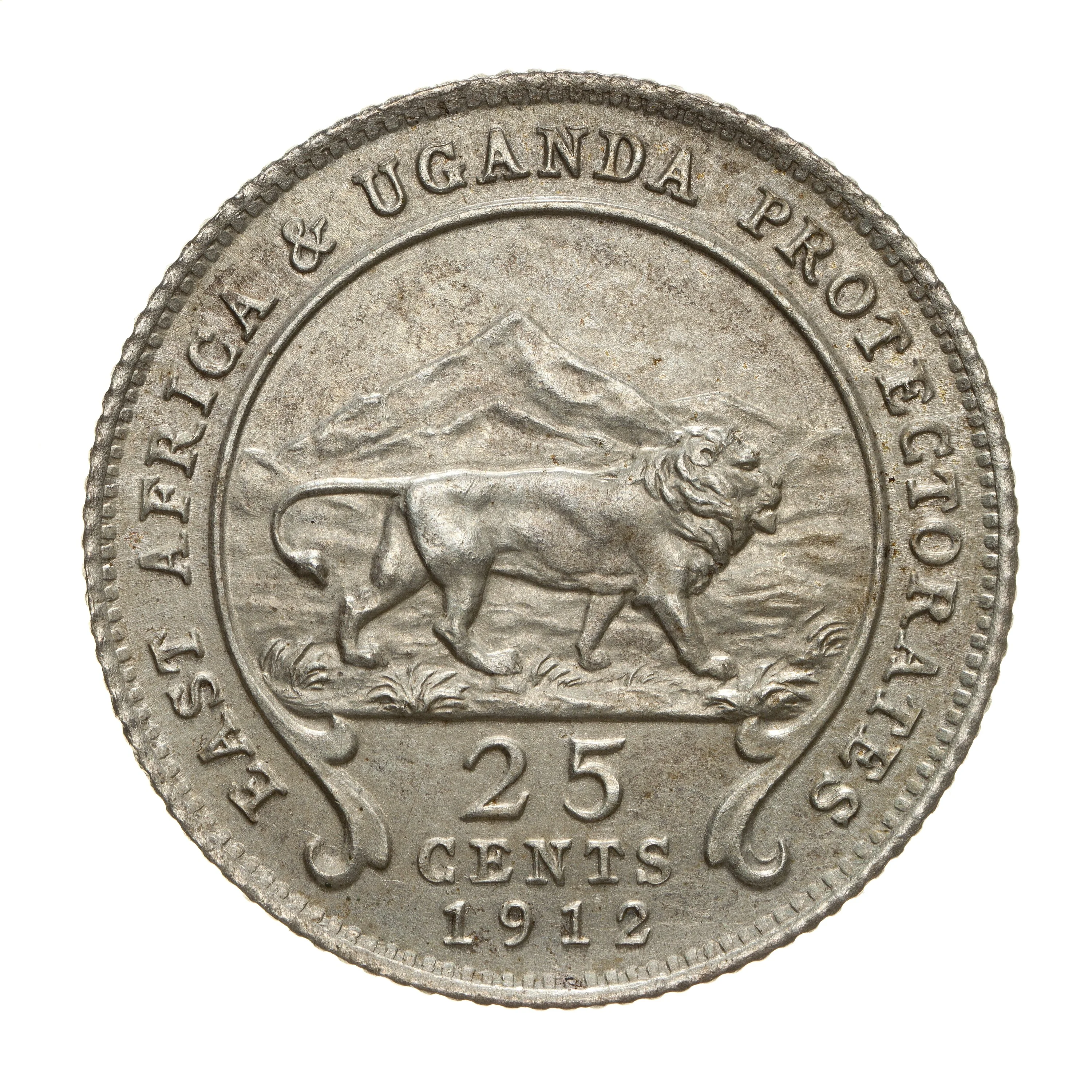
Reverse
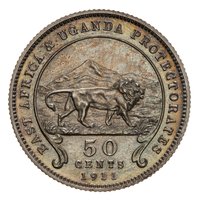
Description:
Lion walking toward mountains.
Inscription:
EAST AFRICA & UGANDA PROTECTORATES
25
CENTS
1913
25
CENTS
1913
Script: Latin
Edge
Milled
Mints
| Name | Mark |
|---|---|
| Royal Mint (Tower Hill) | — |
| Heaton and Sons / The Mint Birmingham | H |
Mintings
Historical background
In 1912, the currency situation in East Africa was a complex mosaic shaped by colonial competition and pre-existing trade networks. The region was divided between British, German, and Italian spheres of influence, each imposing its own monetary system. The British East Africa Protectorate (present-day Kenya) and the Uganda Protectorate used the East African rupee, introduced in 1906 to replace the Indian rupee and the Maria Theresa thaler. Meanwhile, German East Africa (present-day Tanzania, Rwanda, Burundi) operated on the German East African rupie, a silver-based currency tied to the German mark. In the Ethiopian Empire, the Maria Theresa thaler remained a dominant trade coin alongside a debased local currency, while the Italian colony of Somaliland used the Italian lira.
Despite these colonial boundaries, older currencies persisted in circulation, creating a practical, multi-currency environment, especially in border regions and trade hubs. The Maria Theresa thaler, minted in Austria but valued for its consistent silver content, remained a trusted medium for long-distance and caravan trade across the interior. Indian rupees and cowrie shells also still circulated in certain areas, reflecting the region's deep connections to Indian Ocean trade. This monetary plurality often complicated commerce, requiring merchants and colonial administrations to constantly calculate exchange rates between silver-based and gold-standard currencies.
The underlying tension was between a colonial desire for monetary control to facilitate taxation and administration, and the economic realities of a region with deeply ingrained, pre-colonial trade practices. The British, in particular, were already contemplating a shift from the silver rupee to a gold-based currency to align with the sterling system and simplify imperial trade, a change that would culminate in the introduction of the East African shilling in 1920. Thus, 1912 represents a transitional period where the imposed colonial monetary structures were not yet fully entrenched, coexisting with and competing against resilient indigenous and regional currency systems.
Despite these colonial boundaries, older currencies persisted in circulation, creating a practical, multi-currency environment, especially in border regions and trade hubs. The Maria Theresa thaler, minted in Austria but valued for its consistent silver content, remained a trusted medium for long-distance and caravan trade across the interior. Indian rupees and cowrie shells also still circulated in certain areas, reflecting the region's deep connections to Indian Ocean trade. This monetary plurality often complicated commerce, requiring merchants and colonial administrations to constantly calculate exchange rates between silver-based and gold-standard currencies.
The underlying tension was between a colonial desire for monetary control to facilitate taxation and administration, and the economic realities of a region with deeply ingrained, pre-colonial trade practices. The British, in particular, were already contemplating a shift from the silver rupee to a gold-based currency to align with the sterling system and simplify imperial trade, a change that would culminate in the introduction of the East African shilling in 1920. Thus, 1912 represents a transitional period where the imposed colonial monetary structures were not yet fully entrenched, coexisting with and competing against resilient indigenous and regional currency systems.
🌟 Limited