

1 Cent – East Africa
Context
Years: 1909–1910
Issuer: East Africa
Ruler: Edward VII
Currency:
(1906—1920)
Demonetized: Yes
Total mintage: 31,000,000
Material
Diameter: 22.2 mm
Weight: 2.92 g
Thickness: 1 mm
Shape: Round with a round hole
Composition: Copper-nickel
Technique: Milled
Alignment: Medal alignment
flip
References
KM: #Click to copy to clipboard5a
Numista: #7538
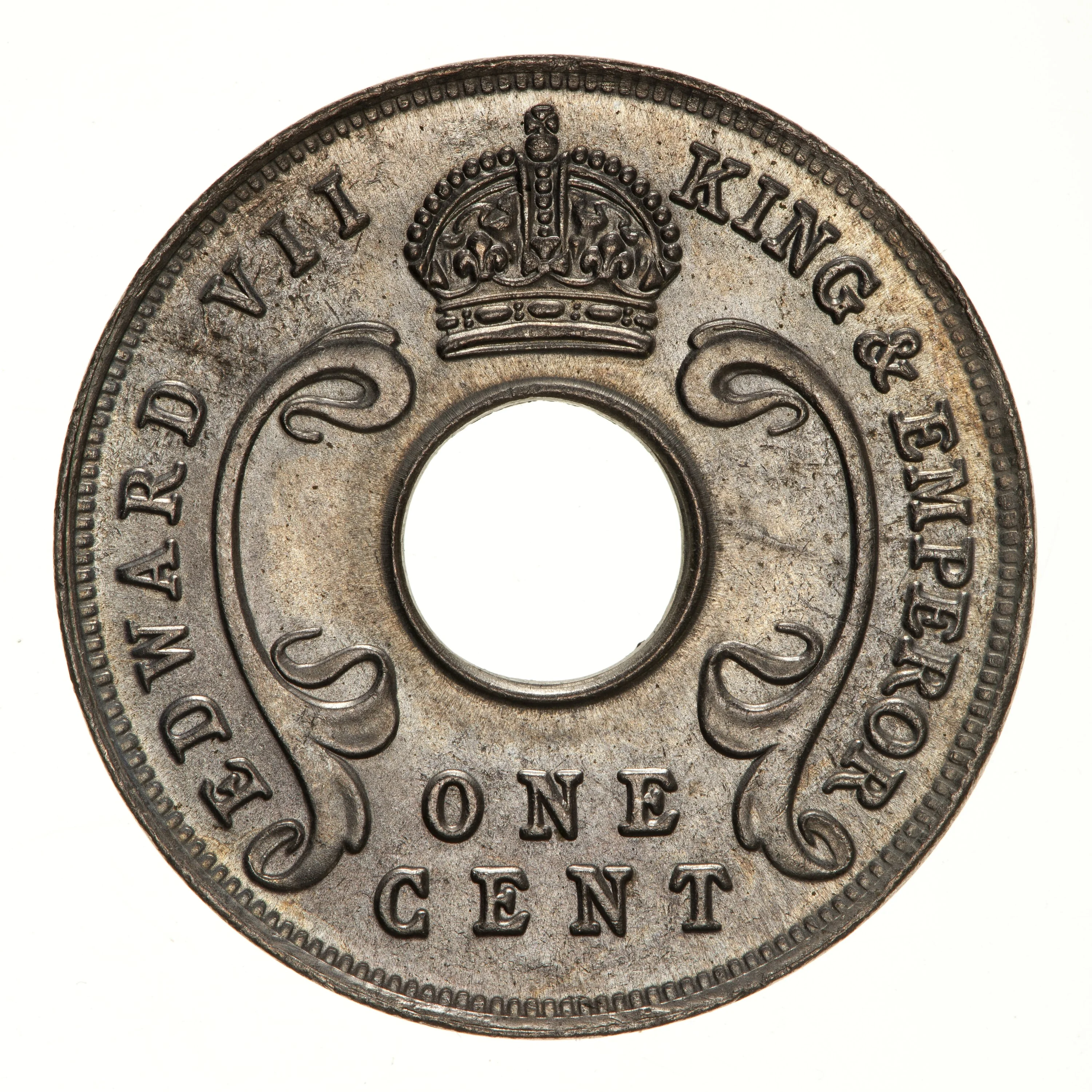
Obverse
Description:
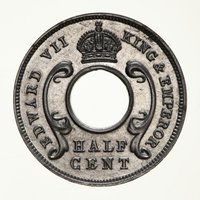
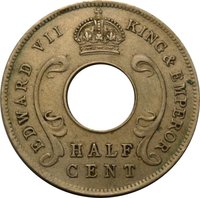
Central hole separates crown and value, encircled by legend.
Inscription:
EDWARD VII KING & EMPEROR
ONE
CENT
ONE
CENT
Script: Latin
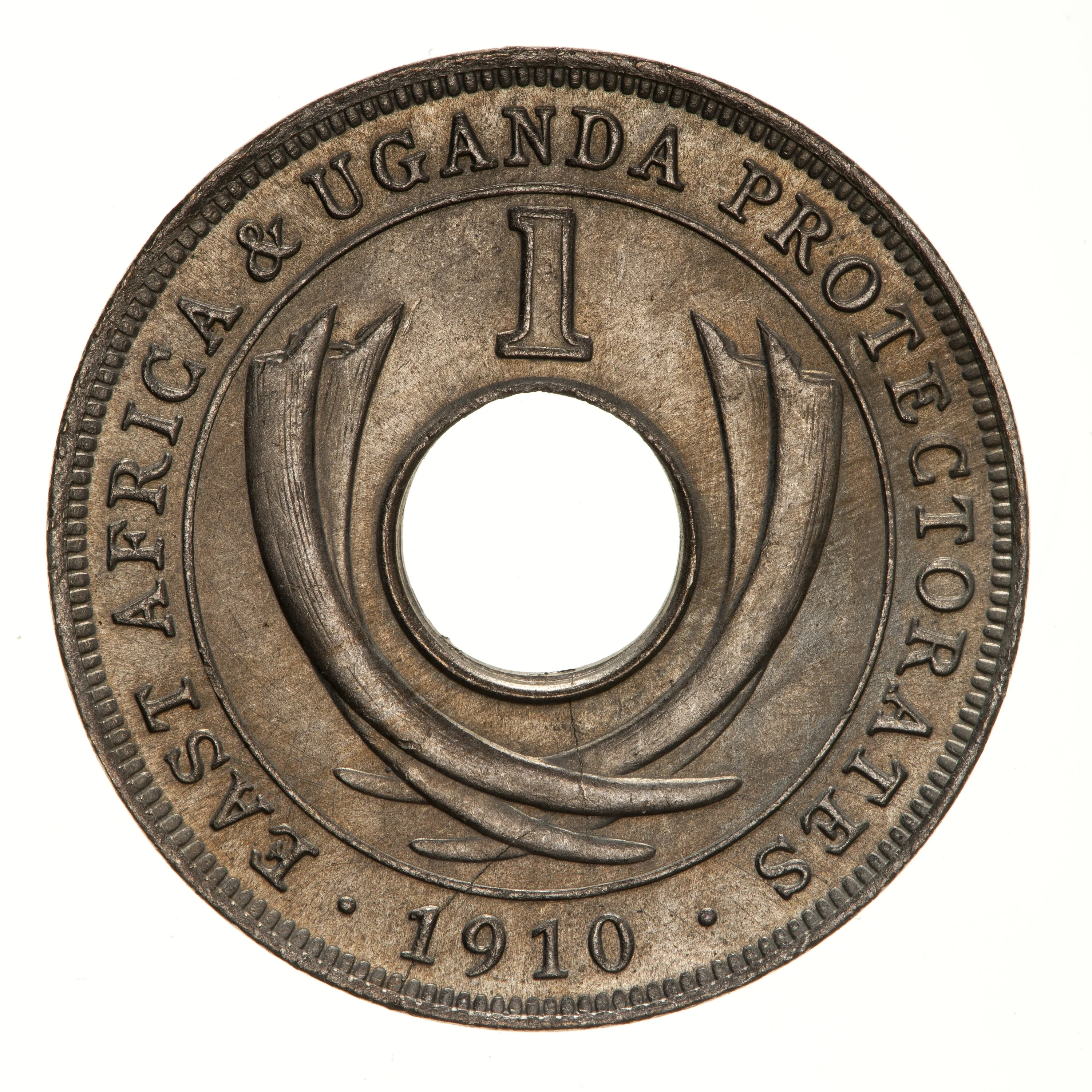
Reverse
Description:
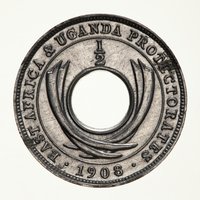
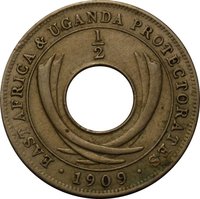
Curved tusks frame the central opening.
Inscription:
EAST AFRICA & UGANDA PROTECTORATES
1
1910
1
1910
Script: Latin
Edge
Plain
Mints
| Name | Mark |
|---|---|
| Royal Mint (Tower Hill) | — |
Mintings
| Year | Mint Mark | Mintage | Quality | Collection |
|---|---|---|---|---|
| 1909 | — | 25,000,000 | ||
| 1910 | — | 6,000,000 |
Historical background
In 1909, the currency situation in East Africa was a complex tapestry of competing imperial systems and local practices, dominated by the British and German colonial powers. The region was not a unified monetary zone; instead, the currency in circulation depended entirely on the colonial authority. In British East Africa (present-day Kenya and Uganda), the official currency was the Indian Rupee, a legacy of the British India administration that initially governed the area. This was supplemented by the East African Florin (introduced in 1906), an early but short-lived attempt to create a distinct currency, and by barter trade in many interior regions.
Simultaneously, in German East Africa (present-day Tanzania, Rwanda, Burundi), the German East African Rupie was the official currency. This silver-based coinage was tied to the German Mark but was minted specifically for the colony. Both the British and German systems existed in tension with a thriving circulation of older, trusted currencies, most notably the Maria Theresa Thaler. This large silver coin remained a preferred medium for long-distance and high-value trade, especially in the interior and with Arab merchants along the coast, due to its consistent silver content and wide recognition beyond colonial borders.
This fragmented monetary landscape created significant challenges for regional trade and economic development. Exchange rates between the Indian Rupee, German Rupie, and Thaler were fluctuating and often problematic for merchants operating across colonial boundaries. The situation was further complicated by a chronic shortage of small change, leading to the continued use of cowrie shells and other commodity monies in local markets. Consequently, 1909 represented a period of transition and instability, with colonial governments seeking to impose monetary order and extract economic value, while indigenous economies and regional trade networks adapted to and resisted these imposed systems.
Simultaneously, in German East Africa (present-day Tanzania, Rwanda, Burundi), the German East African Rupie was the official currency. This silver-based coinage was tied to the German Mark but was minted specifically for the colony. Both the British and German systems existed in tension with a thriving circulation of older, trusted currencies, most notably the Maria Theresa Thaler. This large silver coin remained a preferred medium for long-distance and high-value trade, especially in the interior and with Arab merchants along the coast, due to its consistent silver content and wide recognition beyond colonial borders.
This fragmented monetary landscape created significant challenges for regional trade and economic development. Exchange rates between the Indian Rupee, German Rupie, and Thaler were fluctuating and often problematic for merchants operating across colonial boundaries. The situation was further complicated by a chronic shortage of small change, leading to the continued use of cowrie shells and other commodity monies in local markets. Consequently, 1909 represented a period of transition and instability, with colonial governments seeking to impose monetary order and extract economic value, while indigenous economies and regional trade networks adapted to and resisted these imposed systems.
🌱 Common