

½ Stiver – Ceylon
Sri Lanka
Context
Year: 1815
Country: Sri Lanka 
Issuer: Ceylon
Ruler: George III
Currency:
(1796—1828)
Demonetized: Yes
Total mintage: 2,400,000
Material
References
KM: #Click to copy to clipboard80
Numista: #22517
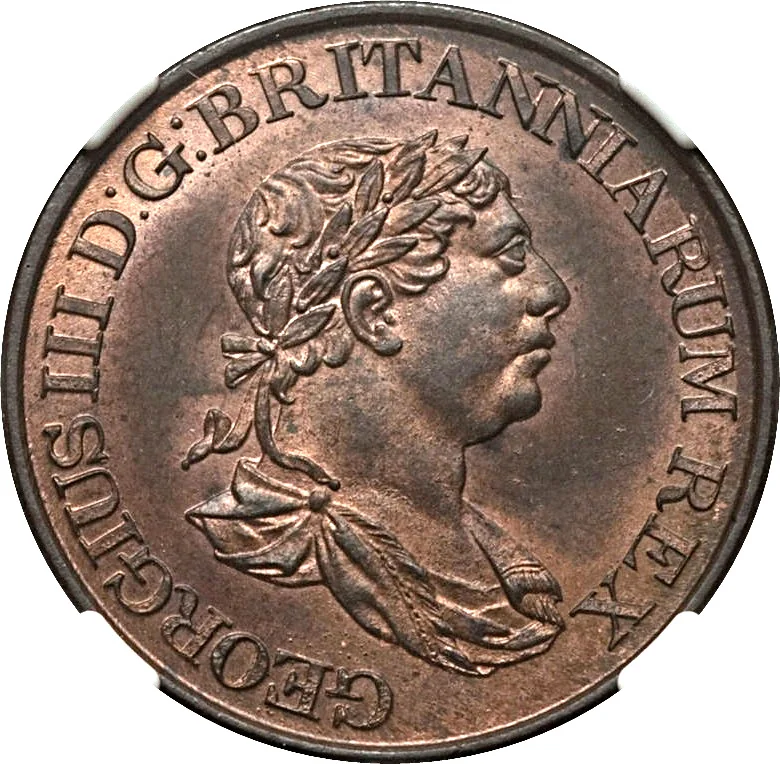
Obverse
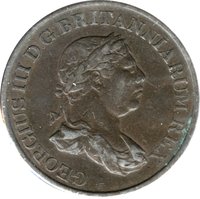
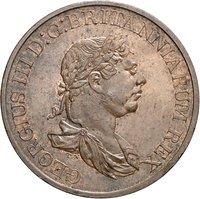
Description:
Laureate head right
Inscription:
GEORGIUS III BRITANNIA RUM REX
Translation:
GEORGE III KING OF THE BRITONS
Script: Latin
Language: Latin
Engraver: Thomas Wyon the Younger
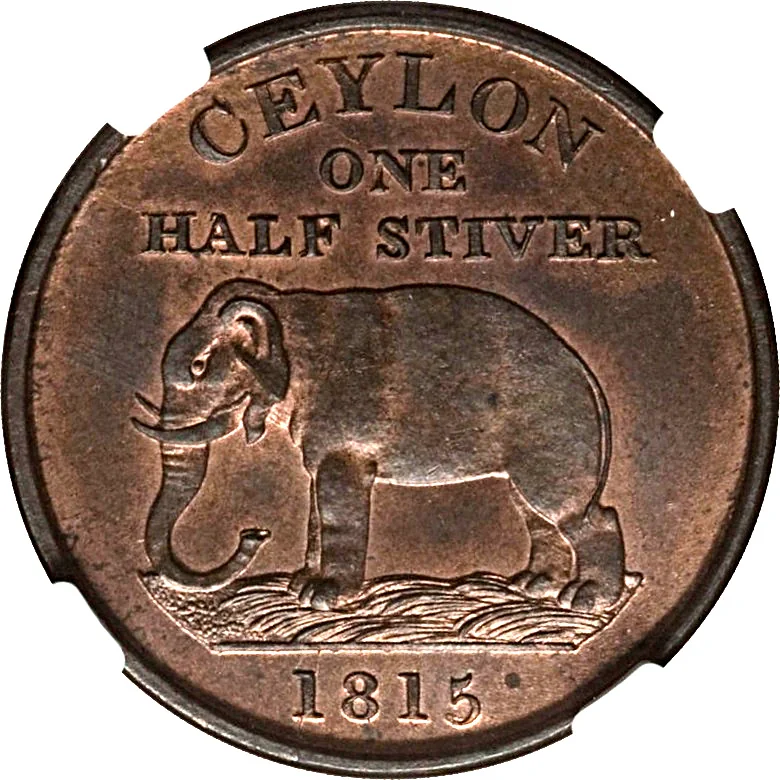
Reverse
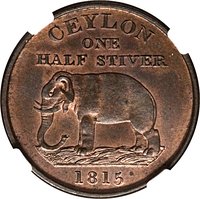
Description:
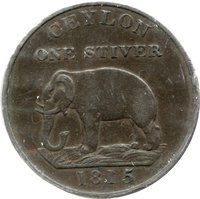
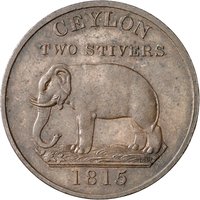
Elephant facing left, value.
Inscription:
CEYLON
ONE
HALF STIVER
1815
ONE
HALF STIVER
1815
Script: Latin
Engraver: Thomas Wyon the Younger
Edge
Plain
Mints
| Name | Mark |
|---|---|
| Royal Mint (Tower Hill) | — |
Mintings
| Year | Mint Mark | Mintage | Quality | Collection |
|---|---|---|---|---|
| 1815 | — | 2,400,000 | ||
| 1815 | — | — | Proof |
Historical background
In 1815, the currency situation in Ceylon (modern Sri Lanka) was complex and transitional, reflecting the island's recent political change. With the fall of the Kingdom of Kandy and the establishment of British rule over the entire island, the monetary systems of the previously separate coastal (Dutch-influenced) and Kandyan territories were forcibly unified. The official currency was the British sterling system, with accounts kept in pounds, shillings, and pence. However, the physical circulation was dominated by a multitude of foreign coins, primarily the Spanish dollar (or "piece of eight") and its fractional parts, alongside Dutch stuivers and Indian rupees and fanams, which were all valued against the sterling standard at officially fixed rates.
This multiplicity of coins created significant practical difficulties for trade and administration. The British authorities struggled with the persistent shortage of official British coinage, leading to a heavy reliance on these older, worn foreign silver coins. Furthermore, the Kandyan highlands had traditionally used a less monetised economy, with barter and payments in kind (like rice or labour) remaining common. The imposition of a cash-based tax system by the new colonial government forced monetisation, often causing hardship as peasants had to convert goods into scarce coin to pay their taxes.
Consequently, the period was marked by monetary instability and confusion. The fixed exchange rates between the various silver coins and sterling often failed to reflect their actual bullion value, leading to arbitrage and the export of undervalued coins. Counterfeiting was also a serious problem. This unsatisfactory situation would prompt the British administration to undertake major currency reforms in the following decades, most notably with the introduction of a unified Ceylon rupee in 1825, which finally replaced sterling as the unit of account and established a more stable, singular currency for the island.
This multiplicity of coins created significant practical difficulties for trade and administration. The British authorities struggled with the persistent shortage of official British coinage, leading to a heavy reliance on these older, worn foreign silver coins. Furthermore, the Kandyan highlands had traditionally used a less monetised economy, with barter and payments in kind (like rice or labour) remaining common. The imposition of a cash-based tax system by the new colonial government forced monetisation, often causing hardship as peasants had to convert goods into scarce coin to pay their taxes.
Consequently, the period was marked by monetary instability and confusion. The fixed exchange rates between the various silver coins and sterling often failed to reflect their actual bullion value, leading to arbitrage and the export of undervalued coins. Counterfeiting was also a serious problem. This unsatisfactory situation would prompt the British administration to undertake major currency reforms in the following decades, most notably with the introduction of a unified Ceylon rupee in 1825, which finally replaced sterling as the unit of account and established a more stable, singular currency for the island.
🌟 Uncommon