

2 euro (Fernão Mendes Pinto) – Portugal
Add to wishlist
Circulating commemorative coins
Commemoration: 500th Birthday of Fernão Mendes Pinto
Portugal
Context
Material
References
KM: #
Numista: #22490
Value
Exchange value: 2 EUR
Inflation-adjusted value: 2.57 EUR
Obverse
Description:
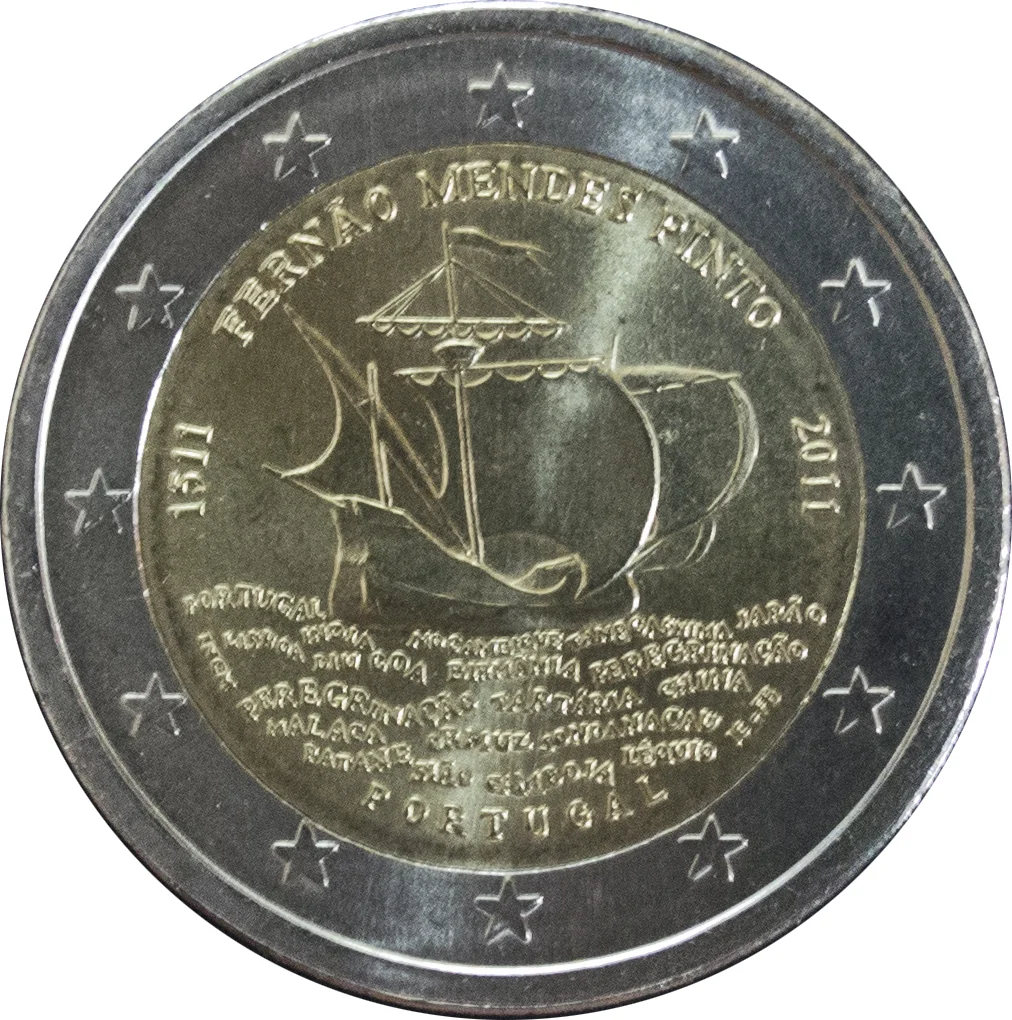
The inner part shows a sailing ship on a sea of wave-shaped references to Portugal, Lisbon, his book "Peregrinação," and his travel destinations, with "Portugal" below. His name and the dates "1511–2011" arch along the top. The outer ring features the 12 stars of the European Union.
Inscription:
FERNÃO MENDES PINTO
1511 2011
PORTUGAL
INCM IC-FB
PORTUGAL INDIA DIU GOA BIRMANIA PEREGRINÄÇO
PEREGRINÄÇO TARTÁRIA CHINA MALACA ORMUZ SONDA NACAU PATANE SIÄO CAMBOIA LÉQUIO
1511 2011
PORTUGAL
INCM IC-FB
PORTUGAL INDIA DIU GOA BIRMANIA PEREGRINÄÇO
PEREGRINÄÇO TARTÁRIA CHINA MALACA ORMUZ SONDA NACAU PATANE SIÄO CAMBOIA LÉQUIO
Translation:
Fernão Mendes Pinto
1511 2011
Portugal
Portuguese Mint - Casa da Moeda - Fábrica de Blindados
Portugal India Diu Goa Burma Peregrination
Peregrination Tartary China Malacca Hormuz Sunda Nagasaki Pattani Siam Cambodia Ryukyu
1511 2011
Portugal
Portuguese Mint - Casa da Moeda - Fábrica de Blindados
Portugal India Diu Goa Burma Peregrination
Peregrination Tartary China Malacca Hormuz Sunda Nagasaki Pattani Siam Cambodia Ryukyu
Script: Latin
Languages: Latin, Portuguese
Engravers: Isabel Carriço, Fernando Branco
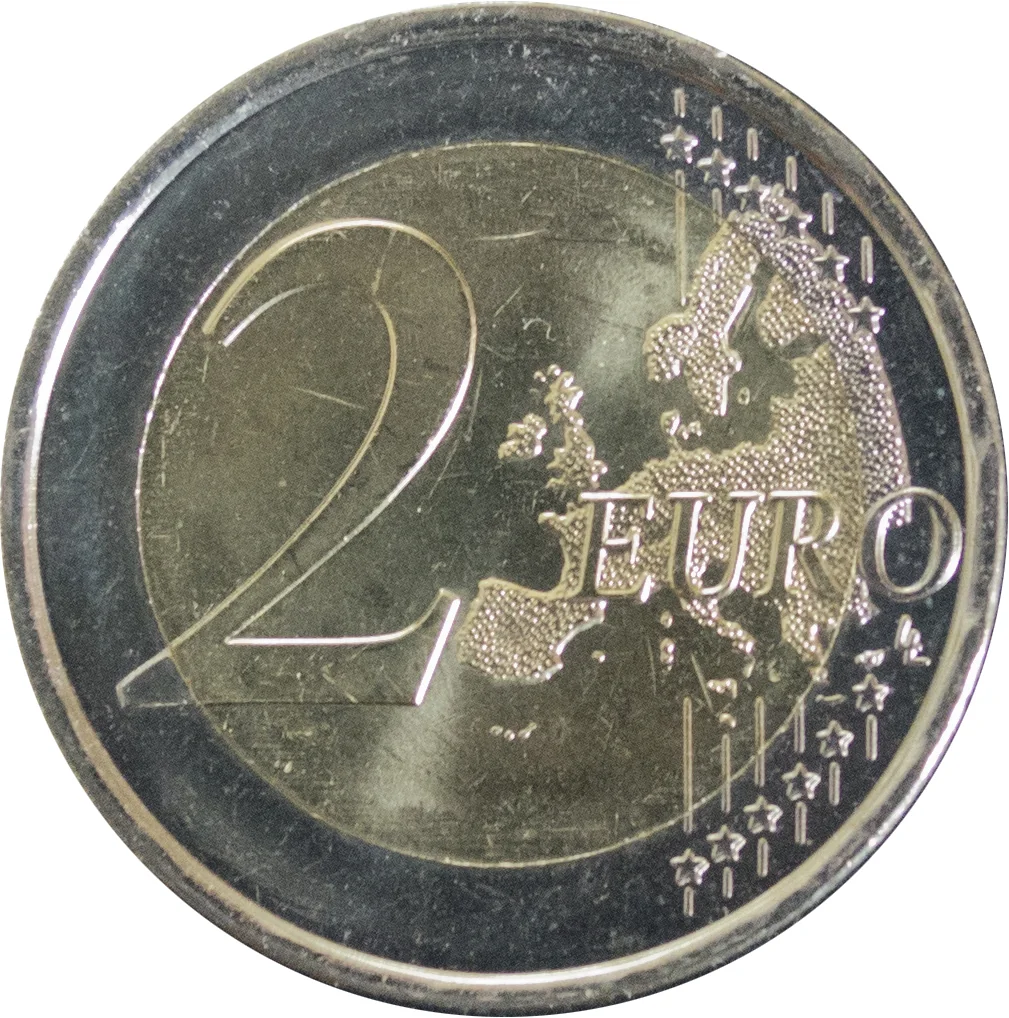
Reverse
Edge
Finely ribbed with seven castles and five coats of arms
Categories
| Art> Literature |
| Event> Birth anniversary |
| Person> Explorer |
| Transportation> Watercraft |
Mintings
| Year | Mint Mark | Mintage | Quality | Collection |
|---|---|---|---|---|
| 2011 | INCM | 500,000 | ||
| 2011 | INCM | 7,498 | Proof | |
| 2011 | INCM | 12,497 | BU |
Historical background
In 2011, Portugal faced a severe sovereign debt crisis that brought it to the brink of economic collapse, a situation deeply intertwined with its membership in the Eurozone. The country had struggled for a decade with low growth, high public and private debt, and a loss of competitiveness within the single currency. Unlike nations with their own central banks, Portugal could not devalue its currency to boost exports, as it used the euro. This structural weakness was exacerbated by the 2008 global financial crisis, leading to soaring budget deficits and a rapid loss of market confidence. By early 2011, the cost of borrowing for the Portuguese government on international bond markets became unsustainable, effectively locking the country out of affordable financing.
The immediate trigger was the collapse of the government in March 2011 after parliament rejected a fourth austerity package, prompting Prime Minister José Sócrates to resign. With its financing options exhausted, Portugal was forced to request a €78 billion financial assistance program from the so-called "Troika" — the European Commission, the European Central Bank (ECB), and the International Monetary Fund (IMF) — in April 2011. This bailout came with strict conditions of severe austerity, including deep spending cuts, tax increases, and structural reforms aimed at reducing the deficit and restoring fiscal sustainability.
The bailout program had profound social and economic consequences, leading to a deep recession, soaring unemployment (peaking near 17%), and significant emigration. However, from a currency perspective, the crisis underscored the double-edged sword of euro membership: while it provided stability and prevented a currency collapse, it also removed key policy tools for recovery. Portugal successfully completed the adjustment program in 2014 and returned to market financing, but the period left a lasting legacy of public debt and highlighted the vulnerabilities within the Eurozone's architecture, which lacked robust mechanisms for asymmetric shocks between member states.
The immediate trigger was the collapse of the government in March 2011 after parliament rejected a fourth austerity package, prompting Prime Minister José Sócrates to resign. With its financing options exhausted, Portugal was forced to request a €78 billion financial assistance program from the so-called "Troika" — the European Commission, the European Central Bank (ECB), and the International Monetary Fund (IMF) — in April 2011. This bailout came with strict conditions of severe austerity, including deep spending cuts, tax increases, and structural reforms aimed at reducing the deficit and restoring fiscal sustainability.
The bailout program had profound social and economic consequences, leading to a deep recession, soaring unemployment (peaking near 17%), and significant emigration. However, from a currency perspective, the crisis underscored the double-edged sword of euro membership: while it provided stability and prevented a currency collapse, it also removed key policy tools for recovery. Portugal successfully completed the adjustment program in 2014 and returned to market financing, but the period left a lasting legacy of public debt and highlighted the vulnerabilities within the Eurozone's architecture, which lacked robust mechanisms for asymmetric shocks between member states.
Series: Portugal 2 euro commemoratives
🌱 Very Common