

20 Kroner (Anne Cath. Vestli) – Norway
Circulating commemorative coins
Commemoration: Anne Cath.-Vestli 100 years birth anniversary
Norway
Context

Material
References
KM: #Click to copy to clipboard496
Numista: #223653
Value
Exchange value: 20 NOK = $2.09
Inflation-adjusted value: 24.56 NOK
Obverse
Description:
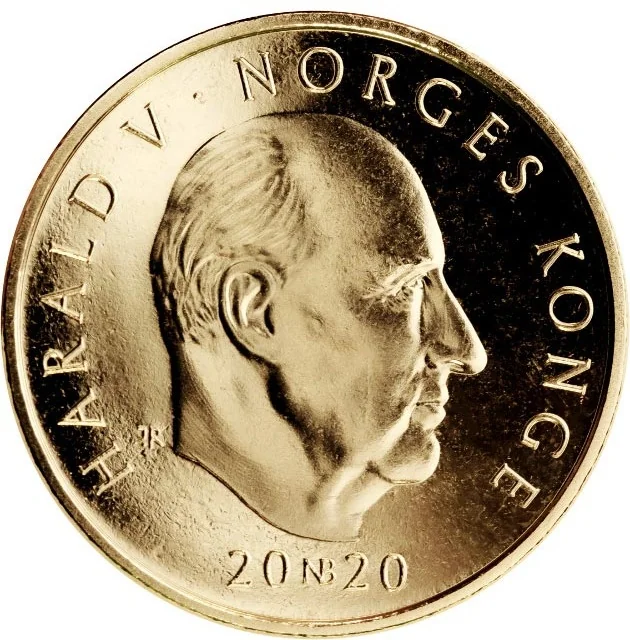
King Harald V bust facing right. Engraver's initials behind bust. Inscription surrounds. Date flanking "NB" below. Solid rim ring.
Inscription:
HARALD V ∙ NORGES KONGE
IAR
20 NB 20
IAR
20 NB 20
Translation:
Harald V, Norway's King
IAR
20 NB 20
IAR
20 NB 20
Script: Latin
Engraver: Ingrid Austlid Rise
Reverse
Description:
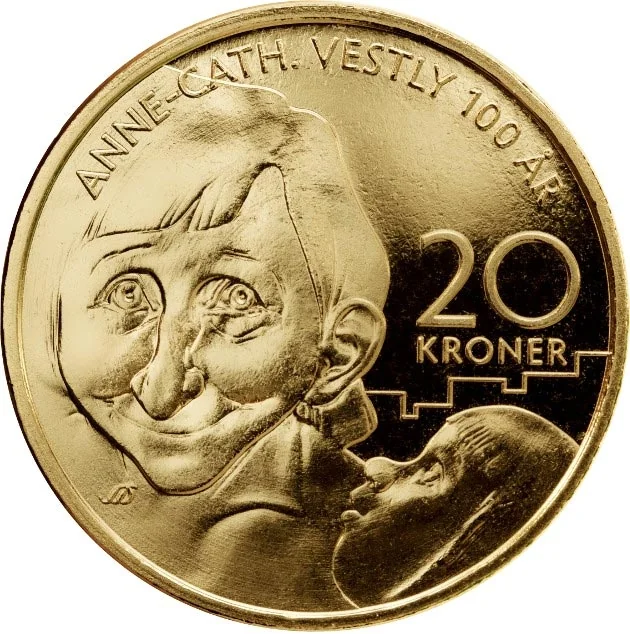
Anne-Cath. Vestly illustration with a child. Inscription above, value to the right, designer initials at bottom left. Solid ring on rim.
Inscription:
ANNE-CATH. VESTLY 100 ÅR
20
KRONER
SD
20
KRONER
SD
Translation:
Anne-Cath. Vestly 100 Years
20
Kroner
S D
20
Kroner
S D
Script: Latin
Language: Norwegian
Engraver: Ingrid Austlid Rise
Designer: Siri Dokken
Edge
Plain
Mints
| Name | Mark |
|---|---|
| Norwegian Mint | — |
Mintings
| Year | Mint Mark | Mintage | Quality | Collection |
|---|---|---|---|---|
| 2020 | — | 503,000 | ||
| 2020 | — | 2,240 | Proof |
Historical background
In 2020, Norway's currency, the krone (NOK), faced significant volatility and depreciation pressure, primarily driven by the dual shocks of the COVID-19 pandemic and a historic collapse in global oil prices. As a major oil and gas exporter, Norway's economy and currency are heavily influenced by hydrocarbon prices. The pandemic-induced global lockdowns crushed demand for oil, leading to Brent crude prices briefly turning negative in April. This triggered a sharp sell-off of the krone, which hit record lows against both the euro and the US dollar in March, as investors fled to safer assets and anticipated a severe economic contraction.
In response, Norges Bank, the country's central bank, took aggressive action to stabilize markets and provide liquidity. It cut its key policy rate three times in March, from 1.5% to a historic low of 0.0%. Furthermore, it intervened directly in the foreign exchange market for the first time since 1999, selling foreign currency (primarily from Norway's vast sovereign wealth fund, the Government Pension Fund Global) to purchase kroner. These measures, combined with a partial recovery in oil prices later in the year and substantial fiscal stimulus from the government, helped to steady the currency from its extreme lows.
Despite this stabilization, the krone ended 2020 substantially weaker than at the start of the year, reflecting ongoing uncertainty and lower long-term oil price expectations. The situation underscored Norway's enduring vulnerability to external commodity shocks, even with its considerable fiscal buffers. The year demonstrated the central bank's readiness to use unconventional tools, while the economy's overall resilience, supported by massive state wealth, prevented a deeper crisis despite the krone's pronounced weakness.
In response, Norges Bank, the country's central bank, took aggressive action to stabilize markets and provide liquidity. It cut its key policy rate three times in March, from 1.5% to a historic low of 0.0%. Furthermore, it intervened directly in the foreign exchange market for the first time since 1999, selling foreign currency (primarily from Norway's vast sovereign wealth fund, the Government Pension Fund Global) to purchase kroner. These measures, combined with a partial recovery in oil prices later in the year and substantial fiscal stimulus from the government, helped to steady the currency from its extreme lows.
Despite this stabilization, the krone ended 2020 substantially weaker than at the start of the year, reflecting ongoing uncertainty and lower long-term oil price expectations. The situation underscored Norway's enduring vulnerability to external commodity shocks, even with its considerable fiscal buffers. The year demonstrated the central bank's readiness to use unconventional tools, while the economy's overall resilience, supported by massive state wealth, prevented a deeper crisis despite the krone's pronounced weakness.
🌟 Uncommon