

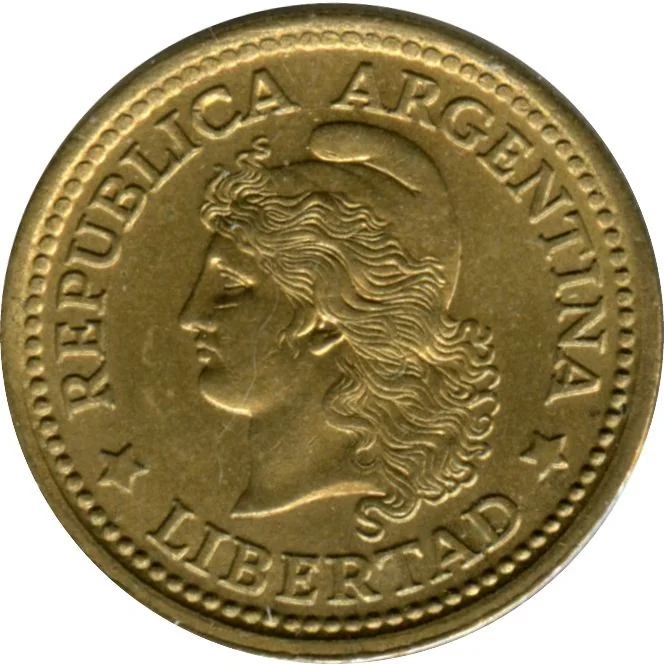
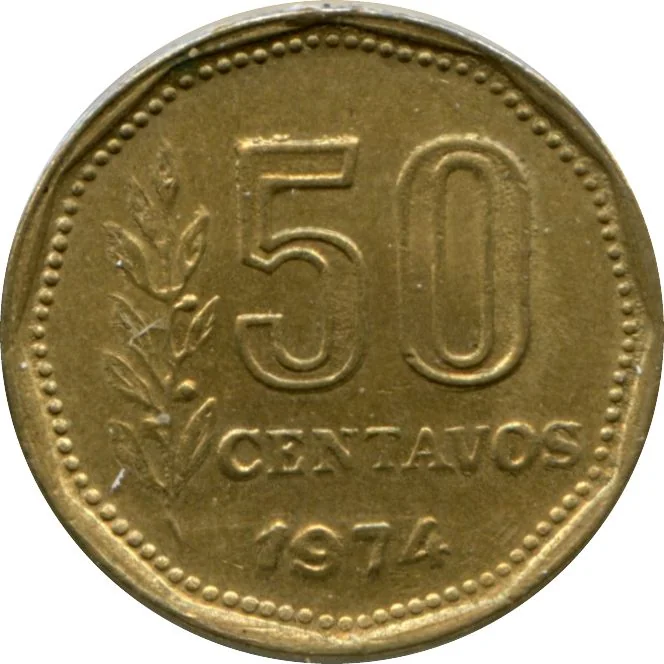
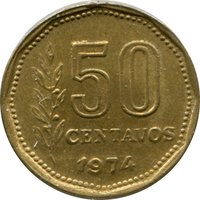
50 Centavos – Argentina
Argentina
Context
Years: 1970–1976
Issuer: Argentina 
Period:
(since 1861)
Currency:
(1970—1983)
Demonetization: 28 December 1979
Total mintage: 330,172,853
Material
References
KM: #Click to copy to clipboard68
Numista: #2218
Value
Exchange value: 0.50 ARL
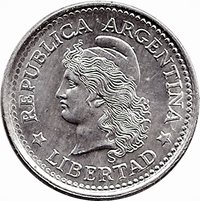
Obverse
Reverse
Edge
Reeded
Categories
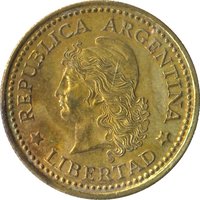
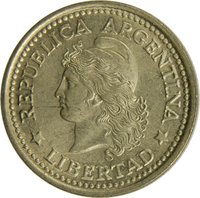
| Symbol> Allegory |
| Symbol> Phrygian cap |
Mintings
| Year | Mint Mark | Mintage | Quality | Collection |
|---|---|---|---|---|
| 1970 | — | 56,103,729 | ||
| 1971 | — | 34,947,000 | ||
| 1972 | — | 40,960,000 | ||
| 1973 | — | 59,472,124 | ||
| 1974 | — | 64,063,000 | ||
| 1975 | — | 64,859,000 | ||
| 1976 | — | 9,768,000 |
Historical background
Argentina entered the 1970s in a state of profound economic and political instability, a legacy of the alternating civilian and military governments that characterized the preceding decades. The currency, the peso, was burdened by chronic inflation, large fiscal deficits financed by money creation, and persistent balance of payments problems. A key feature of this period was the existence of multiple exchange rates—a complex system of official, financial, and black-market rates—designed to control capital flight and subsidize essential imports, but which instead created distortions, encouraged speculation, and eroded confidence in the peso as a store of value.
The decade saw a series of failed stabilization plans and abrupt currency devaluations. The authoritarian regime of General Juan Carlos Onganía (1966-1970) had initially pursued orthodox policies, but by the turn of the decade, inflation was accelerating sharply. The political transition back to a fragile democracy under President Héctor Cámpora and then Juan Perón in 1973 brought a brief attempt at a "social pact" to control prices and wages, accompanied by a significant currency re-denomination (introducing the "Peso Ley"). However, these measures proved temporary, as global oil price shocks and deep-seated structural issues, including powerful union demands and industrial decline, quickly reasserted inflationary pressures.
Thus, by the mid-1970s, the currency situation was deteriorating rapidly. Inflation became entrenched, evolving into hyperinflation by the end of the decade. The multiple exchange rate system became increasingly unsustainable, and the gap between the official and black-market rates widened dramatically, reflecting a complete loss of monetary credibility. This chaotic financial environment set the stage for the radical, yet ultimately disastrous, economic policies of the military junta that took power in 1976, marking the 1970s as the pivotal decade where Argentina's chronic inflation crisis turned acute.
The decade saw a series of failed stabilization plans and abrupt currency devaluations. The authoritarian regime of General Juan Carlos Onganía (1966-1970) had initially pursued orthodox policies, but by the turn of the decade, inflation was accelerating sharply. The political transition back to a fragile democracy under President Héctor Cámpora and then Juan Perón in 1973 brought a brief attempt at a "social pact" to control prices and wages, accompanied by a significant currency re-denomination (introducing the "Peso Ley"). However, these measures proved temporary, as global oil price shocks and deep-seated structural issues, including powerful union demands and industrial decline, quickly reasserted inflationary pressures.
Thus, by the mid-1970s, the currency situation was deteriorating rapidly. Inflation became entrenched, evolving into hyperinflation by the end of the decade. The multiple exchange rate system became increasingly unsustainable, and the gap between the official and black-market rates widened dramatically, reflecting a complete loss of monetary credibility. This chaotic financial environment set the stage for the radical, yet ultimately disastrous, economic policies of the military junta that took power in 1976, marking the 1970s as the pivotal decade where Argentina's chronic inflation crisis turned acute.
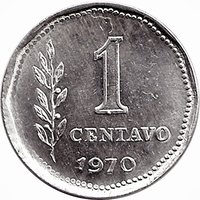
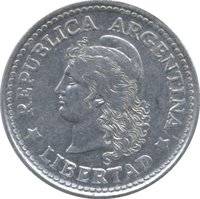
Series: 1970 Argentina circulation coins
🌱 Very Common