

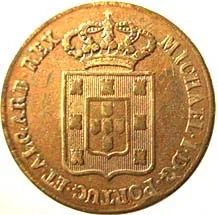
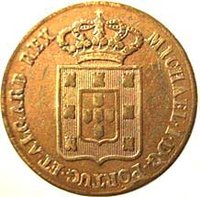
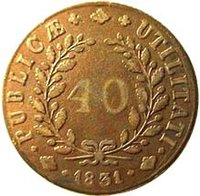
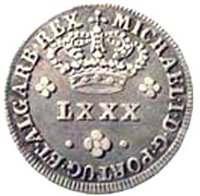
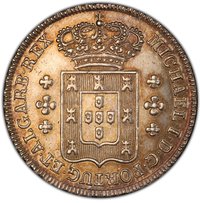
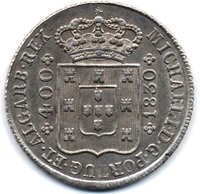
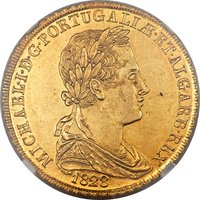
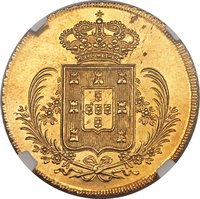
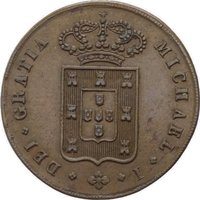
Obverse
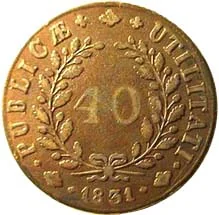
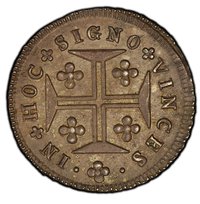
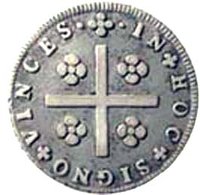
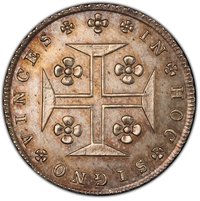
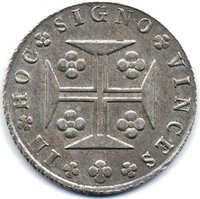
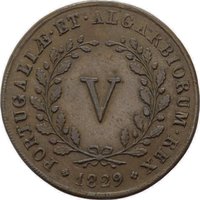
Reverse
Edge
Plain
Mints
| Name | Mark |
|---|---|
| Imprensa Nacional - Casa da Moeda | — |
Mintings
| Year | Mint Mark | Mintage | Quality | Collection |
|---|---|---|---|---|
| 1828 | — | 1,378,078 | ||
| 1829 | — | 1,678,340 | ||
| 1830 | — | 1,783,000 | ||
| 1831 | — | 1,391,000 | ||
| 1832 | — | 1,780,000 | ||
| 1833 | — | 1,631,000 |
Historical background
In 1828, Portugal's currency situation was deeply unstable and reflective of the nation's profound political crisis. The country was embroiled in the Liberal Wars, a civil conflict between the absolutist King Miguel I, who had seized the throne in 1828, and the liberal constitutionalists supporting the rights of his niece, Maria II. This political fracture directly impacted the monetary system, as the realm was effectively divided between Miguelist-controlled territories and liberal strongholds like the Azores. Consequently, there was no single, authoritative currency in circulation nationwide; instead, the legitimacy of coinage depended entirely on which regime one recognized.
The physical currency in people's hands was a chaotic mix. Pre-1828 coins from the reigns of João VI and Pedro IV (including Brazilian gold coins) remained in use but were often hoarded. More critically, both the Miguelist government in Lisbon and the liberal junta in the Azores issued their own copper and silver coinage to finance their war efforts. This led to a dual-system where a coin minted under "Miguel I" would be considered treasonous currency in a liberal-held area, and vice-versa. Furthermore, the economic disruption of war caused severe shortages of specie, leading to widespread use of debased and foreign coins, particularly Spanish and British, further complicating trade and eroding trust in the monetary system.
Underpinning this tangible chaos was a severe fiscal and inflationary crisis. The war had devastated the Portuguese economy, and both sides resorted to printing paper money and taking on debt to pay for military expenses. The Miguelist regime, in particular, issued large quantities of low-value copper coins, effectively a form of inflation tax. This currency debasement, combined with collapsing public confidence and fragmented political authority, meant that the real value of money was highly volatile and localized. Therefore, in 1828, Portugal did not have a unified national currency but rather competing symbols of sovereignty that fueled both economic hardship and civil strife.
The physical currency in people's hands was a chaotic mix. Pre-1828 coins from the reigns of João VI and Pedro IV (including Brazilian gold coins) remained in use but were often hoarded. More critically, both the Miguelist government in Lisbon and the liberal junta in the Azores issued their own copper and silver coinage to finance their war efforts. This led to a dual-system where a coin minted under "Miguel I" would be considered treasonous currency in a liberal-held area, and vice-versa. Furthermore, the economic disruption of war caused severe shortages of specie, leading to widespread use of debased and foreign coins, particularly Spanish and British, further complicating trade and eroding trust in the monetary system.
Underpinning this tangible chaos was a severe fiscal and inflationary crisis. The war had devastated the Portuguese economy, and both sides resorted to printing paper money and taking on debt to pay for military expenses. The Miguelist regime, in particular, issued large quantities of low-value copper coins, effectively a form of inflation tax. This currency debasement, combined with collapsing public confidence and fragmented political authority, meant that the real value of money was highly volatile and localized. Therefore, in 1828, Portugal did not have a unified national currency but rather competing symbols of sovereignty that fueled both economic hardship and civil strife.
Series: 1828 Portugal circulation coins
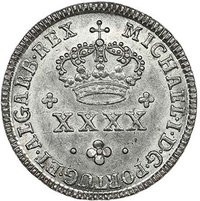
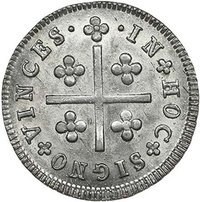
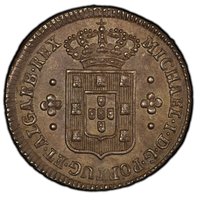
🌱 Fairly Common