

2 euro (Treaty of Rome) – Netherlands
Add to wishlist
Circulating commemorative coins
Commemoration: 50th Anniversary of the Treaty of Rome
Series: Treaty of Rome
Netherlands
Obverse
Description:
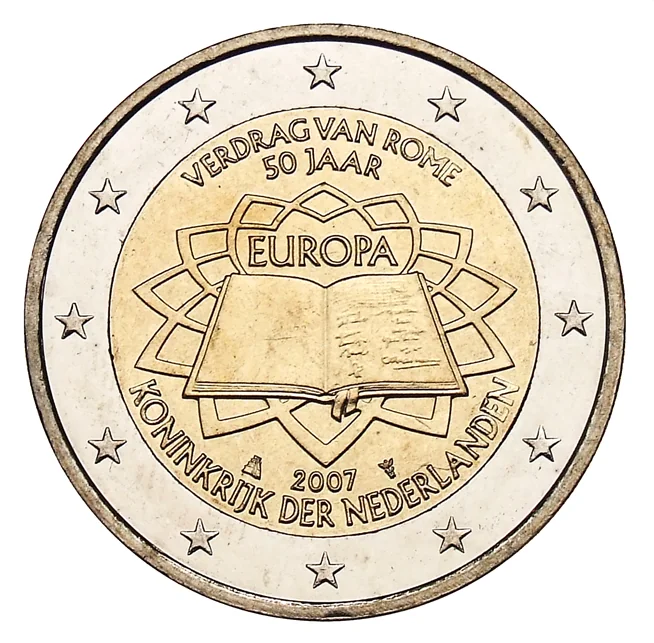
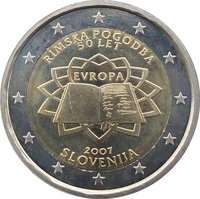
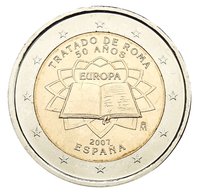
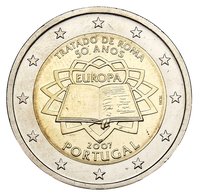
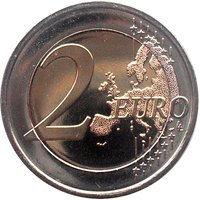
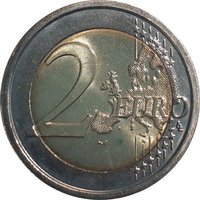
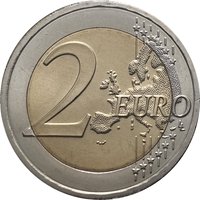
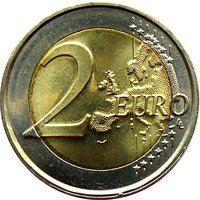
The coin depicts the Treaty of Rome, signed on 25 March 1957, over Michelangelo's Campidoglio pavement. The image is uniform, but the legends—'Treaty of Rome 50 years', 'EUROPE', and the issuing country's name—vary by language. Issued jointly in 2007 to mark the treaty that founded the European Economic Community and led to the euro, its design was chosen in a mint competition. The outer ring features the 12 stars of the EU.
Inscription:
VERDRAG VAN ROME
50 JAAR
EUROPA
2007
KONINKRIJK DER NEDERLANDEN
50 JAAR
EUROPA
2007
KONINKRIJK DER NEDERLANDEN
Translation:
TREATY OF ROME
50 YEARS
EUROPE
2007
KINGDOM OF THE NETHERLANDS
50 YEARS
EUROPE
2007
KINGDOM OF THE NETHERLANDS
Script: Latin
Engraver: Helmut Andexlinger
Reverse
Edge
Mints
| Name | Mark |
|---|---|
| Royal Dutch Mint | — |
Mintings
| Year | Mint Mark | Mintage | Quality | Collection |
|---|---|---|---|---|
| 2007 | — | 6,158,000 | ||
| 2007 | — | 7,500 | Proof | |
| 2007 | — | 15,000 | BU |
Historical background
In 2007, the Netherlands was a core member of the Eurozone, having adopted the euro as its official currency in 2002, replacing the Dutch guilder. The transition was widely considered a success, with the euro fostering greater price transparency, reducing transaction costs, and solidifying the country's deep economic integration with its European partners, particularly Germany. The Dutch economy was performing robustly in 2007, with strong growth, low unemployment, and a disciplined fiscal policy that maintained a budget surplus. Public and political sentiment towards the euro was generally positive, viewing it as a cornerstone of European unity and a practical tool for a major trading nation.
However, beneath this stable surface, early warning signs related to the currency union's structure were emerging. Like many Eurozone members, the Netherlands experienced low interest rates set by the European Central Bank (ECB), which were arguably too accommodative for its economic cycle. This contributed to a rapidly overheating housing market, with property prices reaching unsustainable levels and household debt rising significantly. Furthermore, the "one-size-fits-all" monetary policy of the ECB began to reveal its limitations, as it could not address country-specific inflationary pressures, such as those in the Dutch housing sector.
Crucially, 2007 marked the beginning of the global financial crisis, which would soon profoundly test the Eurozone's framework. While the direct trigger was the collapse of the U.S. subprime mortgage market, the interconnected European banking system quickly came under strain. For the Netherlands, the crisis exposed the vulnerabilities of its large financial institutions, most notably the bank and insurance giant ING, which would require a substantial government bailout in 2008. Thus, by the end of 2007, the Netherlands' stable currency situation was poised on the brink of a severe stress test that would question the resilience of the entire euro project and lead to the subsequent European sovereign debt crisis.
However, beneath this stable surface, early warning signs related to the currency union's structure were emerging. Like many Eurozone members, the Netherlands experienced low interest rates set by the European Central Bank (ECB), which were arguably too accommodative for its economic cycle. This contributed to a rapidly overheating housing market, with property prices reaching unsustainable levels and household debt rising significantly. Furthermore, the "one-size-fits-all" monetary policy of the ECB began to reveal its limitations, as it could not address country-specific inflationary pressures, such as those in the Dutch housing sector.
Crucially, 2007 marked the beginning of the global financial crisis, which would soon profoundly test the Eurozone's framework. While the direct trigger was the collapse of the U.S. subprime mortgage market, the interconnected European banking system quickly came under strain. For the Netherlands, the crisis exposed the vulnerabilities of its large financial institutions, most notably the bank and insurance giant ING, which would require a substantial government bailout in 2008. Thus, by the end of 2007, the Netherlands' stable currency situation was poised on the brink of a severe stress test that would question the resilience of the entire euro project and lead to the subsequent European sovereign debt crisis.
Series: Treaty of Rome


🌱 Very Common