

2 euro – Netherlands
Add to wishlist
Circulating commemorative coins
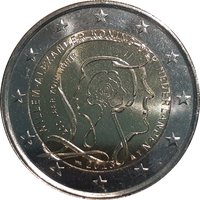
Commemoration: The Announcement of the Abdication of the Throne by Her Majesty Queen Beatrix
Netherlands
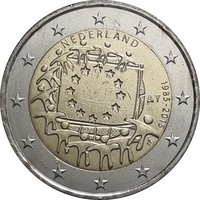
Obverse
Description:
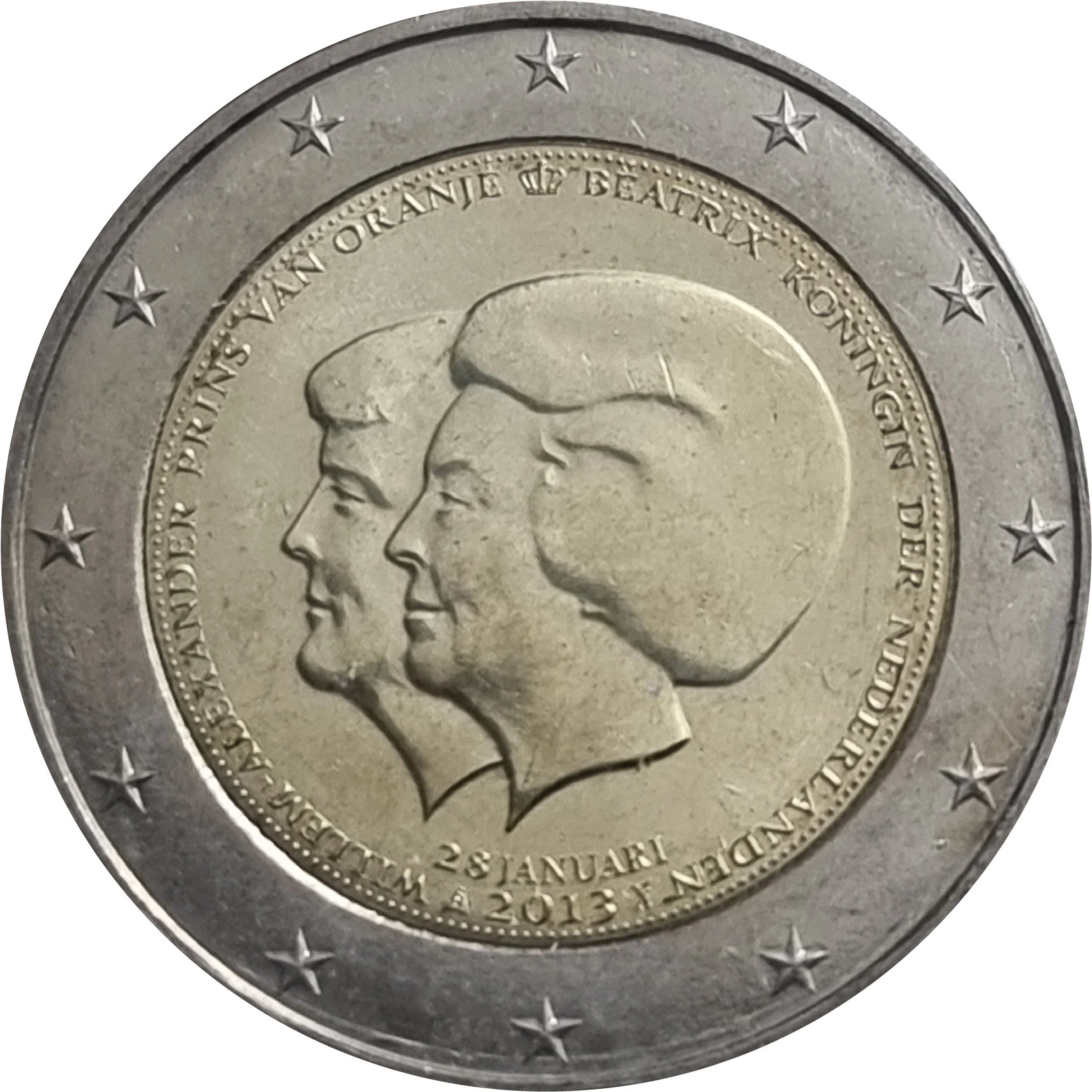
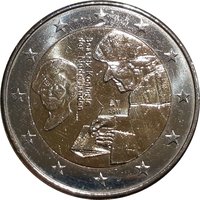
Foreground: Queen Beatrix. Background: the Prince of Orange, partly covered. Inscription: WILLEM-ALEXANDER PRINS VAN ORANJE (crown) BEATRIX KONINGIN DER NEDERLANDEN (mintmark) 28 JANUARI 2013 (mint master mark). Outer ring: 12 EU stars.
Inscription:
WILLEM-ALEXANDER PRINS VAN ORANJE BEATRIX KONINGIN DER NEDERLANDEN
28 JANUARI
2013
28 JANUARI
2013
Translation:
WILLEM-ALEXANDER PRINCE OF ORANGE BEATRIX QUEEN OF THE NETHERLANDS
28 JANUARY
2013
28 JANUARY
2013
Script: Latin
Engraver: Pannos Goutzemisis
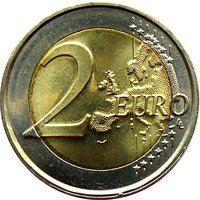
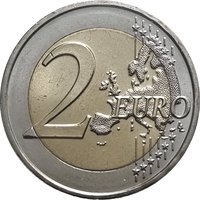
Reverse
Edge
Reeded with inscription.
Legend:
GOD ☆ ZIJ ☆ MET ☆ ONS ☆
Translation:
God be with us
Language: Dutch
Categories
| Event> Coronation |
| Person> Monarch |
| Map |
Mints
| Name | Mark |
|---|---|
| Royal Dutch Mint | — |
Mintings
| Year | Mint Mark | Mintage | Quality | Collection |
|---|---|---|---|---|
| 2013 | — | 19,965,000 | ||
| 2013 | — | 10,000 | Proof | |
| 2013 | — | 25,000 | BU |
Historical background
In 2013, the Netherlands was a core member of the Eurozone, having adopted the euro in 2002 and phasing out the Dutch guilder. The country's currency situation was therefore intrinsically tied to the stability and crises of the wider euro area. The aftermath of the 2009-2010 European debt crisis still cast a long shadow, with concerns over the solvency of southern European members like Greece, Portugal, and Spain. While the Netherlands itself maintained a AAA credit rating for much of the period, its economy was in a mild recession in 2013, and there was growing domestic political debate about the costs of Eurozone bailouts and the future of the monetary union.
Domestically, the currency situation was characterized by the Netherlands' traditional role as a staunch advocate for fiscal discipline within the Eurozone. The Dutch government, led by Prime Minister Mark Rutte, insisted on strict austerity measures for bailout recipients and was a key proponent of stronger EU budgetary rules. This hardline stance was popular at home but created tension with other EU partners advocating for more growth-focused policies. Furthermore, the strong and stable euro, which the Netherlands benefited from for trade, was also seen by some exporters as a potential drag on competitiveness.
Despite the Eurozone's challenges, there was no serious political movement to abandon the euro and return to a national currency. Public and political consensus largely supported euro membership as vital for trade and stability, though with increasing frustration over perceived fiscal transfers. The year 2013 thus represented a period of cautious stability for the Netherlands within the euro, navigating between domestic economic pressures, a commitment to Eurozone rules, and the ongoing project of stabilizing the common currency area in the wake of a major crisis.
Domestically, the currency situation was characterized by the Netherlands' traditional role as a staunch advocate for fiscal discipline within the Eurozone. The Dutch government, led by Prime Minister Mark Rutte, insisted on strict austerity measures for bailout recipients and was a key proponent of stronger EU budgetary rules. This hardline stance was popular at home but created tension with other EU partners advocating for more growth-focused policies. Furthermore, the strong and stable euro, which the Netherlands benefited from for trade, was also seen by some exporters as a potential drag on competitiveness.
Despite the Eurozone's challenges, there was no serious political movement to abandon the euro and return to a national currency. Public and political consensus largely supported euro membership as vital for trade and stability, though with increasing frustration over perceived fiscal transfers. The year 2013 thus represented a period of cautious stability for the Netherlands within the euro, navigating between domestic economic pressures, a commitment to Eurozone rules, and the ongoing project of stabilizing the common currency area in the wake of a major crisis.

🌱 Very Common