

2 euro – Finland
Add to wishlist
Circulating commemorative coins
Commemoration: Fifth Enlargement of the European Union
Finland
Obverse
Description:
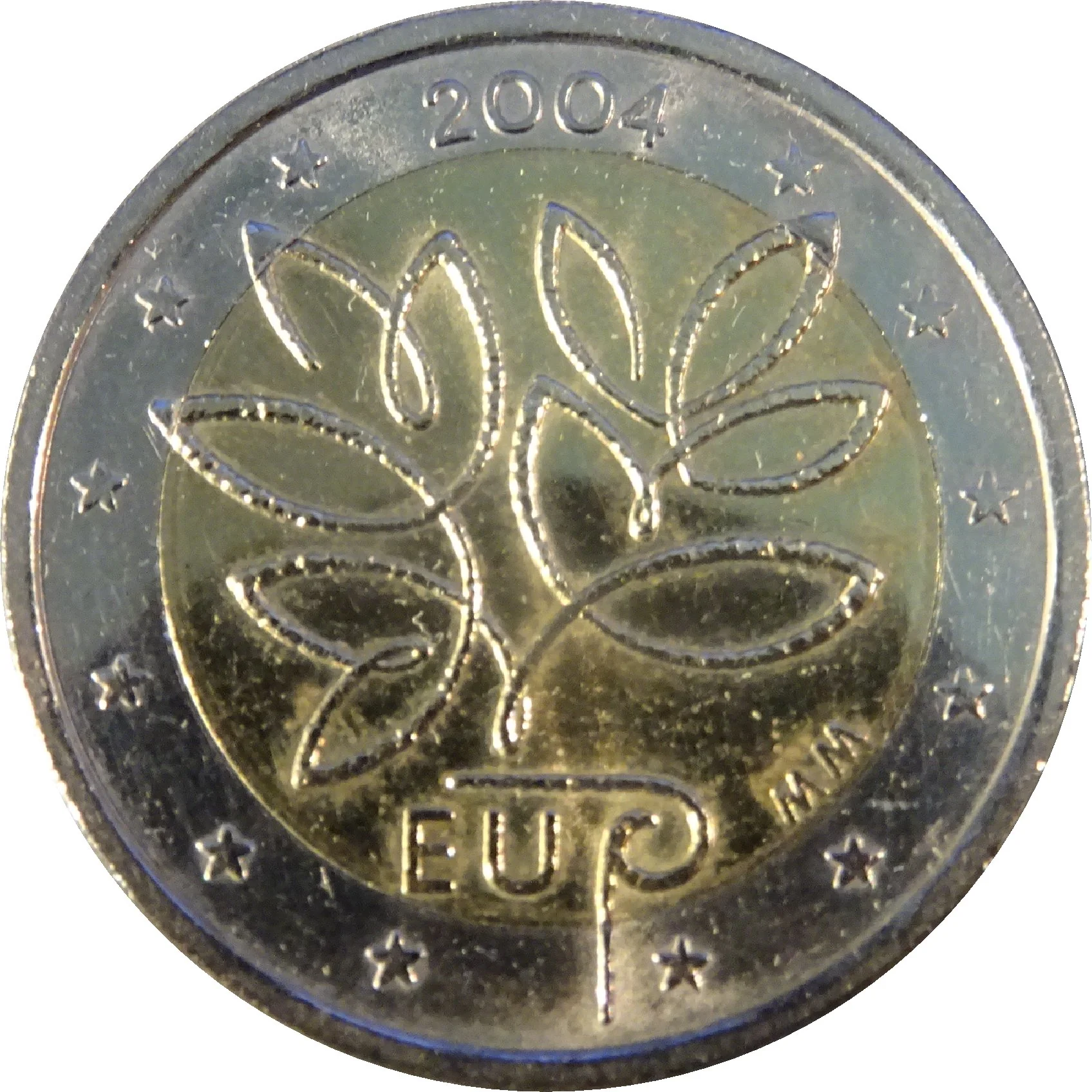
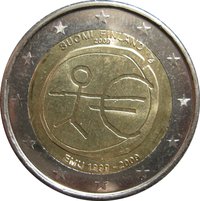
A stylized pillar with upward-growing sprouts symbolizes EU enlargement, with "EU" beside it and the date and twelve stars above.
Inscription:
2004 EU M M
Script: Latin
Engraver: Pertti Mäkinen
Reverse
Categories
| Map |
Mints
| Name | Mark |
|---|---|
| Mint of Finland | — |
Mintings
| Year | Mint Mark | Mintage | Quality | Collection |
|---|---|---|---|---|
| 2004 | — | 63,600 | BU | |
| 2004 | — | 932,900 | ||
| 2004 | — | 5,000 | Proof |
Historical background
In 2004, Finland was a well-established member of the Eurozone, having adopted the euro as its official currency on 1 January 1999, with euro banknotes and coins entering circulation in 2002. By 2004, the transition from the Finnish markka (mark) was complete, and the markka was no longer legal tender. The country was fully integrated into the European Central Bank's monetary policy framework, which meant that key interest rates and broader monetary decisions were set in Frankfurt for the entire currency bloc, not specifically for Finland's domestic economic conditions.
The domestic economic backdrop in 2004 was one of recovery and growth. Finland had weathered the early-2000s technology downturn, which hit its key telecommunications sector hard, particularly the struggles of Nokia's network infrastructure business. However, by 2004, the economy was rebounding strongly, driven by robust exports and a resurgent global demand for technology and paper products. This growth occurred under the stability of the euro, which eliminated exchange rate risks with major European trading partners and was generally viewed as having lowered transaction costs and boosted trade.
Nevertheless, the euro membership also presented challenges. The common currency's external value was influenced by the economic performance of all member states, not just the stronger northern economies like Finland. Some Finnish exporters expressed concerns about the euro's strength against other currencies, potentially affecting competitiveness in global markets outside Europe. Furthermore, as a small economy within the bloc, Finland had relinquished the ability to use independent monetary policy or currency devaluation as tools to adjust to asymmetric economic shocks, placing a greater emphasis on fiscal policy and structural reforms to maintain competitiveness within the single currency area.
The domestic economic backdrop in 2004 was one of recovery and growth. Finland had weathered the early-2000s technology downturn, which hit its key telecommunications sector hard, particularly the struggles of Nokia's network infrastructure business. However, by 2004, the economy was rebounding strongly, driven by robust exports and a resurgent global demand for technology and paper products. This growth occurred under the stability of the euro, which eliminated exchange rate risks with major European trading partners and was generally viewed as having lowered transaction costs and boosted trade.
Nevertheless, the euro membership also presented challenges. The common currency's external value was influenced by the economic performance of all member states, not just the stronger northern economies like Finland. Some Finnish exporters expressed concerns about the euro's strength against other currencies, potentially affecting competitiveness in global markets outside Europe. Furthermore, as a small economy within the bloc, Finland had relinquished the ability to use independent monetary policy or currency devaluation as tools to adjust to asymmetric economic shocks, placing a greater emphasis on fiscal policy and structural reforms to maintain competitiveness within the single currency area.
Series: Finland 2 euro commemoratives
🌱 Very Common