

2 euro (Universal Declaration of Human Rights) – Finland
Add to wishlist
Circulating commemorative coins
Commemoration: 60th Anniversary of the Universal Declaration of Human Rights
Finland
Obverse
Description:
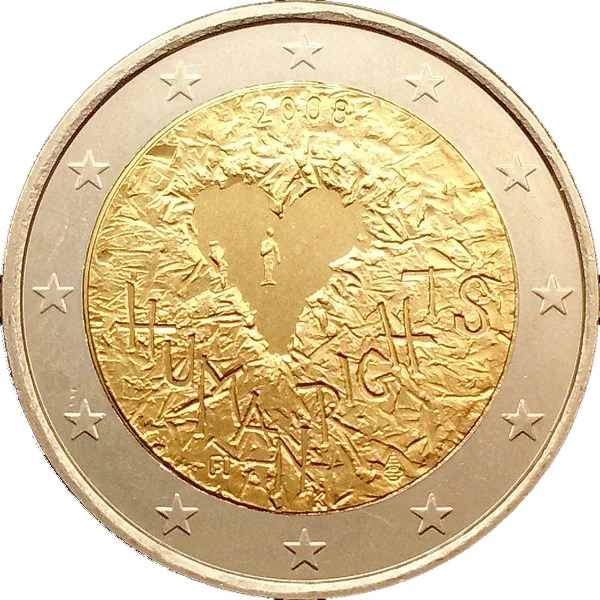
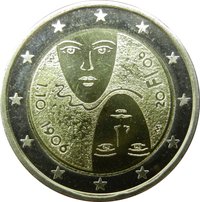
Designed by sculptor Tapio Kettunen, the coin features a person inside a heart above the inscription 'HUMAN RIGHTS'. The inner part includes 'FI', the sculptor's initial 'K', the mint mark, and the year 2008. The EU stars are on the outer ring.
Inscription:
2008
HUMAN RIGHTS
FI K
HUMAN RIGHTS
FI K
Translation:
2008
HUMAN RIGHTS
FI
HUMAN RIGHTS
FI
Script: Latin
Engraver: Tapio Kettunen
Reverse
Categories
| Map |
| Human rights |
| Symbols> Heart |
Mints
| Name | Mark |
|---|---|
| Mint of Finland | (FI) |
Mintings
| Year | Mint Mark | Mintage | Quality | Collection |
|---|---|---|---|---|
| 2008 | FI | 1,500,000 | ||
| 2008 | FI | 29,600 | BU | |
| 2008 | FI | 22,500 | Proof |
Historical background
In 2008, Finland was a member of the European Union and had fully adopted the euro as its currency in 2002, replacing the Finnish markka. As a result, the country's monetary policy was no longer under the control of the Bank of Finland but was instead set by the European Central Bank (ECB) in Frankfurt. This meant that Finland, as part of the Eurozone, shared a common interest rate and exchange rate policy with other member states, which provided stability but also removed the national tool of currency devaluation to boost competitiveness.
The global financial crisis of 2008 presented a significant challenge to this arrangement. While the euro itself provided a buffer against the speculative currency attacks that hit some non-Eurozone countries, Finland faced a severe economic shock due to its heavy reliance on exports, particularly in the technology and forestry sectors. The collapse of global demand led to a sharp recession, with Finnish GDP contracting by over 8% in 2009. A key domestic event was the near-collapse and subsequent government bailout of the Finnish bank Pohjola Bank (part of the OP Financial Group), highlighting the vulnerability of even stable Nordic banks to the international credit freeze.
Furthermore, the crisis exposed structural tensions within the Eurozone that would later escalate. Finland's economy, characterized by high productivity and strong institutions, was hit differently than those of southern Eurozone members. However, being tied to the euro meant Finland had to participate in ECB-led crisis measures and, later, Eurozone bailout packages for other countries. Domestically, this sparked debate about the costs and benefits of euro membership, though support for the currency remained majority-strong. Thus, Finland's 2008 currency situation was defined by its embeddedness in the Eurozone, which provided exchange rate stability during the storm but also meant navigating the crisis without a national monetary policy lever.
The global financial crisis of 2008 presented a significant challenge to this arrangement. While the euro itself provided a buffer against the speculative currency attacks that hit some non-Eurozone countries, Finland faced a severe economic shock due to its heavy reliance on exports, particularly in the technology and forestry sectors. The collapse of global demand led to a sharp recession, with Finnish GDP contracting by over 8% in 2009. A key domestic event was the near-collapse and subsequent government bailout of the Finnish bank Pohjola Bank (part of the OP Financial Group), highlighting the vulnerability of even stable Nordic banks to the international credit freeze.
Furthermore, the crisis exposed structural tensions within the Eurozone that would later escalate. Finland's economy, characterized by high productivity and strong institutions, was hit differently than those of southern Eurozone members. However, being tied to the euro meant Finland had to participate in ECB-led crisis measures and, later, Eurozone bailout packages for other countries. Domestically, this sparked debate about the costs and benefits of euro membership, though support for the currency remained majority-strong. Thus, Finland's 2008 currency situation was defined by its embeddedness in the Eurozone, which provided exchange rate stability during the storm but also meant navigating the crisis without a national monetary policy lever.
Series: Finland 2 euro commemoratives
🌱 Very Common