

5 Cents – United States
United States
Context
Years: 1829–1837
Issuer: United States 
Period:
(since 1776)
Currency:
(since 1785)
Total mintage: 13,058,700
Material
References
KM: #Click to copy to clipboard47
Numista: #11135
Value
Exchange value: 0.05 USD = $0.05
Bullion value: $3.38
Obverse
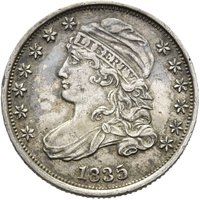
Description:
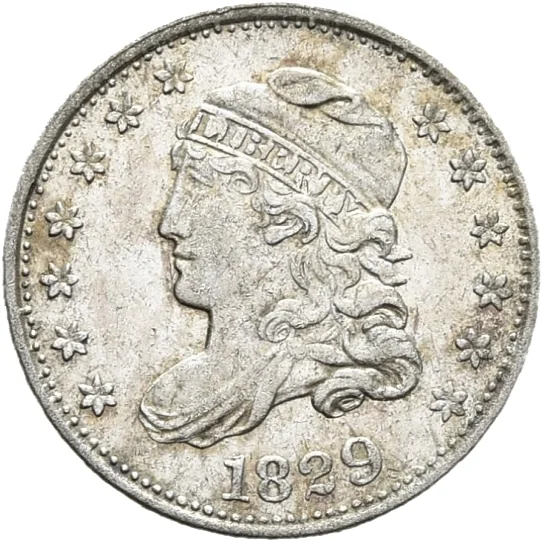
Liberty cap, stars flank.
Inscription:
1834
Script: Latin
Engraver: William Kneass
Designer: John Reich
Reverse
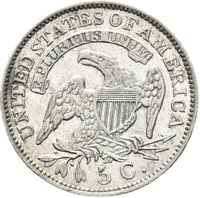
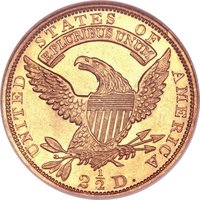
Description:
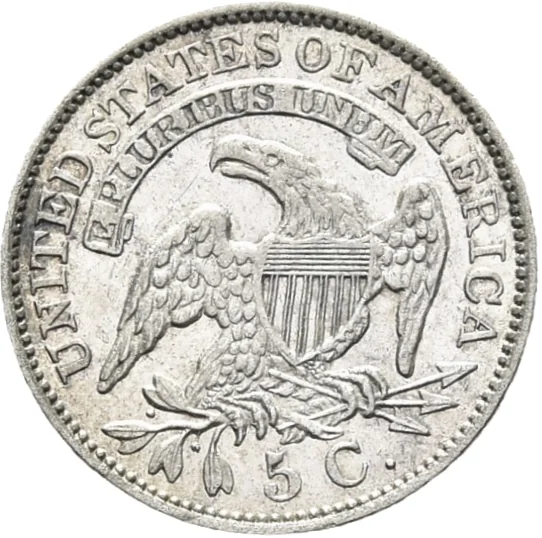
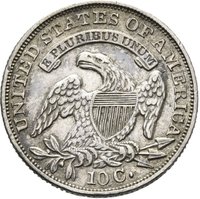
Eagles clutching arrows, banner overhead.
Inscription:
UNITED STATES OF AMERICA
E PLURIBUS UNUM
5 C.
E PLURIBUS UNUM
5 C.
Script: Latin
Engraver: William Kneass
Designer: John Reich
Edge
Reeded
Categories
| Animal> Bird> Eagle |
| Symbol> Allegory |
| Symbol> Phrygian cap |
| Object> Cold weapons |
Mints
| Name | Mark |
|---|---|
| United States Mint of Philadelphia | — |
Mintings
| Year | Mint Mark | Mintage | Quality | Collection |
|---|---|---|---|---|
| 1829 | — | 1,230,000 | ||
| 1830 | — | 1,240,000 | ||
| 1831 | — | 1,242,700 | ||
| 1832 | — | 965,000 | ||
| 1833 | — | 1,370,000 | ||
| 1834 | — | 1,480,000 | ||
| 1835 | — | 2,760,000 | ||
| 1836 | — | 1,900,000 | ||
| 1837 | — | 871,000 |
Historical background
In 1829, the United States operated under a bimetallic standard, where both gold and silver were legal tender and could be minted into coins at a fixed ratio set by the Coinage Act of 1792. This system established a 15:1 ratio, meaning one ounce of gold was valued at fifteen ounces of silver. However, the official mint ratio often diverged from the global market value of the metals, leading to chronic instability. When the market valued one metal more highly than the mint's fixed price, that metal would be exported or hoarded, while the other flooded into circulation—a principle known as Gresham's Law. By 1829, silver was undervalued at the U.S. Mint compared to Europe, causing much of the nation's silver coinage to disappear from everyday use.
The practical currency in circulation was a chaotic patchwork. While federal coins were the official money, they were scarce. Instead, Americans primarily relied on a vast array of paper banknotes issued by hundreds of state-chartered private banks. These notes were promises to pay in specie (gold or silver), but their actual value fluctuated wildly based on the perceived solvency of the issuing bank. Notes from distant or dubious banks often traded at a steep discount, creating confusion and risk in commerce. Furthermore, the Second Bank of the United States (BUS), chartered in 1816, held a unique position as the federal government's fiscal agent and was meant to regulate this chaotic system by demanding state banks redeem their notes for specie, theoretically restraining excessive paper money issuance.
This financial landscape existed at the center of a fierce political battle. President Andrew Jackson, inaugurated in March 1829, deeply distrusted paper money and banking elites, viewing the BUS as an unconstitutional and corrupt monopoly that favored the wealthy over ordinary citizens. His hostility set the stage for the "Bank War" of the 1830s. Thus, in 1829, the currency situation was not merely an economic issue but a deeply political one, defined by the tension between a scarce and unstable metallic base, a proliferating and unreliable paper system, and a growing populist movement demanding a more democratic financial order.
The practical currency in circulation was a chaotic patchwork. While federal coins were the official money, they were scarce. Instead, Americans primarily relied on a vast array of paper banknotes issued by hundreds of state-chartered private banks. These notes were promises to pay in specie (gold or silver), but their actual value fluctuated wildly based on the perceived solvency of the issuing bank. Notes from distant or dubious banks often traded at a steep discount, creating confusion and risk in commerce. Furthermore, the Second Bank of the United States (BUS), chartered in 1816, held a unique position as the federal government's fiscal agent and was meant to regulate this chaotic system by demanding state banks redeem their notes for specie, theoretically restraining excessive paper money issuance.
This financial landscape existed at the center of a fierce political battle. President Andrew Jackson, inaugurated in March 1829, deeply distrusted paper money and banking elites, viewing the BUS as an unconstitutional and corrupt monopoly that favored the wealthy over ordinary citizens. His hostility set the stage for the "Bank War" of the 1830s. Thus, in 1829, the currency situation was not merely an economic issue but a deeply political one, defined by the tension between a scarce and unstable metallic base, a proliferating and unreliable paper system, and a growing populist movement demanding a more democratic financial order.
🌱 Common