

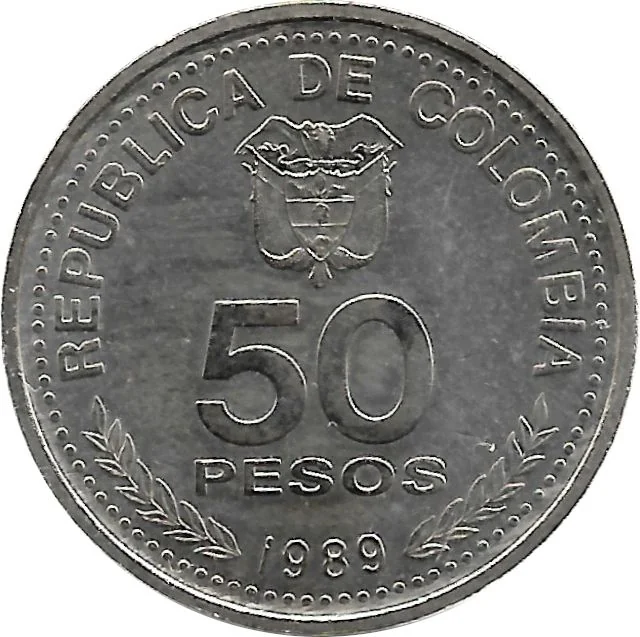
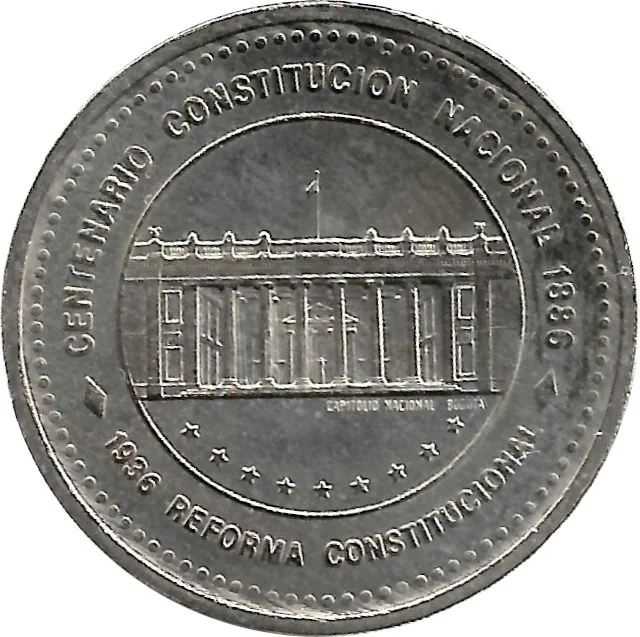
50 pesos (Constitution) – Colombia
Add to wishlist
Circulating commemorative coins
Commemoration: 100th Anniversary of National Constitution; 50th Anniversary of Constitutional Reform
Colombia
Obverse
Reverse
Edge
Smooth with inscription
Legend:
** CASA DE MONEDA ** LIBERTAD Y ORDEN
Categories
| Building |
| Symbols> Coat of Arms |
Mints
| Name | Mark |
|---|---|
| Fábrica de Moneda de Ibagué | — |
Mintings
| Year | Mint Mark | Mintage | Quality | Collection |
|---|---|---|---|---|
| 1986 | — | 14,900,000 | ||
| 1987 | — | 40,042,000 | ||
| 1988 | — | 100,002,000 | ||
| 1989 | — | 80,696,450 |
Historical background
In 1986, Colombia's currency situation was characterized by a managed exchange rate system under significant pressure. The country operated a crawling peg regime, where the Colombian peso was periodically devalued against the US dollar at a pre-announced rate, intended to maintain export competitiveness and control inflation. However, this period followed the profound economic shocks of the early 1980s, including the Latin American debt crisis and a collapse in coffee prices—a key export. Consequently, foreign reserves were strained, and the peso faced persistent downward pressure, requiring active intervention from the Banco de la República to defend the official parity.
Economically, the year was marked by the challenges of President Virgilio Barco's newly inaugurated administration, which inherited an inflation rate soaring above 20%. The currency policy was tightly linked to this battle against inflation, as devaluations were seen as directly feeding into higher import costs and domestic price increases. While the crawling peg aimed for predictability, it often struggled against market forces and illicit capital flight, fueled in part by the burgeoning narcotics trade, which generated vast amounts of US dollars outside formal financial channels and distorted the economy.
Overall, the 1986 currency landscape was one of cautious management amidst internal and external vulnerabilities. The authorities balanced the need for a stable exchange rate to anchor prices with the necessity of maintaining a competitive peso for exporters. This delicate equilibrium would be tested in the coming years, setting the stage for more profound financial liberalization in the early 1990s, including a move towards a more flexible exchange rate system.
Economically, the year was marked by the challenges of President Virgilio Barco's newly inaugurated administration, which inherited an inflation rate soaring above 20%. The currency policy was tightly linked to this battle against inflation, as devaluations were seen as directly feeding into higher import costs and domestic price increases. While the crawling peg aimed for predictability, it often struggled against market forces and illicit capital flight, fueled in part by the burgeoning narcotics trade, which generated vast amounts of US dollars outside formal financial channels and distorted the economy.
Overall, the 1986 currency landscape was one of cautious management amidst internal and external vulnerabilities. The authorities balanced the need for a stable exchange rate to anchor prices with the necessity of maintaining a competitive peso for exporters. This delicate equilibrium would be tested in the coming years, setting the stage for more profound financial liberalization in the early 1990s, including a move towards a more flexible exchange rate system.
🌱 Very Common