

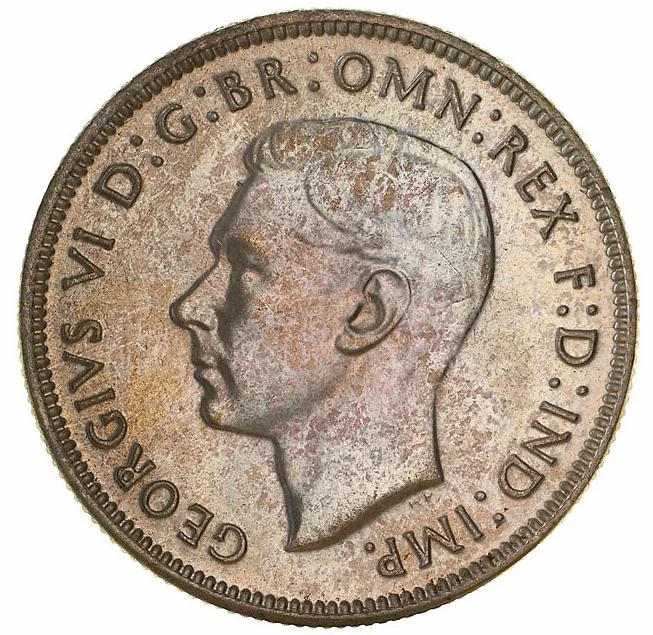
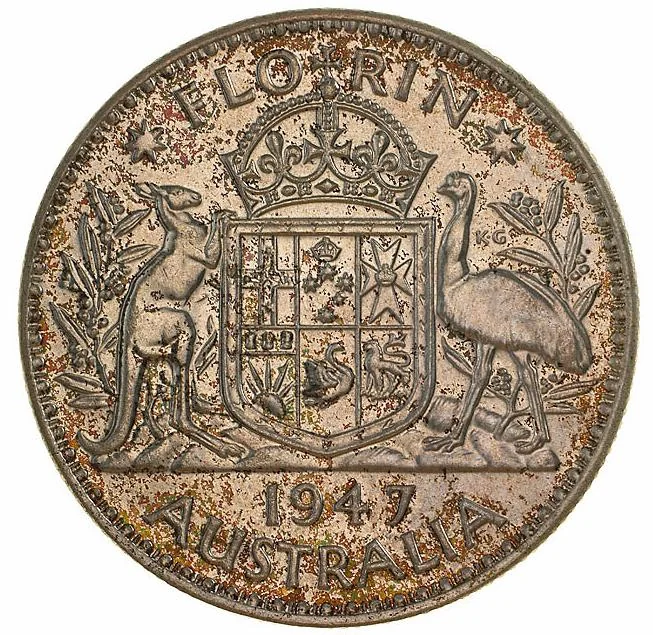

Obverse
Description:
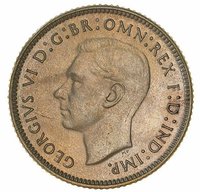
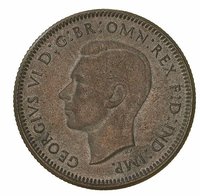
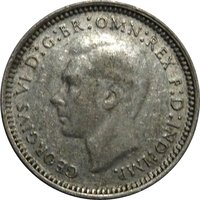
King George VI, left-facing portrait.
Inscription:
GEORGIVS VI D:G:BR:OMN:REX F:D:IND:IMP.
HP
HP
Translation:
George VI by the Grace of God King of all the Britains Defender of the Faith Emperor of India.
Script: Latin
Language: Latin
Designer: Thomas Humphrey Paget
Reverse
Description:
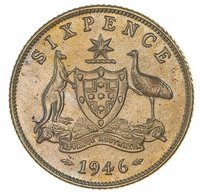
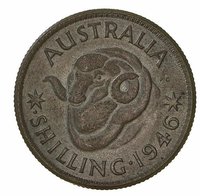
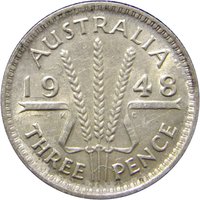
Heraldic emblem
Inscription:
FLORIN
K·G
1946
AUSTRALIA
K·G
1946
AUSTRALIA
Script: Latin
Designer: George Kruger Gray
Edge
Reeded
Mints
| Name | Mark |
|---|---|
| Royal Mint | — |
Mintings
| Year | Mint Mark | Mintage | Quality | Collection |
|---|---|---|---|---|
| 1946 | — | 22,154,000 | ||
| 1946 | — | — | Proof | |
| 1947 | — | 39,292,000 | ||
| 1947 | — | — | Proof |
Historical background
In 1946, Australia’s currency situation was fundamentally shaped by its wartime experience and its position within the British Commonwealth. The nation operated under a strict system of exchange controls, administered by the Commonwealth Bank, which had been instituted in 1939 at the outbreak of World War II. These controls fixed the Australian pound (A£) to sterling at the pre-war parity of A£125 = £100 sterling, creating a "sterling area" bloc with strict limits on converting currency for transactions outside this zone, particularly into US dollars. This framework was designed to conserve foreign reserves, manage the balance of payments, and ensure priority access to essential imports for reconstruction.
The immediate post-war period was characterised by a complex economic duality. Domestically, pent-up consumer demand and a shift to peacetime production fuelled inflationary pressures, which monetary policy sought to contain through continued regulation of bank lending and interest rates. Internationally, Australia faced a severe "dollar shortage," as its need for American capital goods for development vastly outstripped its earnings from exports, which were still heavily oriented toward the UK and wool. Consequently, the government maintained and even tightened exchange controls to prioritise the use of scarce US dollars for critical machinery and petroleum, while discouraging non-essential imports.
This controlled environment was formalised and extended with the passage of the Banking Act 1945 and the Commonwealth Bank Act 1945, which consolidated the central bank’s power over monetary policy and foreign exchange. Thus, in 1946, the Australian currency was not freely convertible and was part of a managed, sterling-aligned system aimed squarely at national economic stability and post-war reconstruction, setting the stage for the economic challenges and debates over financial independence that would define the following decades.
The immediate post-war period was characterised by a complex economic duality. Domestically, pent-up consumer demand and a shift to peacetime production fuelled inflationary pressures, which monetary policy sought to contain through continued regulation of bank lending and interest rates. Internationally, Australia faced a severe "dollar shortage," as its need for American capital goods for development vastly outstripped its earnings from exports, which were still heavily oriented toward the UK and wool. Consequently, the government maintained and even tightened exchange controls to prioritise the use of scarce US dollars for critical machinery and petroleum, while discouraging non-essential imports.
This controlled environment was formalised and extended with the passage of the Banking Act 1945 and the Commonwealth Bank Act 1945, which consolidated the central bank’s power over monetary policy and foreign exchange. Thus, in 1946, the Australian currency was not freely convertible and was part of a managed, sterling-aligned system aimed squarely at national economic stability and post-war reconstruction, setting the stage for the economic challenges and debates over financial independence that would define the following decades.
🌱 Very Common