

10 Korun – Czech Republic
Czechia
Context
Years: 1993–2025
Country: Czechia 
Issuer: Czech Republic
Period:
(since 1993)
Currency:
(since 1993)
Total mintage: 219,956,792
Material
References
KM: #Click to copy to clipboard4
Numista: #2152
Value
Exchange value: 10 CZK = $0.49
Inflation-adjusted value: 44.39 CZK
Obverse
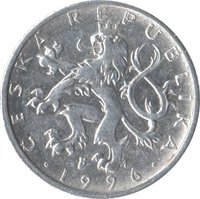
Description:
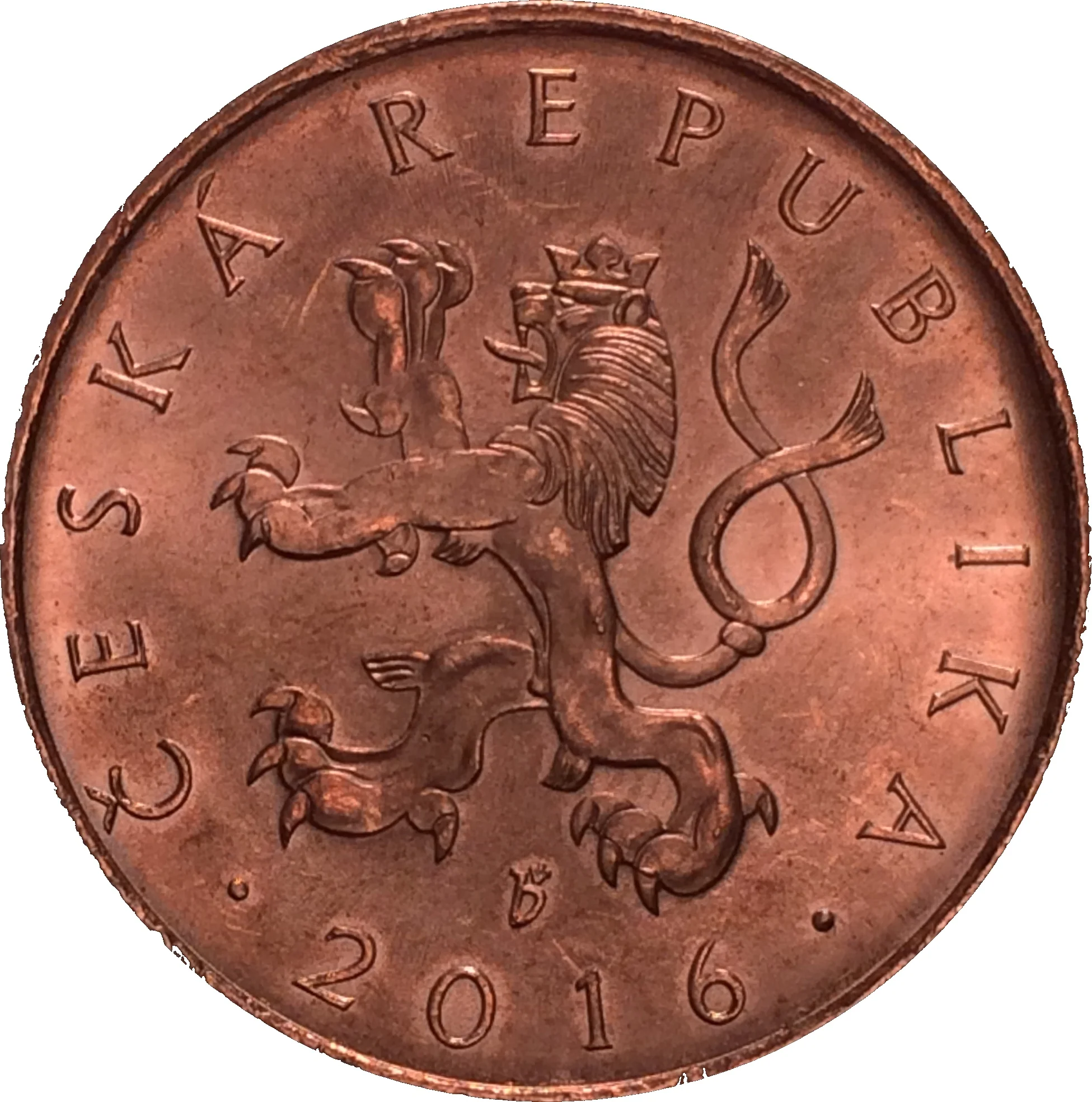
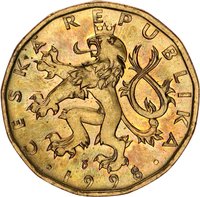
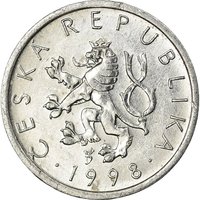
Czech lion, year, mintmark.
Inscription:
ČESKÁ REPUBLIKA
·2016·
·2016·
Translation:
CZECH REPUBLIC
·2016·
·2016·
Script: Latin
Language: Czech
Engraver: Ladislav Kozák
Reverse
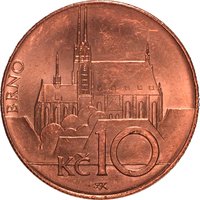
Description:
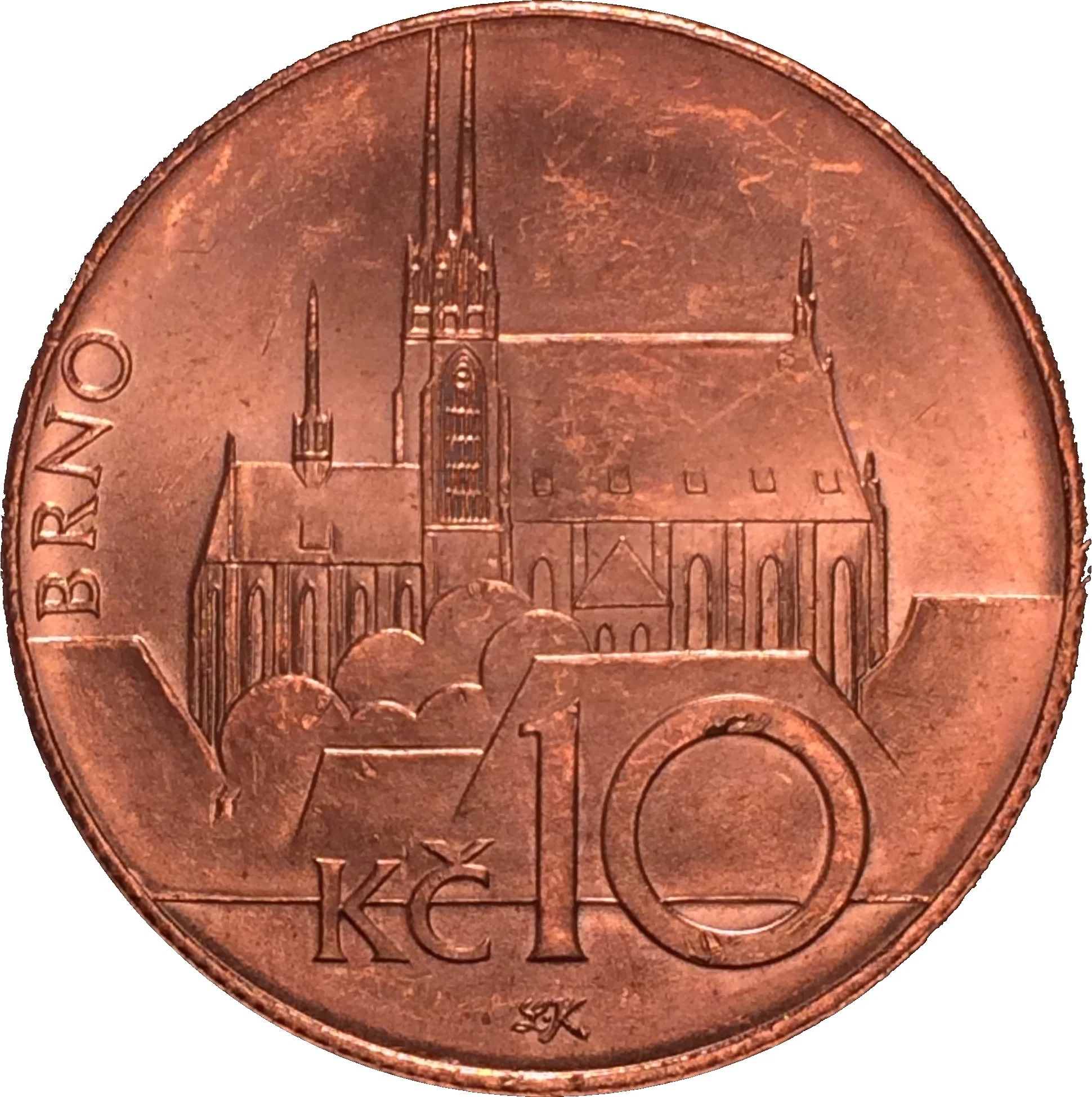
Cathedral of St. Peter and Paul, Brno. Engraver's mark "LK" (position varies).
Inscription:
BRNO
KČ 10 LK
KČ 10 LK
Translation:
BRNO
10 Czech Crowns LK
10 Czech Crowns LK
Script: Latin
Language: Czech
Engraver: Ladislav Kozák
Edge
Reeded (144 reeds)
Categories
| Building> Religious building |
Mints
| Name | Mark |
|---|---|
| Czech Mint | (b) |
| Hamburgische Münze | (HM) |
Mintings
| Year | Mint Mark | Mintage | Quality | Collection |
|---|---|---|---|---|
| 1993 | HM | 1,000 | BU | |
| 1994 | b | 30,000 | ||
| 1995 | b | 20,530,459 | ||
| 1996 | b | 20,644,143 | ||
| 1997 | b | 48,215 | In sets | |
| 1997 | b | 1,500 | Proof | |
| 1998 | b | 25,000 | In sets | |
| 1998 | b | 2,500 | Proof | |
| 1999 | b | 29,490 | In sets | |
| 1999 | b | 2,000 | Proof | |
| 2000 | b | 25,000 | In sets | |
| 2000 | b | 2,500 | Proof | |
| 2001 | b | 25,000 | In sets | |
| 2001 | b | 2,500 | Proof | |
| 2002 | b | 20,156 | In sets | |
| 2002 | b | 3,490 | Proof | |
| 2003 | b | 18,747,000 | ||
| 2003 | b | 3,000 | Proof | |
| 2004 | b | 2,255,740 | ||
| 2004 | b | 4,000 | Proof | |
| 2005 | b | 14,000 | In sets | |
| 2005 | b | 3,000 | Proof | |
| 2006 | b | 30,500 | In sets | |
| 2006 | b | 2,500 | Proof | |
| 2007 | b | 20,500 | In sets | |
| 2007 | b | 2,500 | Proof | |
| 2008 | b | 10,092,000 | ||
| 2008 | b | 2,500 | Proof | |
| 2009 | b | 10,511,000 | ||
| 2009 | b | 3,200 | Proof | |
| 2010 | b | 16,811,000 | ||
| 2010 | b | 3,200 | Proof | |
| 2011 | b | 15,000 | In sets | |
| 2011 | b | 7,000 | Proof | |
| 2012 | b | 22,003 | In sets | |
| 2012 | b | 7,000 | Proof | |
| 2013 | b | 7,872,603 | ||
| 2013 | b | 8,500 | Proof | |
| 2014 | b | 7,360,133 | ||
| 2014 | b | 4,500 | Proof | |
| 2015 | b | 5,267,733 | ||
| 2015 | b | 3,500 | Proof | |
| 2016 | b | 12,612,203 | ||
| 2016 | b | 3,500 | Proof | |
| 2017 | b | 13,666,513 | ||
| 2017 | b | 3,500 | Proof | |
| 2018 | b | 18,679,253 | ||
| 2018 | b | 3,500 | Proof | |
| 2019 | b | 3,200 | Proof | |
| 2019 | b | 10,494,283 | ||
| 2020 | b | 21,018,563 | ||
| 2020 | b | 3,100 | Proof | |
| 2021 | b | 3,100 | Proof | |
| 2021 | b | 6,274,253 | ||
| 2022 | b | 24,953 | ||
| 2022 | b | 3,000 | Proof | |
| 2023 | b | 6,145,633 | ||
| 2023 | b | 3,000 | Proof | |
| 2024 | b | 10,545,673 | ||
| 2024 | b | 3,000 | Proof | |
| 2025 | b | — | ||
| 2025 | b | — | Proof |
Historical background
The currency situation in the Czech Republic in 1993 was defined by the peaceful and meticulously planned dissolution of the Czechoslovak monetary union. Following the "Velvet Divorce" on January 1, 1993, which split Czechoslovakia into two independent states, the Czech and Slovak governments initially maintained a common currency. This interim period, however, proved unsustainable due to fears of asymmetric economic shocks and a lack of a central coordinating authority, leading to concerns about a potential "bank run" as citizens feared devaluation.
To prevent economic chaos, the two republics enacted a swift and orderly separation. On February 8, 1993, the currencies were physically demarcated with adhesive stamps, creating temporary "Czech korunas" and "Slovak korunas." This was a provisional measure to allow for the sorting and redistribution of banknotes. The process was completed with remarkable efficiency, and by mid-1993, the Czech National Bank had introduced its own permanent banknotes and coins, fully establishing the independent Czech koruna (CZK).
This successful monetary divorce was a critical factor in the Czech Republic's subsequent economic stability. The new currency was managed conservatively, avoiding the high inflation that plagued other post-communist transitions. The koruna quickly gained credibility, establishing a foundation for the country's market reforms and paving the way for its future integration into the European Union and, later, participation in the European Exchange Rate Mechanism (ERM II).
To prevent economic chaos, the two republics enacted a swift and orderly separation. On February 8, 1993, the currencies were physically demarcated with adhesive stamps, creating temporary "Czech korunas" and "Slovak korunas." This was a provisional measure to allow for the sorting and redistribution of banknotes. The process was completed with remarkable efficiency, and by mid-1993, the Czech National Bank had introduced its own permanent banknotes and coins, fully establishing the independent Czech koruna (CZK).
This successful monetary divorce was a critical factor in the Czech Republic's subsequent economic stability. The new currency was managed conservatively, avoiding the high inflation that plagued other post-communist transitions. The koruna quickly gained credibility, establishing a foundation for the country's market reforms and paving the way for its future integration into the European Union and, later, participation in the European Exchange Rate Mechanism (ERM II).
🌱 Very Common