

Obverse
Description:
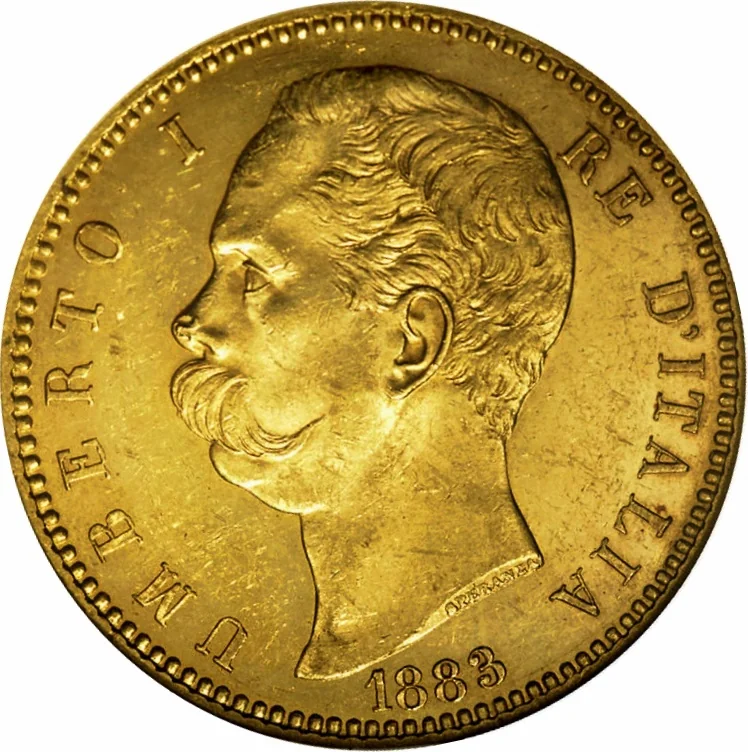
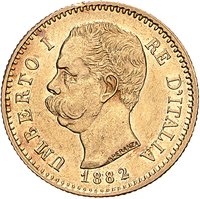
King Umberto I facing left. Date below neck. Engraver's name in neck-cut.
Inscription:
UMBERTO I RE D'ITALIA
1883
1883
Script: Latin
Engraver: Filippo Speranza
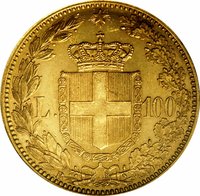
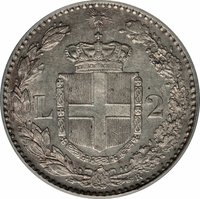
Reverse
Description:
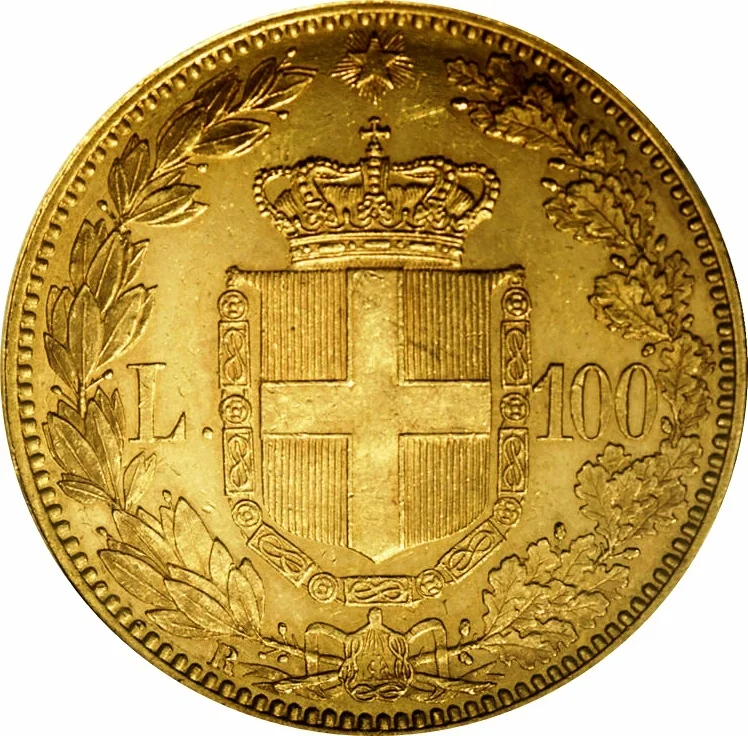
Crowned Savoy coat of arms with the Annunziata collar, flanked by the value and encircled by a laurel and oak wreath. The Star of Italy is above the shield; the mintmark is below the wreath on the right.
Inscription:
L 100
R
R
Script: Latin
Engraver: Filippo Speranza
Edge
Reeded
Mintings
| Year | Mint Mark | Mintage | Quality | Collection |
|---|---|---|---|---|
| 1880 | R | 145 | ||
| 1882 | R | 1,229 | ||
| 1883 | R | 4,219 | ||
| 1888 | R | 1,169 | ||
| 1891 | R | 209 |
Historical background
In 1880, Italy found itself in a precarious monetary situation, caught between its recent political unification and the economic realities of a disparate peninsula. The country was officially on a bimetallic standard (gold and silver), but in practice, the lira was struggling to maintain a stable gold parity. The financial strain of unification, heavy public debt, and large infrastructure projects had led to repeated budget deficits, often financed by printing paper money not fully backed by specie. This resulted in a proliferation of different banknotes from multiple issuing banks, causing confusion and undermining confidence in the currency.
A critical issue was the "forced course" (corso forzoso), a state of inconvertibility decreed in 1866. This meant the government suspended the right to convert paper banknotes into gold or silver, effectively making paper money legal tender. While this provided short-term fiscal flexibility, it led to a divergence between the face value of the paper lira and its metallic value, causing exchange rate instability and inflation. By 1880, the lira traded at a significant discount on international markets, harming trade and foreign investment, and creating a persistent debate about a return to convertibility.
The period around 1880 was thus one of transition and debate. The government, led by Agostino Depretis, was under increasing pressure from industrial and financial interests, particularly in the more developed North, to restore sound money and join the emerging international gold standard. However, the political and economic cost of accumulating sufficient gold reserves and imposing the necessary fiscal austerity was immense. Consequently, Italy remained in a state of monetary limbo, with the corso forzoso persisting until 1883, when a cautious and partial return to convertibility began, setting the stage for the country's turbulent integration into the global gold standard system.
A critical issue was the "forced course" (corso forzoso), a state of inconvertibility decreed in 1866. This meant the government suspended the right to convert paper banknotes into gold or silver, effectively making paper money legal tender. While this provided short-term fiscal flexibility, it led to a divergence between the face value of the paper lira and its metallic value, causing exchange rate instability and inflation. By 1880, the lira traded at a significant discount on international markets, harming trade and foreign investment, and creating a persistent debate about a return to convertibility.
The period around 1880 was thus one of transition and debate. The government, led by Agostino Depretis, was under increasing pressure from industrial and financial interests, particularly in the more developed North, to restore sound money and join the emerging international gold standard. However, the political and economic cost of accumulating sufficient gold reserves and imposing the necessary fiscal austerity was immense. Consequently, Italy remained in a state of monetary limbo, with the corso forzoso persisting until 1883, when a cautious and partial return to convertibility began, setting the stage for the country's turbulent integration into the global gold standard system.
💎 Extremely Rare