


Obverse
Description:
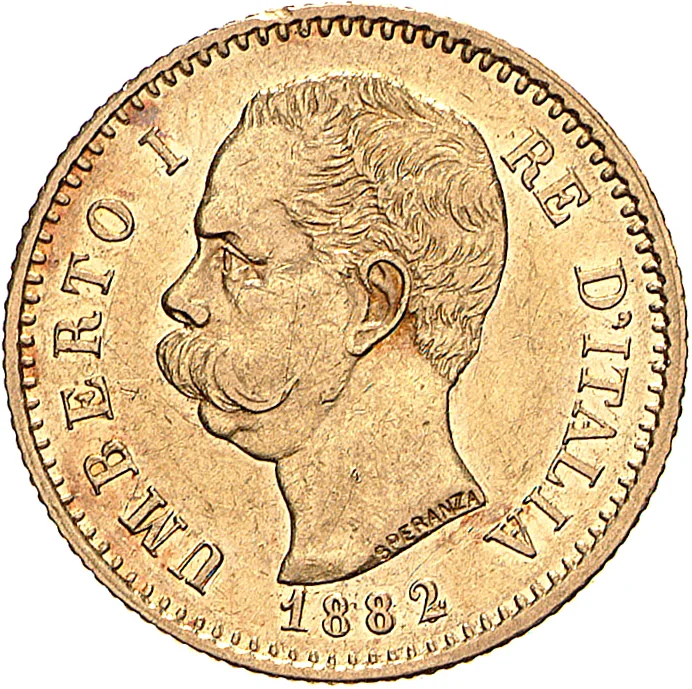
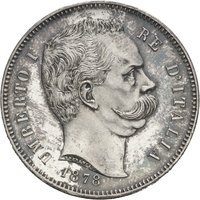
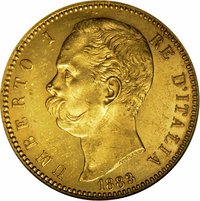
King Umberto I facing left, date below neck, engraver's name in neck-cut.
Inscription:
UMBERTO I RE D'ITALIA
SPERANZA
1891
SPERANZA
1891
Translation:
Umberto I King of Italy
Hope
1891
Hope
1891
Script: Latin
Language: Italian
Engraver: Filippo Speranza
Reverse
Description:
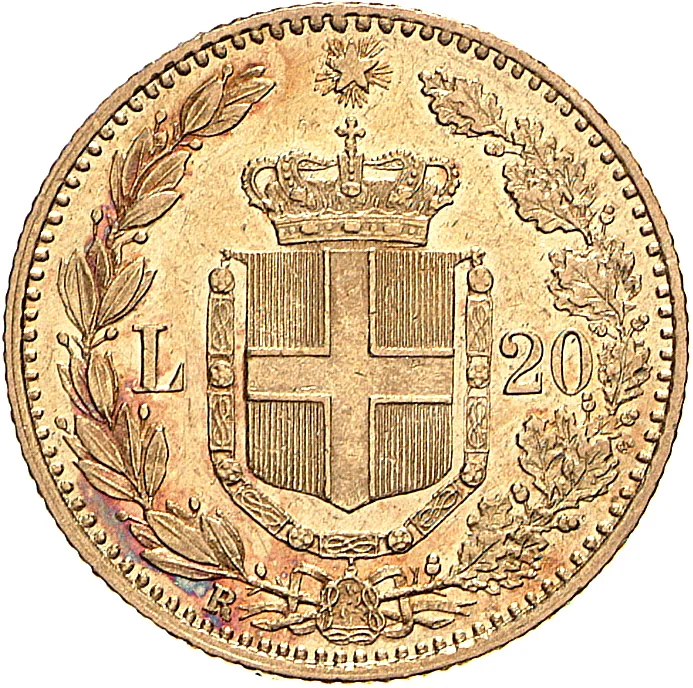
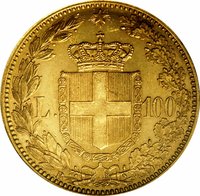
Crowned Savoy coat of arms with the Annunziata collar, flanked by the value and encircled by a laurel and oak wreath. The Star of Italy is above the shield; the mintmark is below the wreath on the right.
Inscription:
L 20
R
R
Translation:
Twenty Lire
Script: Latin
Language: Italian
Engraver: Filippo Speranza
Edge
Reeded
Mints
| Name | Mark |
|---|---|
| Rome | R |
Mintings
Historical background
In 1879, Italy found itself in a precarious monetary situation, characterized by the forced and unpopular policy known as "corso forzoso" (forced circulation). Instituted in 1866 to finance the costs of the Third War of Independence and the nascent state's heavy debts, this law had severed the convertibility of paper banknotes into gold or silver. By 1879, this suspension had entered its thirteenth year, making the lira an inconvertible fiat currency whose value was unstable and largely dependent on government decree rather than metallic reserves. This system created a dual economy: a depreciated paper lira for everyday transactions and a premium-valued gold-based lira for international trade, leading to exchange rate volatility and economic uncertainty.
The prolonged corso forzoso was a source of significant political and economic debate. On one side, industrialists and the government, led by Prime Minister Agostino Depretis, often saw the flexible paper currency as a necessary tool for financing development and managing the kingdom's substantial public debt. On the other side, orthodox economists, creditors, and international financial circles viewed it as a mark of fiscal irresponsibility that discouraged foreign investment and fueled inflation. The pressure to return to a metallic standard was immense, as Italy sought to align itself with the financial orthodoxy of major powers like Britain and France, which were on the gold standard, to gain credibility and stabilize trade.
By the end of the 1870s, a combination of budget surpluses and growing gold reserves provided a pathway toward resumption. The year 1879 was a pivotal turning point, as the Italian Parliament began serious legislative preparations to end the corso forzoso. This culminated in the Law of April 7, 1881, which authorized a return to convertibility within three years. Thus, 1879 represented the final phase of the inconvertible era, a year of intense preparation where Italy was poised to abandon its forced paper currency and commit to the gold standard, a move finally achieved in 1883.
The prolonged corso forzoso was a source of significant political and economic debate. On one side, industrialists and the government, led by Prime Minister Agostino Depretis, often saw the flexible paper currency as a necessary tool for financing development and managing the kingdom's substantial public debt. On the other side, orthodox economists, creditors, and international financial circles viewed it as a mark of fiscal irresponsibility that discouraged foreign investment and fueled inflation. The pressure to return to a metallic standard was immense, as Italy sought to align itself with the financial orthodoxy of major powers like Britain and France, which were on the gold standard, to gain credibility and stabilize trade.
By the end of the 1870s, a combination of budget surpluses and growing gold reserves provided a pathway toward resumption. The year 1879 was a pivotal turning point, as the Italian Parliament began serious legislative preparations to end the corso forzoso. This culminated in the Law of April 7, 1881, which authorized a return to convertibility within three years. Thus, 1879 represented the final phase of the inconvertible era, a year of intense preparation where Italy was poised to abandon its forced paper currency and commit to the gold standard, a move finally achieved in 1883.

🌱 Common