

1 Shilling – Uganda
Uganda
Context
Year: 1987
Issuer: Uganda 
Issuing organization: Bank of Uganda
Period:
(since 1962)
Currency:
(since 1987)
Material
Diameter: 19.85 mm
Weight: 4.3 g
Thickness: 2.05 mm
Shape: Dodecagonal
Technique: Milled
Alignment: Medal alignment
flip
References
KM: #Click to copy to clipboard27
Numista: #2112
Value
Exchange value: 1 UGX
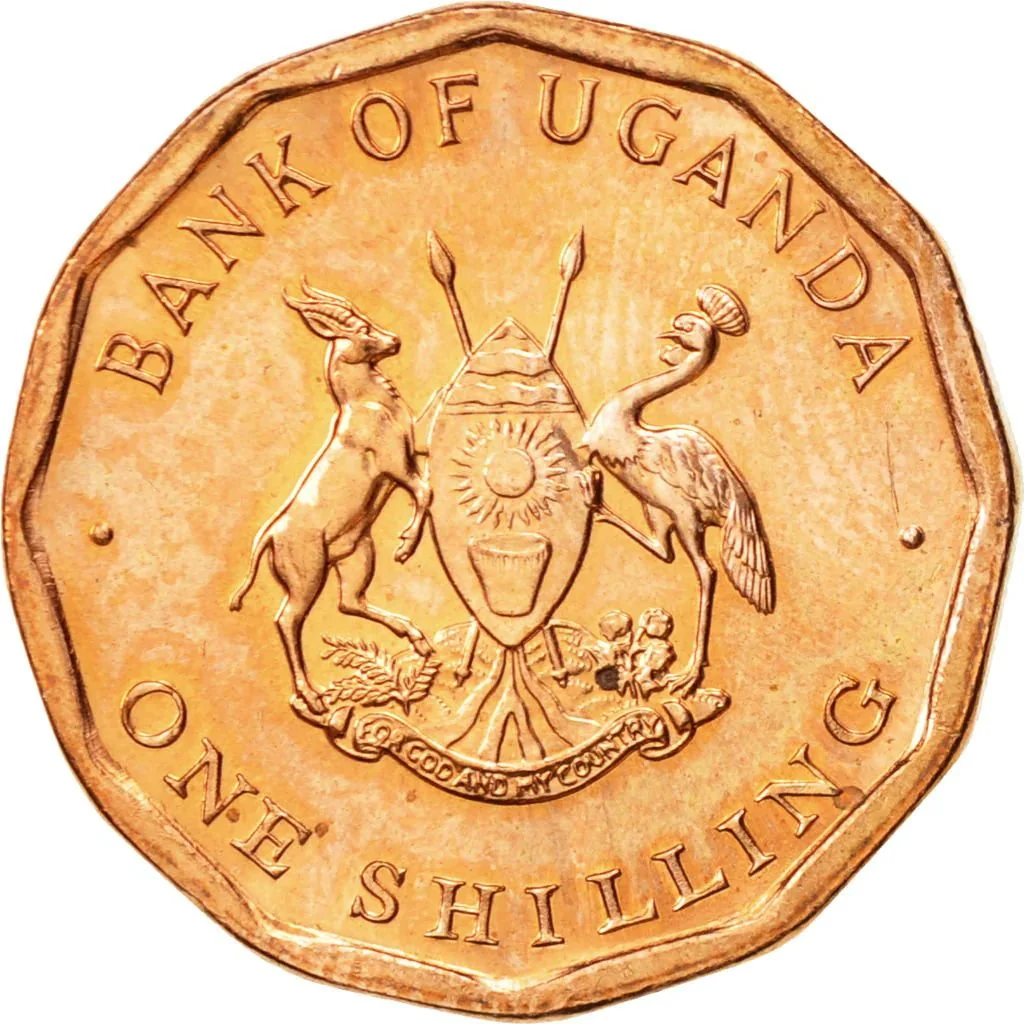
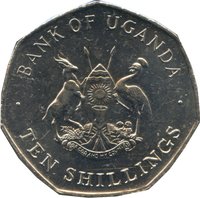
Obverse
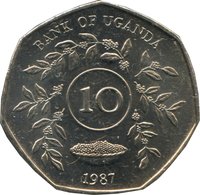
Reverse
Description:
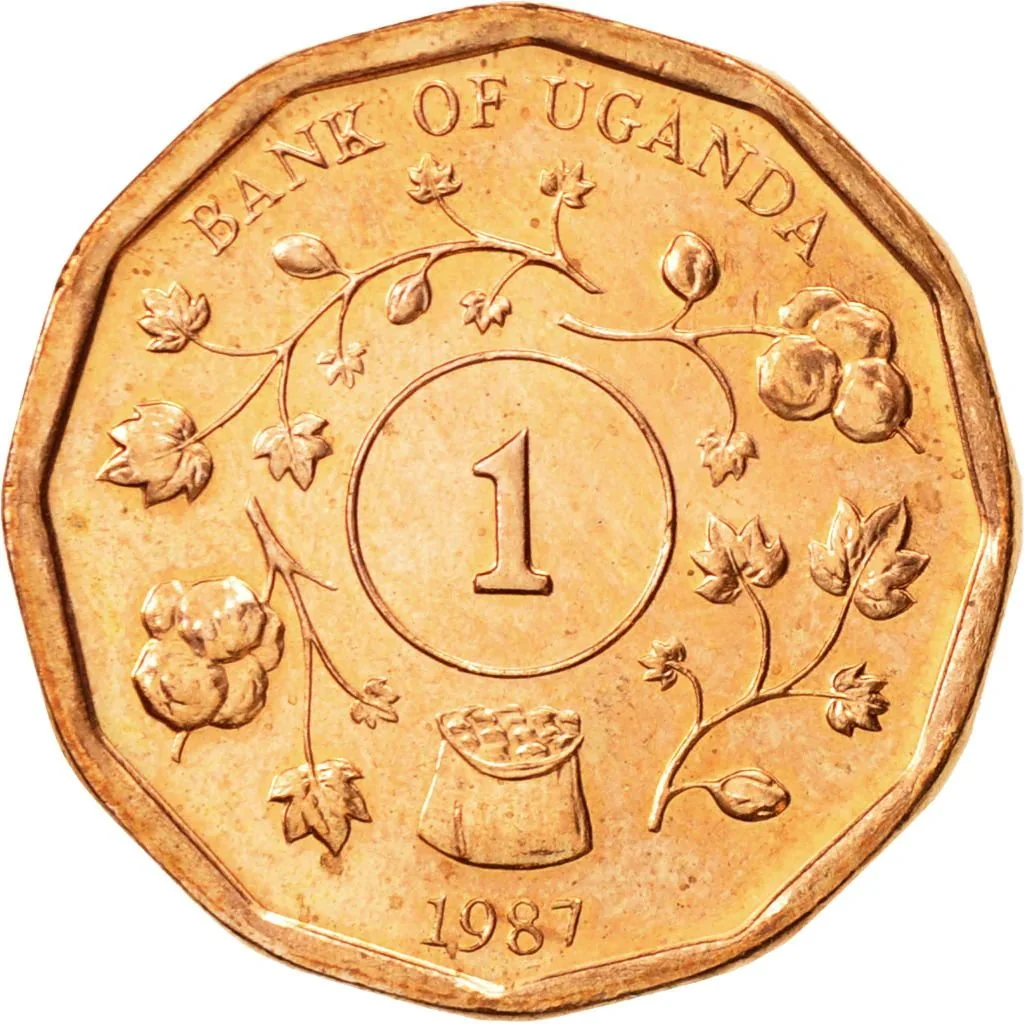
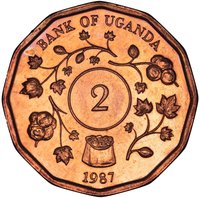
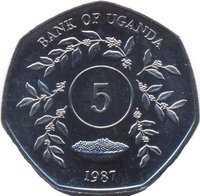
Cotton sprigs encircling a value. Sack of nuts below.
Inscription:
BANK OF UGANDA
1
1987
1
1987
Script: Latin
Edge
Plain
Categories
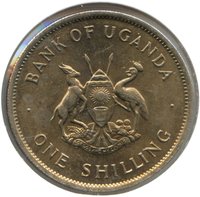
| Symbols> Coat of Arms |
Mints
| Name | Mark |
|---|---|
| Royal Mint | — |
Mintings
| Year | Mint Mark | Mintage | Quality | Collection |
|---|---|---|---|---|
| 1987 | — | — | ||
| 1987 | — | — | Proof |
Historical background
In 1987, Uganda was emerging from two decades of profound political turmoil and economic collapse under the regimes of Idi Amin and Milton Obote. The national currency, the Ugandan shilling, was severely debased, suffering from hyperinflation that had reached an annual rate of over 200%. Years of fiscal indiscipline, rampant money printing to fund deficits, collapsed export production, and widespread economic mismanagement had destroyed public confidence in the currency, leading to a thriving black market where the shilling traded at a fraction of its official, overvalued rate.
Recognizing that economic stabilization was essential for national recovery, the new government of President Yoweri Museveni, which had taken power in 1986, embarked on a radical reform program in consultation with the International Monetary Fund and World Bank. The cornerstone of this program was the introduction of a new currency in May 1987. The old shilling was replaced at a rate of 100 to 1 with the "new" Ugandan shilling (UGX), a measure intended to simplify transactions and signal a decisive break from the past. This devaluation and currency reform were part of a broader Economic Recovery Programme (ERP) aimed at restoring fiscal discipline, liberalizing markets, and rebuilding the productive capacity of the economy.
The immediate aftermath was challenging, as the currency change alone could not instantly curb inflation, which remained high due to underlying structural issues. However, the 1987 reforms marked a critical turning point. The move established a foundation for macroeconomic stability by beginning the process of unifying the exchange rate and restoring a degree of monetary control. It represented the first painful but necessary step in Uganda's long and difficult journey from post-conflict economic ruin toward the sustained growth and relative stability it would experience in the subsequent decades.
Recognizing that economic stabilization was essential for national recovery, the new government of President Yoweri Museveni, which had taken power in 1986, embarked on a radical reform program in consultation with the International Monetary Fund and World Bank. The cornerstone of this program was the introduction of a new currency in May 1987. The old shilling was replaced at a rate of 100 to 1 with the "new" Ugandan shilling (UGX), a measure intended to simplify transactions and signal a decisive break from the past. This devaluation and currency reform were part of a broader Economic Recovery Programme (ERP) aimed at restoring fiscal discipline, liberalizing markets, and rebuilding the productive capacity of the economy.
The immediate aftermath was challenging, as the currency change alone could not instantly curb inflation, which remained high due to underlying structural issues. However, the 1987 reforms marked a critical turning point. The move established a foundation for macroeconomic stability by beginning the process of unifying the exchange rate and restoring a degree of monetary control. It represented the first painful but necessary step in Uganda's long and difficult journey from post-conflict economic ruin toward the sustained growth and relative stability it would experience in the subsequent decades.
Series: 1987 series
🌱 Very Common