

5 kroner (Immigration to America) – Norway
Add to wishlist
Circulating commemorative coins
Commemoration: 150th anniversary - Immigration to America
Norway
Context
Material
Diameter: 29.5 mm
Weight: 11.5 g
Thickness: 2.23 mm
Shape: Round
Composition: Copper-nickel
Technique: Milled
Alignment: Medal alignment
flip
References
KM: #
Numista: #14684
Value
Exchange value: 5 NOK
Inflation-adjusted value: 39.49 NOK
Obverse
Description:
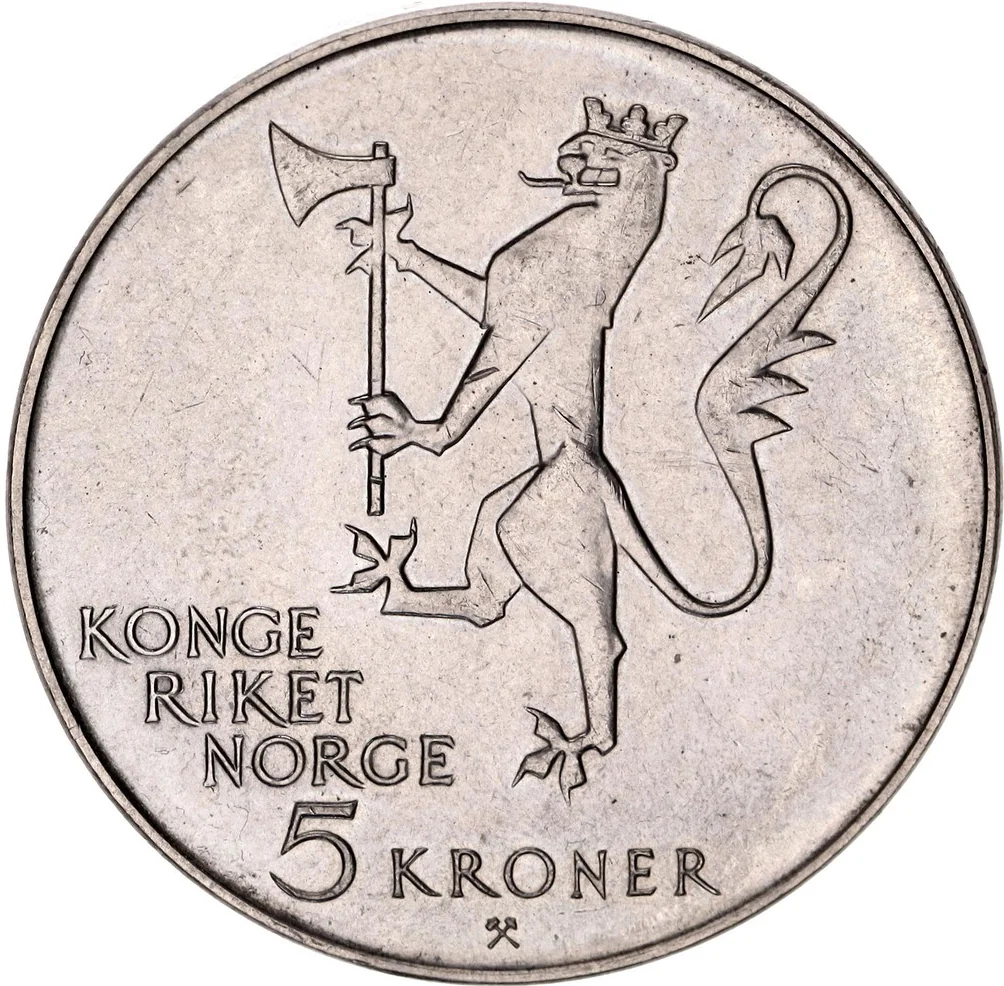
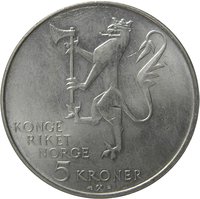
Crowned Norwegian lion facing left, holding a halberd. Three-line inscription by its back, value and mintmark below. Solid rim ring.
Inscription:
KONGE
RIKET
NORGE
5 KRONER
⚒
RIKET
NORGE
5 KRONER
⚒
Translation:
Kingdom of Norway
5 Kroner
5 Kroner
Script: Latin
Language: Norwegian
Engraver: Øivind Hansen
Reverse
Description:
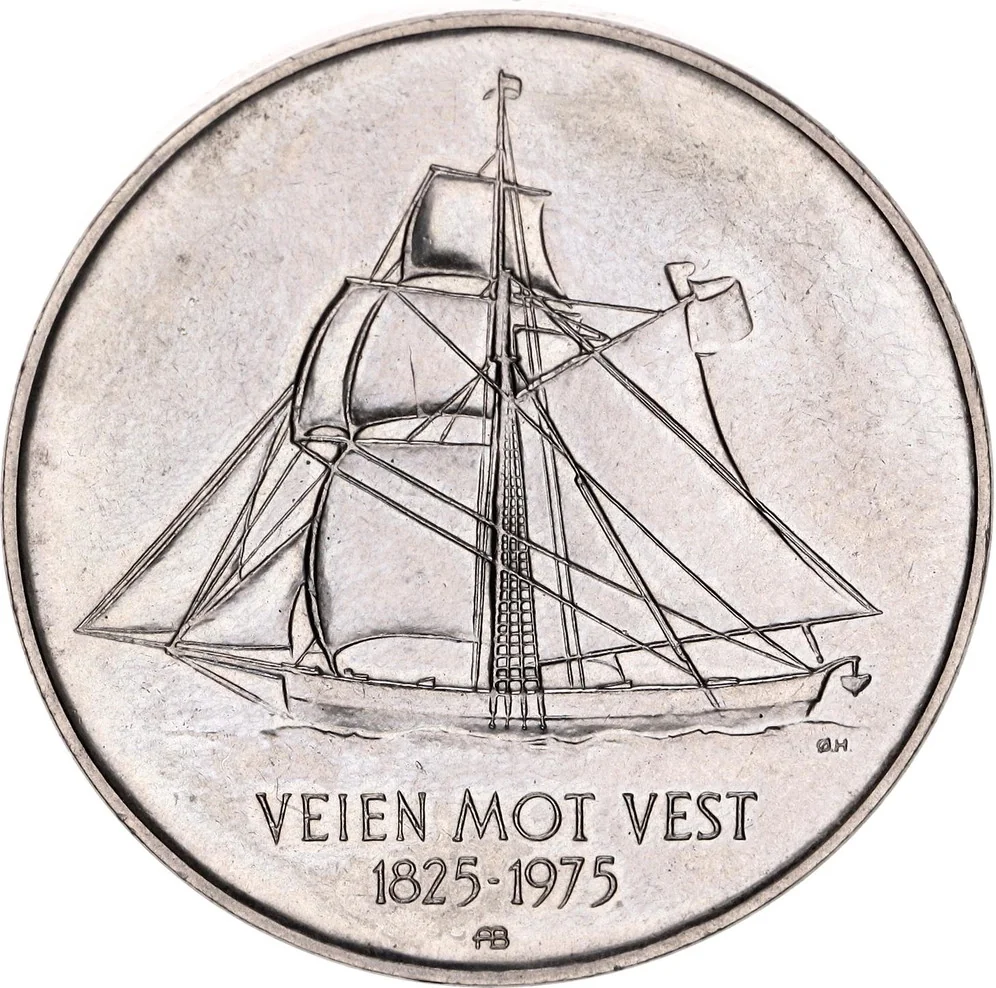
Sailing ship "Restaurasjonen" facing left. Engraver's initials below ship; inscription, date, and mintmaster's initials below. Solid ring on rim.
Inscription:
Ø.H.
VEIEN MOT VEST
1825-1975
AB
VEIEN MOT VEST
1825-1975
AB
Translation:
The Road West
1825-1975
1825-1975
Script: Latin
Language: Norwegian
Engraver: Øivind Hansen
Edge
Plain
Categories
| Transportation> Watercraft |
Mints
| Name | Mark |
|---|---|
| Norwegian Mint | — |
Mintings
| Year | Mint Mark | Mintage | Quality | Collection |
|---|---|---|---|---|
| 1975 | — | 1,187,333 |
Historical background
In 1975, Norway’s currency situation was defined by its participation in the European "snake in the tunnel" exchange rate mechanism, a collective effort to limit fluctuations between European currencies following the collapse of the Bretton Woods system. Norway, not an EEC member but closely tied to European trade, had joined the arrangement in 1972. However, maintaining a stable krone within the agreed narrow bands proved increasingly difficult. The country faced significant economic pressures, including high inflation imported from the global oil crisis and a domestic wage boom, which eroded competitiveness and led to persistent downward pressure on the krone.
This period was one of frequent devaluations and instability for the Norwegian krone (NOK). Within the "snake," Norway was forced to undertake several unilateral devaluations in the early 1970s to correct trade imbalances. The situation culminated in 1975 when, after struggling to defend the currency, Norway made a decisive break. In December, the government announced it would cease its efforts to keep the krone within the "snake's" strict margins, opting instead to peg it to a trade-weighted basket of currencies. This move effectively ended Norway’s tight coupling to the German Mark and the core European bloc, allowing for a more flexible and manageable exchange rate policy tailored to its own economic conditions.
The shift in 1975 was a pragmatic response to domestic economic realities, occurring just as revenues from the fledgling North Sea oil industry began to flow. While oil wealth would soon transform the national economy, its full impact on the krone was not yet felt. Therefore, the currency policy of 1975 reflected a transitional phase—moving away from the constraints of a European system that had become unsustainable for Norway, and toward a more independent monetary framework that would later have to manage the profound complexities of becoming a major petroleum exporter.
This period was one of frequent devaluations and instability for the Norwegian krone (NOK). Within the "snake," Norway was forced to undertake several unilateral devaluations in the early 1970s to correct trade imbalances. The situation culminated in 1975 when, after struggling to defend the currency, Norway made a decisive break. In December, the government announced it would cease its efforts to keep the krone within the "snake's" strict margins, opting instead to peg it to a trade-weighted basket of currencies. This move effectively ended Norway’s tight coupling to the German Mark and the core European bloc, allowing for a more flexible and manageable exchange rate policy tailored to its own economic conditions.
The shift in 1975 was a pragmatic response to domestic economic realities, occurring just as revenues from the fledgling North Sea oil industry began to flow. While oil wealth would soon transform the national economy, its full impact on the krone was not yet felt. Therefore, the currency policy of 1975 reflected a transitional phase—moving away from the constraints of a European system that had become unsustainable for Norway, and toward a more independent monetary framework that would later have to manage the profound complexities of becoming a major petroleum exporter.
🌱 Common