

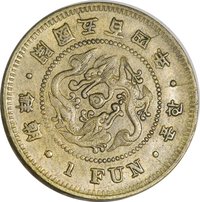
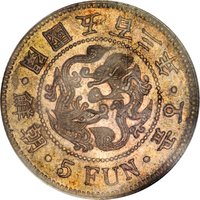
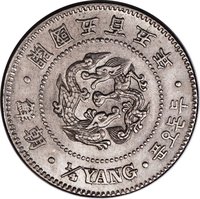
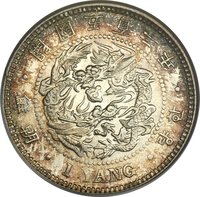
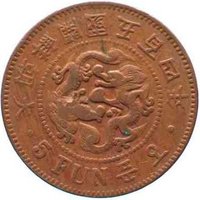
Obverse
Description:
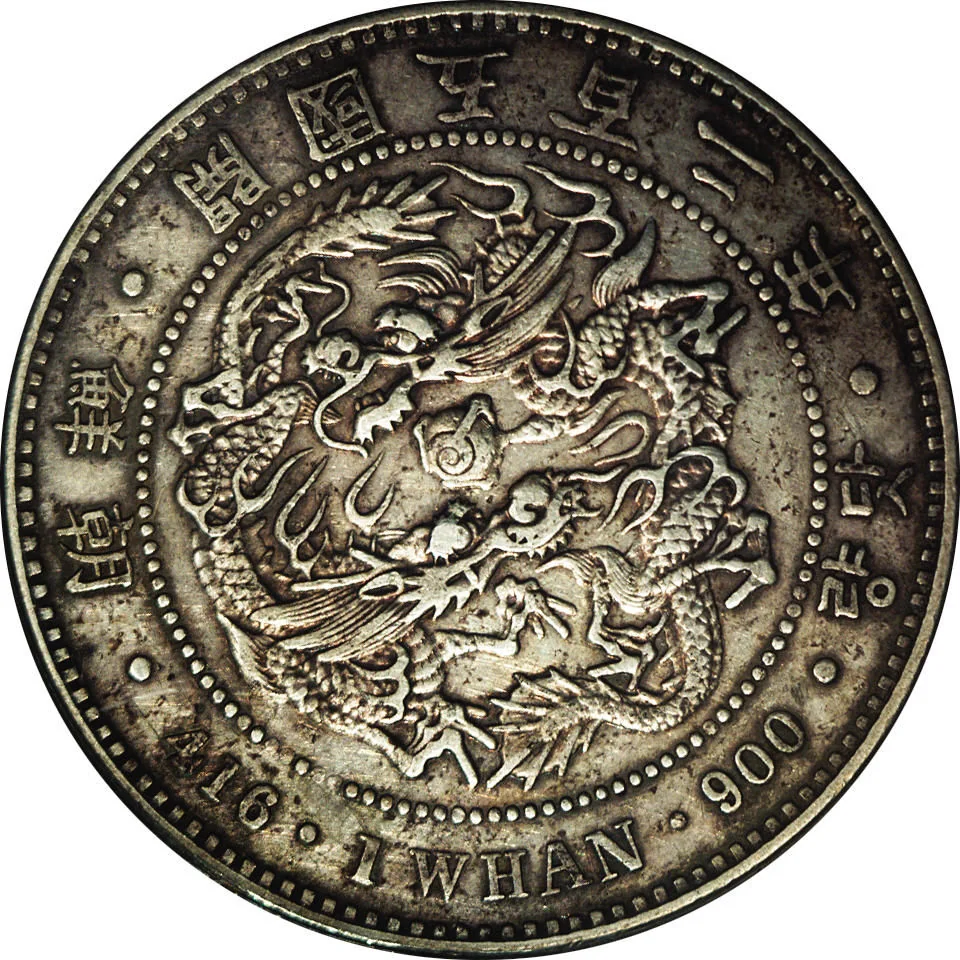
Two dragons. Date top, denomination bottom.
Inscription:
• 朝鮮 • 開國五百二年 • 닷량 • 416·1 WHAN·900
Translation:
Five Hundred Second Year of the [Korean] Empire, Five Yang, 416.1 WHAN·900
Languages: Chinese characters, Korean
Engraver: Masuda Tomō
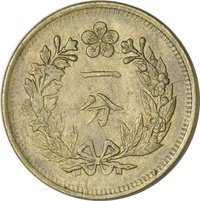
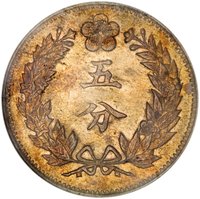
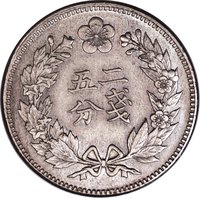
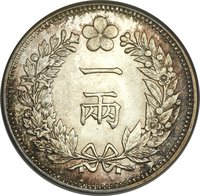
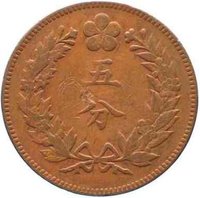
Reverse
Description:
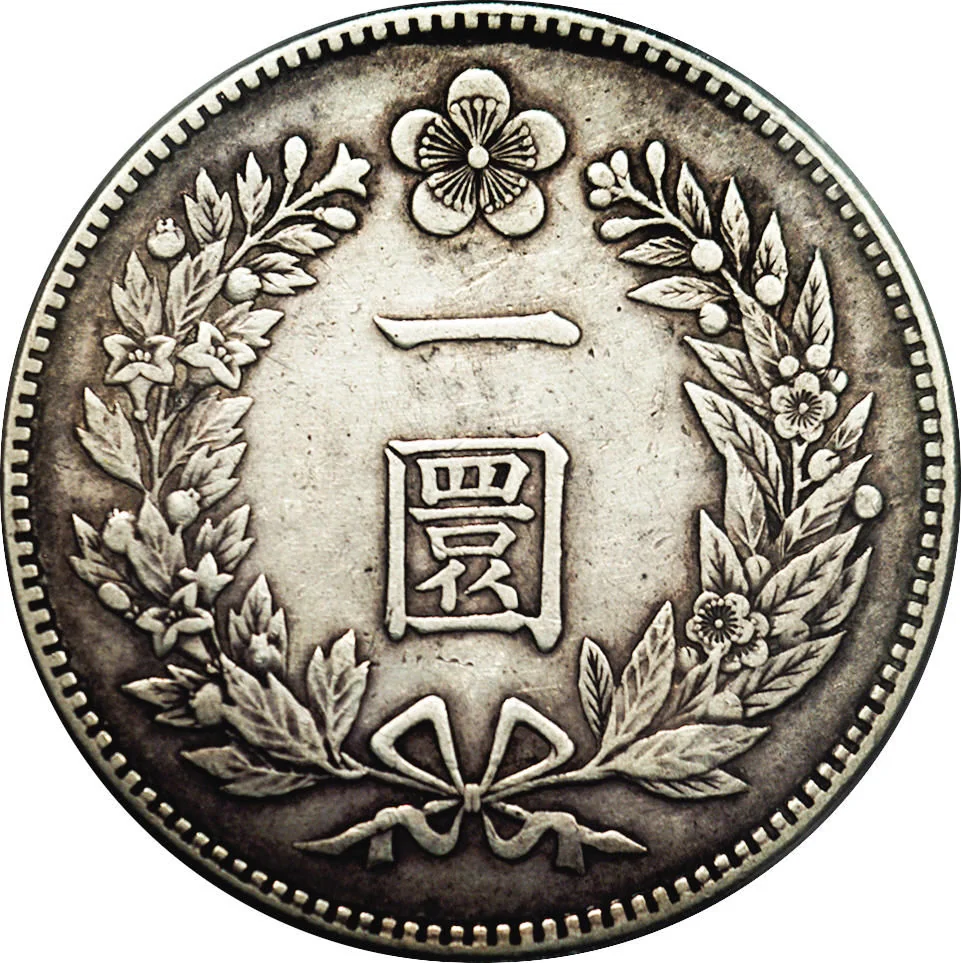
Denomination encircled by Rose of Sharon (left) and plum (right), with the Plum Blossom (Imperial Seal) above.
Inscription:
一
圜
圜
Translation:
One Coin
Language: Classical Chinese
Engraver: Egami Genjirō
Edge
Categories
| Mythology> Fantastic animal |
| Plants> Flower |
| Symbols> Coat of Arms |
| Symbol> Wreath |
Mints
| Name | Mark |
|---|---|
| Incheon | — |
Mintings
| Year | Mint Mark | Mintage | Quality | Collection |
|---|---|---|---|---|
| 1893 | — | — |
Historical background
In 1893, the currency system of the Joseon Dynasty was in a state of profound crisis and confusion, characterized by a chaotic multiplicity of currencies. The official coinage, the sangpyeong tongbo copper-alloy cash coins, had been severely debased over decades, leading to rampant counterfeiting. Alongside these, various forms of paper money, including both government-issued notes and privately issued sahwan (private merchant notes), circulated with unreliable backing. Furthermore, the economy was flooded with foreign currencies, particularly the Mexican silver dollar (and its Japanese-minted counterpart, the yen), which became the preferred medium for large transactions and foreign trade, undermining the state's monetary sovereignty.
This monetary disorder was not merely an economic issue but a potent source of social unrest and political weakness. The fluctuating and often arbitrary exchange rates between copper, silver, and paper created opportunities for exploitation by corrupt officials and wealthy merchants, burdening the peasantry and sparking localized revolts. The Donghak Peasant Rebellion, which would erupt in 1894, drew significant energy from these widespread economic grievances, including anger over unstable currency and predatory lending practices. Internationally, the currency chaos reflected and exacerbated Joseon's vulnerability, as Chinese, Japanese, and Russian interests vied for influence, each seeking to tie the Korean economy to their own monetary sphere.
King Gojong's government, under the guidance of the Gaehwa (Enlightenment) Party, recognized the need for reform and had begun to lay the groundwork for a modern, unified currency system. Efforts were made to establish a royal mint (the Joseon Tongchi), and discussions were underway with foreign advisors and the Japanese to introduce machine-struck silver and copper coins. However, in 1893, these plans remained largely aspirational. The state was trapped between the collapsing old order and a not-yet-realized new one, leaving the year as a final, turbulent chapter of the traditional monetary system before the upheavals of the Gabo Reforms (1894-1896) and the eventual introduction of the yang and won.
This monetary disorder was not merely an economic issue but a potent source of social unrest and political weakness. The fluctuating and often arbitrary exchange rates between copper, silver, and paper created opportunities for exploitation by corrupt officials and wealthy merchants, burdening the peasantry and sparking localized revolts. The Donghak Peasant Rebellion, which would erupt in 1894, drew significant energy from these widespread economic grievances, including anger over unstable currency and predatory lending practices. Internationally, the currency chaos reflected and exacerbated Joseon's vulnerability, as Chinese, Japanese, and Russian interests vied for influence, each seeking to tie the Korean economy to their own monetary sphere.
King Gojong's government, under the guidance of the Gaehwa (Enlightenment) Party, recognized the need for reform and had begun to lay the groundwork for a modern, unified currency system. Efforts were made to establish a royal mint (the Joseon Tongchi), and discussions were underway with foreign advisors and the Japanese to introduce machine-struck silver and copper coins. However, in 1893, these plans remained largely aspirational. The state was trapped between the collapsing old order and a not-yet-realized new one, leaving the year as a final, turbulent chapter of the traditional monetary system before the upheavals of the Gabo Reforms (1894-1896) and the eventual introduction of the yang and won.
Series: 1893 Joseon circulation coins
💎 Very Rare