

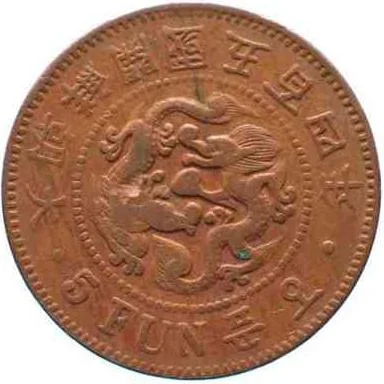
Obverse
Description:
Two dragons. Date top, denomination bottom.
Inscription:
• 大朝鮮 開國五百四年 • 오푼 • 5 FUN
Translation:
Great Korea, Open Country 504th Year; Five Fun; 5 FUN
Language: Korean
Engraver: Masuda Tomō
Reverse
Description:
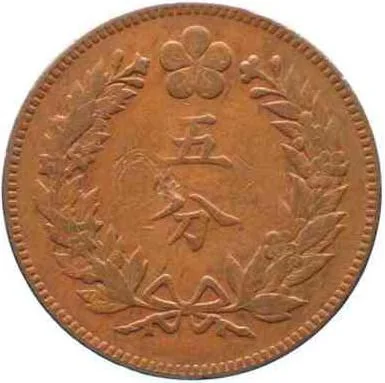
Denomination encircled by Rose of Sharon (left) and plum (right), with the Plum Blossom (Imperial Seal) above.
Inscription:
五
分
分
Translation:
Five Cents
Language: Chinese
Engraver: Egami Genjirō
Edge
Plain
Categories
| Plants> Flower |
| Symbols> Coat of Arms |
| Mythology> Fantastic animal |
| Symbol> Wreath |
Mints
| Name | Mark |
|---|---|
| Incheon | — |
Mintings
| Year | Mint Mark | Mintage | Quality | Collection |
|---|---|---|---|---|
| 1895 | — | — | ||
| 1896 | — | — |
Historical background
In 1895, the currency system of the Joseon Dynasty was in a state of profound crisis and transition, emblematic of the kingdom's struggle to maintain sovereignty. The traditional system, based on copper mun coins and silver yang ingots, was plagued by chronic instability. For centuries, rampant counterfeiting and the arbitrary issuance of devalued coins by both the government and private mints had led to severe inflation and a loss of public trust. This monetary confusion crippled domestic commerce and state finances, leaving the economy vulnerable.
This vulnerability was exploited by foreign powers, particularly Japan and China, who sought economic and political dominance over the Korean Peninsula. Following the Sino-Japanese War (1894-1895), Japan, through the Treaty of Shimonoseki, ended China's suzerainty over Joseon. Japan then pushed aggressively for modernization, including monetary reform, to integrate Joseon into the Japanese economic sphere. In 1895, Japanese advisors, wielding significant influence over the reformist cabinet, drafted the "Currency Ordinance" to replace the old mun with a new decimal system based on the won and jeon, modeled directly on the Japanese yen.
Thus, the currency situation in 1895 was a pivotal moment, caught between the collapse of a centuries-old metallic system and the forced imposition of a modern, foreign-designed one. The Gabo Reforms of 1894-1896, which included the monetary ordinance, were less an organic development and more a tool of Japanese imperial policy. While aiming for stability, the reforms effectively began the process of subordinating Joseon's economy to Japan, a prelude to the formal establishment of the Korean Empire's new currency in 1901 and, ultimately, annexation in 1910.
This vulnerability was exploited by foreign powers, particularly Japan and China, who sought economic and political dominance over the Korean Peninsula. Following the Sino-Japanese War (1894-1895), Japan, through the Treaty of Shimonoseki, ended China's suzerainty over Joseon. Japan then pushed aggressively for modernization, including monetary reform, to integrate Joseon into the Japanese economic sphere. In 1895, Japanese advisors, wielding significant influence over the reformist cabinet, drafted the "Currency Ordinance" to replace the old mun with a new decimal system based on the won and jeon, modeled directly on the Japanese yen.
Thus, the currency situation in 1895 was a pivotal moment, caught between the collapse of a centuries-old metallic system and the forced imposition of a modern, foreign-designed one. The Gabo Reforms of 1894-1896, which included the monetary ordinance, were less an organic development and more a tool of Japanese imperial policy. While aiming for stability, the reforms effectively began the process of subordinating Joseon's economy to Japan, a prelude to the formal establishment of the Korean Empire's new currency in 1901 and, ultimately, annexation in 1910.
⭐ Somewhat Rare