

1 riyal – Saudi Arabia
Add to wishlist
Saudi Arabia
Context
Year: 1955
Islamic (Hijri) Year:: 1374
Issuer: Saudi Arabia
Ruler: Saud bin Abdulaziz
Currency:
(1925—1960)
Demonetized: Yes
Total mintage: 48,000,000
Material
References
KM: #
Numista: #21033
Value
Bullion value: $19.28
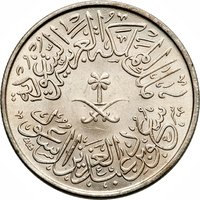
Obverse
Description:
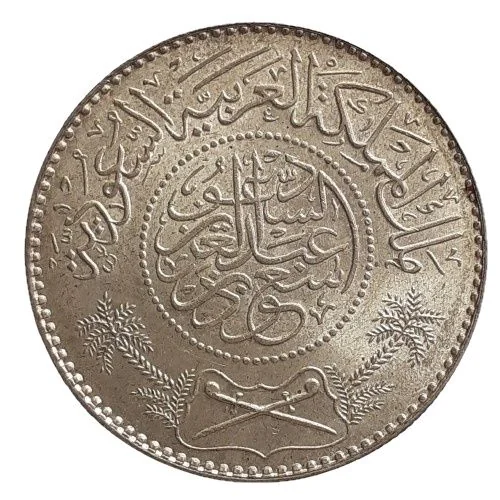
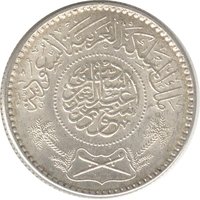
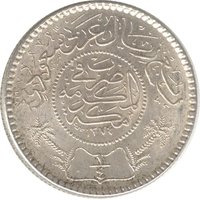
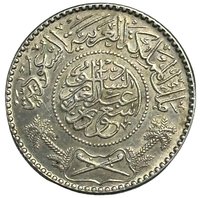
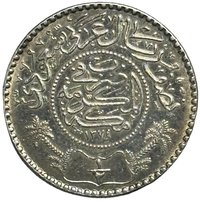
A grenetis with a circular Arabic thuluth inscription, flanked by palm trees and featuring a shield with two crossed swords.
Inscription:
ملك المملكة العربية السعودية
سعود بن عبد العزيز آل سعود
سعود بن عبد العزيز آل سعود
Translation:
King of the Kingdom of Saudi Arabia
Saud bin Abdulaziz Al Saud
Saud bin Abdulaziz Al Saud
Script: Arabic
Language: Arabic
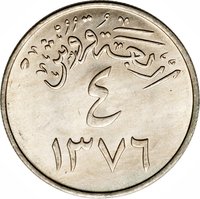
Reverse
Edge
Reeded
Categories
| Object> Cold weapons |
| Plant> Tree |
Mints
| Name | Mark |
|---|---|
| Mexican Mint | — |
Mintings
| Year | Mint Mark | Mintage | Quality | Collection |
|---|---|---|---|---|
| 1955 | — | 48,000,000 |
Historical background
In 1955, Saudi Arabia’s currency system was in a state of transition, characterized by a dual circulation of metal and paper money. The official currency was the Saudi Riyal (SAR), which was pegged to and freely convertible with gold sovereigns. However, the primary medium of exchange for large transactions and foreign trade was not a Saudi note but the Maria Theresa Thaler (MTT), a silver coin minted abroad. This venerable silver dollar had circulated in the region for centuries and remained deeply trusted, especially in the Hijaz. Alongside it, gold sovereigns were used for high-value dealings, creating a bimetallic system largely independent of a central bank, as the Saudi Arabian Monetary Agency (SAMA) had only been established in 1952.
The young SAMA, under the guidance of American financial advisor Arthur N. Young, was actively working to establish a unified national currency and modernize the financial system. A key step had been taken in 1953 with the introduction of the first Saudi Arabian gold-backed paper currency, the "Pilgrims' Receipts." These were initially intended for use by pilgrims to the holy cities but began circulating more widely. By 1955, SAMA was consolidating its role, aiming to replace the heterogeneous mix of foreign and metallic currencies with a stable, government-issued paper Riyal, thereby asserting greater monetary control and facilitating economic development.
Thus, the currency situation in 1955 was one of deliberate changeover. The old, familiar system of silver Thalers and gold coins coexisted with the new paper Riyals, reflecting both the traditional mercantile economy and the modernizing ambitions of the state. This period marked the final chapter of the Thaler's dominance, as SAMA's systematic efforts would soon lead to its full demonetization and the establishment of the Saudi Riyal as the sole legal tender, paving the way for the oil-fueled economic transformation that lay ahead.
The young SAMA, under the guidance of American financial advisor Arthur N. Young, was actively working to establish a unified national currency and modernize the financial system. A key step had been taken in 1953 with the introduction of the first Saudi Arabian gold-backed paper currency, the "Pilgrims' Receipts." These were initially intended for use by pilgrims to the holy cities but began circulating more widely. By 1955, SAMA was consolidating its role, aiming to replace the heterogeneous mix of foreign and metallic currencies with a stable, government-issued paper Riyal, thereby asserting greater monetary control and facilitating economic development.
Thus, the currency situation in 1955 was one of deliberate changeover. The old, familiar system of silver Thalers and gold coins coexisted with the new paper Riyals, reflecting both the traditional mercantile economy and the modernizing ambitions of the state. This period marked the final chapter of the Thaler's dominance, as SAMA's systematic efforts would soon lead to its full demonetization and the establishment of the Saudi Riyal as the sole legal tender, paving the way for the oil-fueled economic transformation that lay ahead.
🌟 Uncommon