

50 piastres – Syria
Add to wishlist
Syria
Context
Year: 1958
Islamic (Hijri) Year:: 1377
Issuer: Syria
Period:
(1958—1961)
Currency:
(since 1919)
Demonetized: Yes
Total mintage: 1,779,100
Material
References
KM: #
Numista: #21016
Value
Exchange value: 0.50 SYP
Bullion value: $7.34
Obverse
Description:
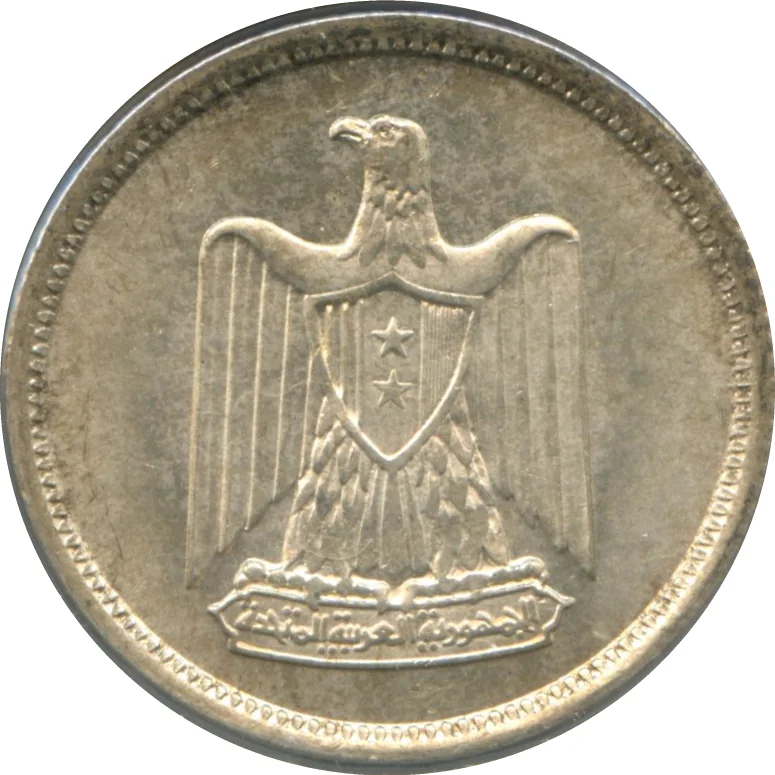
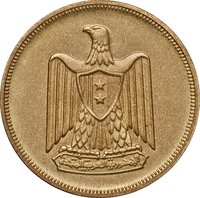
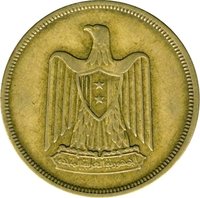
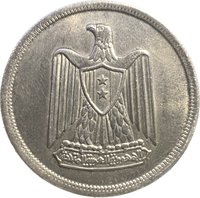
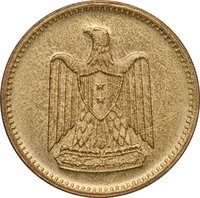
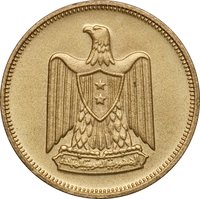
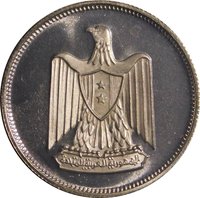
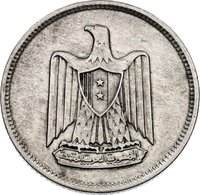
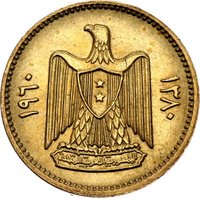
United Arab Republic coat of arms (1958-1961): A left-facing Saladin eagle with outstretched wings holds a scroll. On its chest is a shield trisected vertically, featuring two stars on the central band.
Inscription:
الجمهورية العربية المتحدة
Translation:
The United Arab Republic
Script: Arabic
Language: Arabic
Reverse
Edge
Reeded
Categories
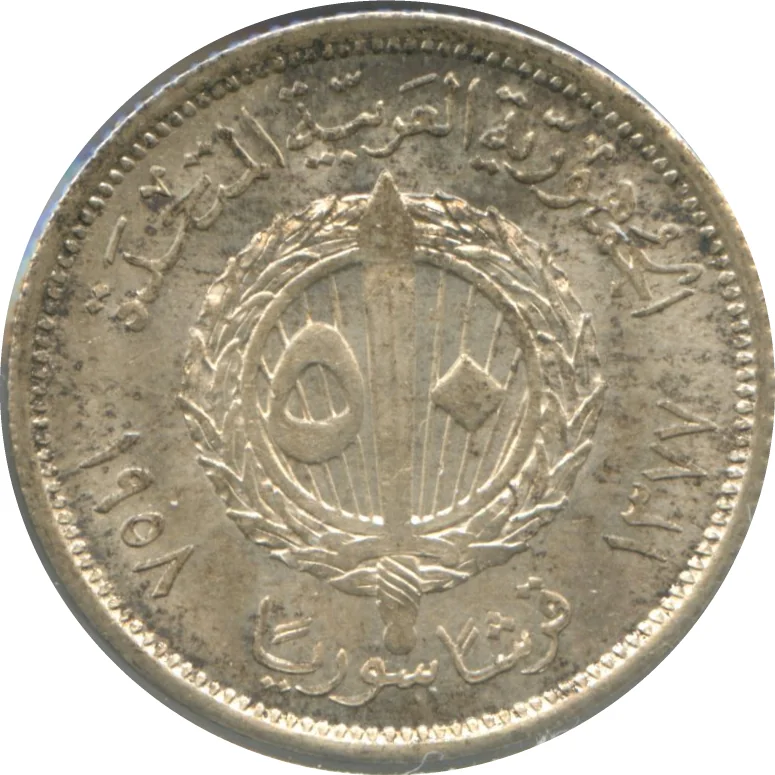
| Symbol> Wreath |
| Object> Cold weapons |
| Animal> Bird> Eagle |
| Symbols> Coat of Arms |
Mints
| Name | Mark |
|---|---|
| Egyptian Mint Authority | — |
Mintings
| Year | Mint Mark | Mintage | Quality | Collection |
|---|---|---|---|---|
| 1958 | — | 1,779,100 |
Historical background
In 1958, Syria's currency situation was fundamentally reshaped by its political union with Egypt, forming the United Arab Republic (UAR). Prior to this, Syria operated on a currency board system, issuing the Syrian pound (S£) which was backed by and pegged to the French franc. This system provided stability but was seen by many as a vestige of colonial influence. The country's economy was largely agricultural, with a growing industrial sector, and its monetary policy was conservative, maintaining strong foreign exchange reserves.
The creation of the UAR in February 1958 triggered immediate monetary integration. A central bank, the Central Bank of Syria and Egypt, was established in Damascus to replace the old currency board, marking a shift toward a more active central banking model. While the Syrian and Egyptian pounds remained separate physical currencies, they were declared legally equal and interchangeable at par (1:1) within the union. This was a political symbol of unity, intended to facilitate trade and economic merger, though in practice, full monetary union was never fully realized.
Consequently, 1958 represents a year of transitional uncertainty rather than stable reform. The artificial 1:1 parity was difficult to maintain, as the economies of Syria and Egypt were structurally different and not well-integrated. Fears of inflation from Egypt and concerns over Syrian economic autonomy began to surface. By the end of the year, the groundwork was laid for future monetary instability, which would eventually contribute to the economic tensions preceding the UAR's dissolution in 1961.
The creation of the UAR in February 1958 triggered immediate monetary integration. A central bank, the Central Bank of Syria and Egypt, was established in Damascus to replace the old currency board, marking a shift toward a more active central banking model. While the Syrian and Egyptian pounds remained separate physical currencies, they were declared legally equal and interchangeable at par (1:1) within the union. This was a political symbol of unity, intended to facilitate trade and economic merger, though in practice, full monetary union was never fully realized.
Consequently, 1958 represents a year of transitional uncertainty rather than stable reform. The artificial 1:1 parity was difficult to maintain, as the economies of Syria and Egypt were structurally different and not well-integrated. Fears of inflation from Egypt and concerns over Syrian economic autonomy began to surface. By the end of the year, the groundwork was laid for future monetary instability, which would eventually contribute to the economic tensions preceding the UAR's dissolution in 1961.
Series: UAR- Salaheldin Eagle
🌱 Fairly Common