

½ Quart – Gibraltar
United Kingdom
Context
Years: 1842–1861
Country: United Kingdom 
Issuer: Gibraltar 
Ruler: Victoria
Currency:
(1802—1861)
Demonetized: Yes
Total mintage: 38,700
Material
References
KM: #Click to copy to clipboard1
Numista: #20939
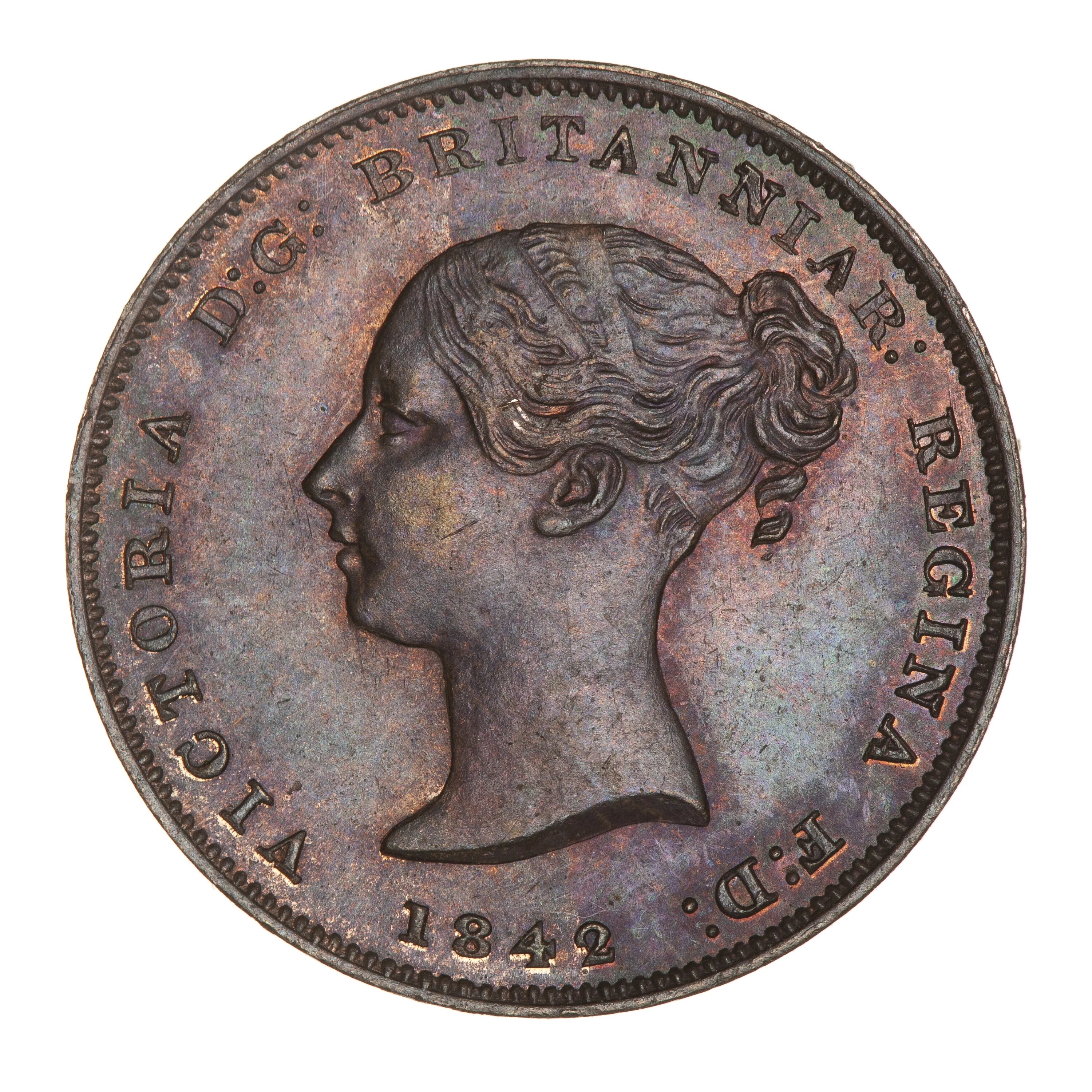
Obverse
Description:
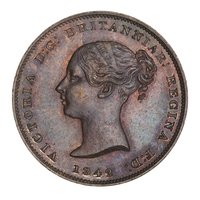
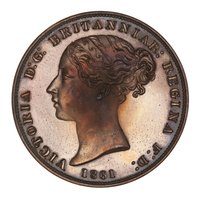
Victoria's head, facing left.
Inscription:
VICTORIA D:G: BRITANNIAR: REGINA F:D:
1861
1861
Translation:
Victoria by the Grace of God, Queen of the Britains, Defender of the Faith.
Script: Latin
Language: Latin
Designer and engraver: William Wyon
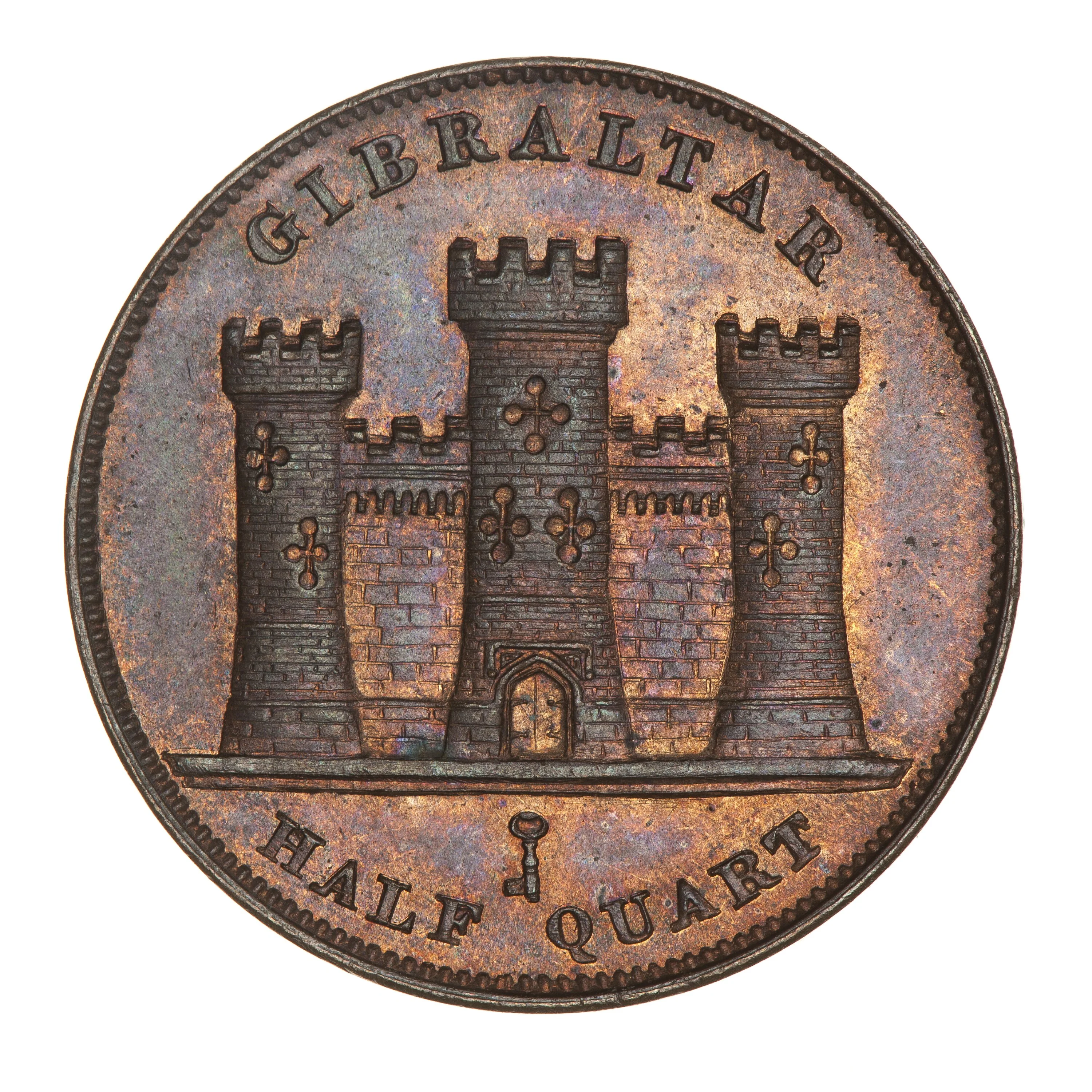
Reverse
Edge
Categories
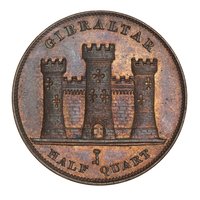
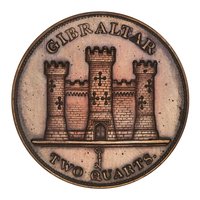
| Building> Castle or fortification |
| Building> Tower |
Mints
| Name | Mark |
|---|---|
| Royal Mint (Tower Hill) | — |
Mintings
| Year | Mint Mark | Mintage | Quality | Collection |
|---|---|---|---|---|
| 1842 | — | 38,700 | ||
| 1861 | — | — | Proof |
Historical background
In 1842, Gibraltar's currency situation was a complex and practical reflection of its unique position as a British fortress-colony with a predominantly Spanish-speaking population engaged in vibrant Mediterranean trade. Officially, the British pound sterling was the legal tender, but in everyday commerce, a diverse array of coins circulated freely. These included Spanish reales and dollars (pesos), British sovereigns and shillings, Portuguese coins, and even French francs and Arabic currencies from North Africa. This monetary bazaar was driven by necessity, as the limited supply of official British coinage was insufficient for local needs, and the port's economy relied heavily on transactions with neighbouring Spain and visiting merchant ships.
The British authorities, while asserting sovereignty, adopted a pragmatic approach to this de facto multi-currency system. They accepted Spanish dollars for payment of government dues and even used them to pay the garrison, calculating their value against a fixed sterling standard. This created a dual-system where accounts were kept in pounds, shillings, and pence, but physical transactions were often conducted in Spanish currency. The situation was formalised by local ordinances that gave specific foreign coins, particularly the Spanish dollar, a legal valuation for transactional purposes, effectively creating a regulated foreign currency circulation alongside sterling.
This period preceded the major imperial currency reforms of the later 19th century. The year 1842 thus represents a point of stable, if complicated, equilibrium in Gibraltar's monetary history. The system, though untidy, functioned adequately for trade and daily life. However, it was inherently dependent on the stability and silver content of the Spanish dollar, and shifts in Spain's own political and economic fortunes would later prompt Gibraltar to move toward a more formalised sterling-based system, a process that would take decades to fully complete.
The British authorities, while asserting sovereignty, adopted a pragmatic approach to this de facto multi-currency system. They accepted Spanish dollars for payment of government dues and even used them to pay the garrison, calculating their value against a fixed sterling standard. This created a dual-system where accounts were kept in pounds, shillings, and pence, but physical transactions were often conducted in Spanish currency. The situation was formalised by local ordinances that gave specific foreign coins, particularly the Spanish dollar, a legal valuation for transactional purposes, effectively creating a regulated foreign currency circulation alongside sterling.
This period preceded the major imperial currency reforms of the later 19th century. The year 1842 thus represents a point of stable, if complicated, equilibrium in Gibraltar's monetary history. The system, though untidy, functioned adequately for trade and daily life. However, it was inherently dependent on the stability and silver content of the Spanish dollar, and shifts in Spain's own political and economic fortunes would later prompt Gibraltar to move toward a more formalised sterling-based system, a process that would take decades to fully complete.
🌟 Limited