


Obverse
Description:
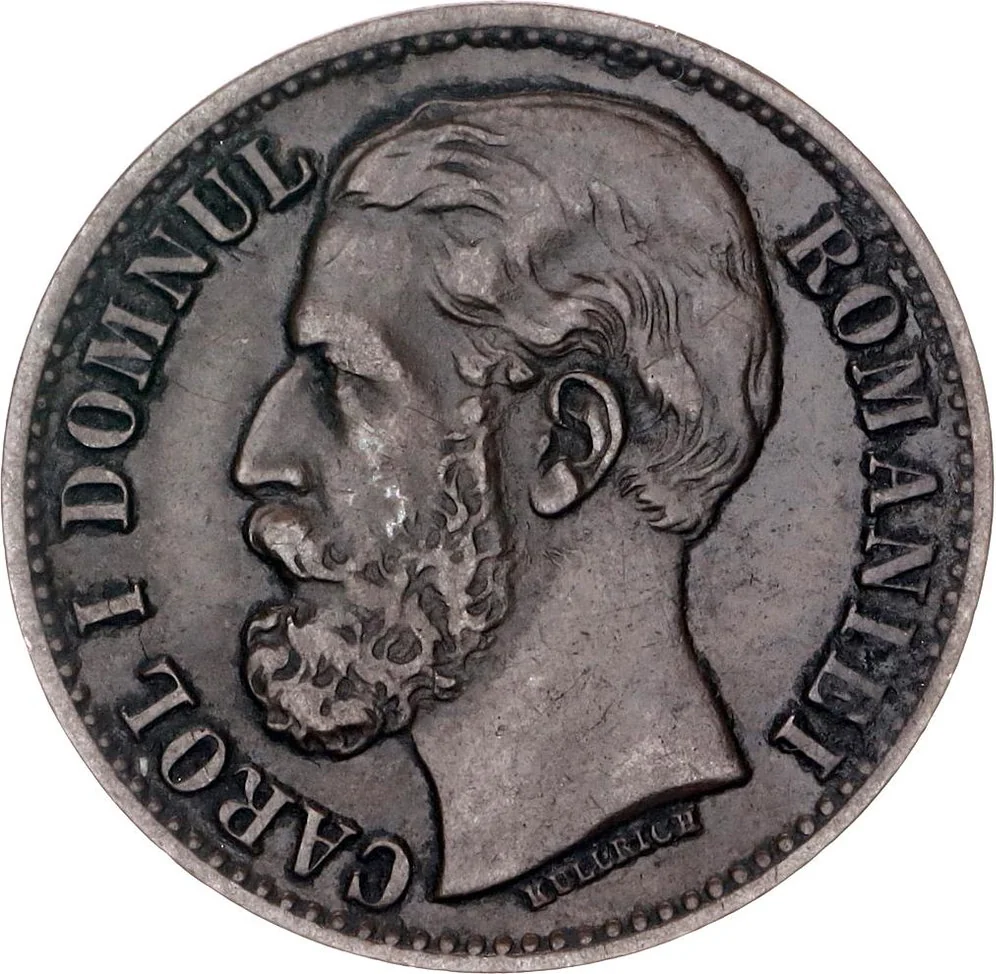
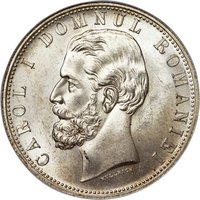
King Carol I left profile.
Inscription:
CAROL I DOMNUL ROMANIEI
KULLRICH
KULLRICH
Translation:
CAROL I LORD OF ROMANIA
KULLRICH
KULLRICH
Script: Latin
Language: Romanian
Engraver: Friedrich Wilhelm Kullrich
Reverse
Edge
Plain
Categories
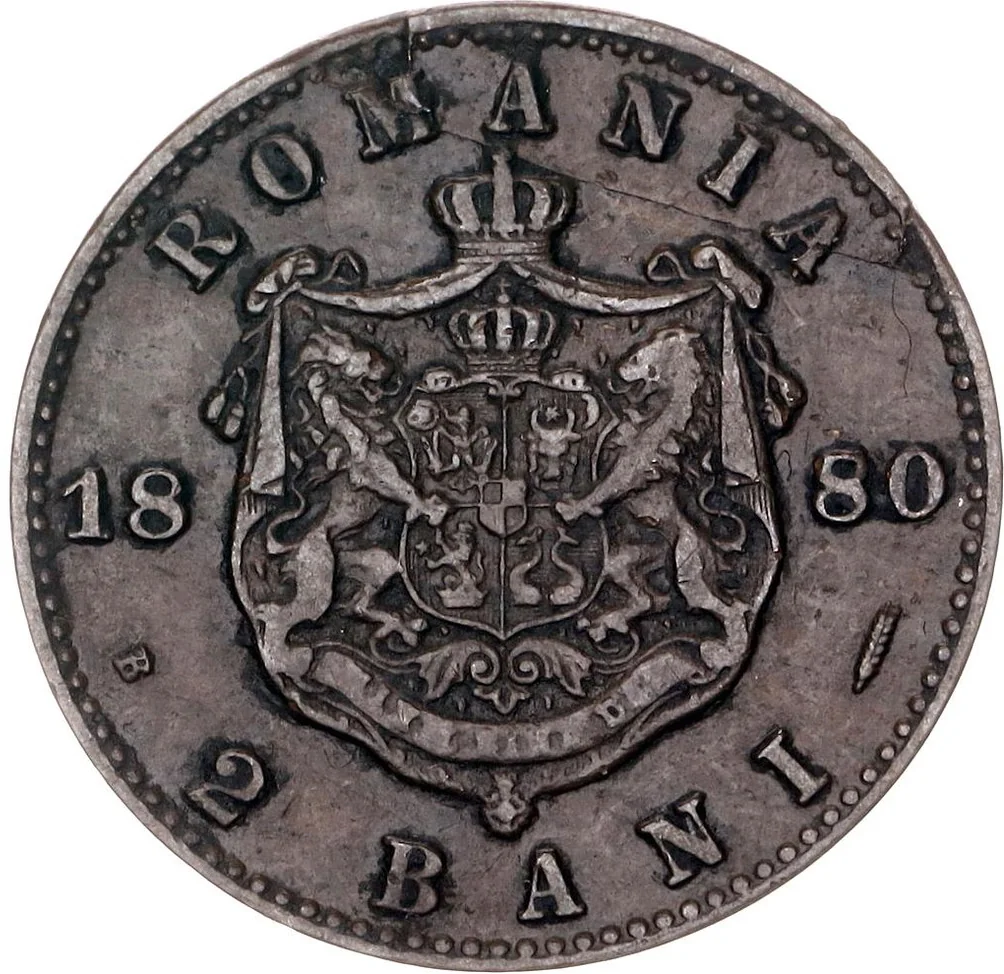
| Symbols> Coat of Arms |
| Person> Monarch |
Mints
| Name | Mark |
|---|---|
| State Mint | B |
Historical background
In 1879, Romania stood at a pivotal economic and political juncture, having recently gained full independence from the Ottoman Empire following the Russo-Turkish War (1877-1878). The nation's monetary system was a complex and cumbersome reflection of its past. The official currency was the Romanian Leu, but in practice, the circulation was dominated by a multitude of foreign coins, primarily silver Austro-Hungarian florins (forints) and Russian rubles, alongside older Ottoman and other European currencies. This lack of a unified, sovereign currency hindered domestic trade, state finances, and was a symbolic obstacle to national sovereignty.
The government, led by Prime Minister Ion Brătianu, recognized that monetary reform was essential for modern state-building and economic development. Consequently, 1879 marked the year of decisive legislative action. The Law for the Creation of the National Bank of Romania was passed, establishing the Banca Națională a României, which was tasked with issuing a stable, uniform national currency. Furthermore, the Law on the Mint was enacted, which officially adopted a bimetallic standard, pegging the leu to both gold and silver, aligning it with the Latin Monetary Union system used by France, Belgium, Switzerland, and Italy.
Therefore, the currency situation in 1879 was one of transition from chaotic multiplicity to ordered uniformity. While the actual issuance of new national coinage would begin in 1880, the foundational laws passed in 1879 set the critical institutional framework. This reform aimed to solidify Romania's financial independence, attract foreign investment for its burgeoning oil and grain industries, and integrate the young kingdom more firmly into the European economic and political order.
The government, led by Prime Minister Ion Brătianu, recognized that monetary reform was essential for modern state-building and economic development. Consequently, 1879 marked the year of decisive legislative action. The Law for the Creation of the National Bank of Romania was passed, establishing the Banca Națională a României, which was tasked with issuing a stable, uniform national currency. Furthermore, the Law on the Mint was enacted, which officially adopted a bimetallic standard, pegging the leu to both gold and silver, aligning it with the Latin Monetary Union system used by France, Belgium, Switzerland, and Italy.
Therefore, the currency situation in 1879 was one of transition from chaotic multiplicity to ordered uniformity. While the actual issuance of new national coinage would begin in 1880, the foundational laws passed in 1879 set the critical institutional framework. This reform aimed to solidify Romania's financial independence, attract foreign investment for its burgeoning oil and grain industries, and integrate the young kingdom more firmly into the European economic and political order.
🌱 Common